

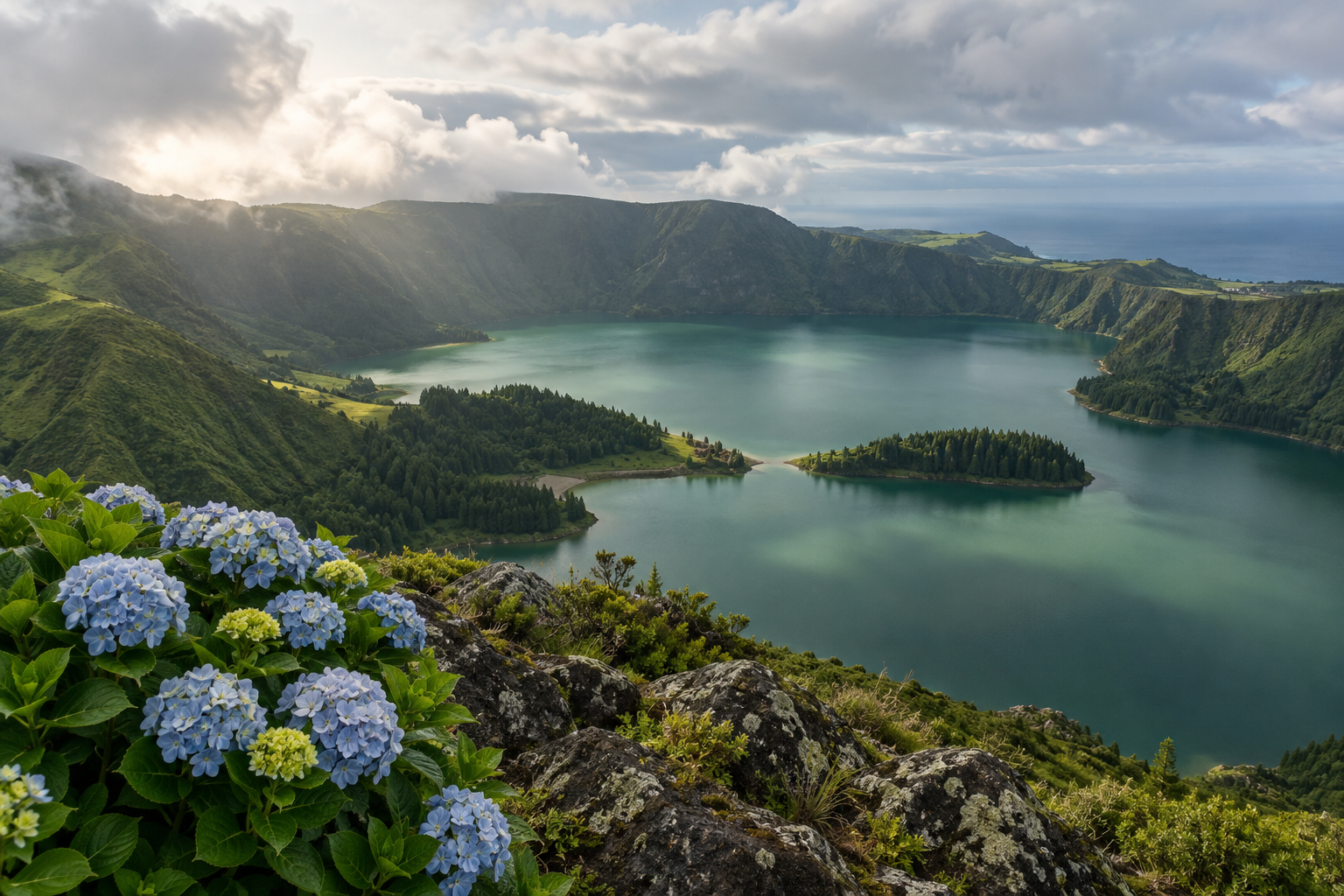

Azores
The Azores are nine islands, not one interchangeable landscape. São Miguel offers crater lakes and thermal country, Pico brings its mountain and vineyards, Faial carries a strong maritime character, and the smaller islands reward a slower route. Choose two or three islands well rather than collecting airport codes.
Know before you go
- Fly into: Ponta Delgada on São Miguel for the broadest connections. Other islands can be reached by regional flights or seasonal ferries.
- Trip length: Eight to twelve nights for two islands. Add nights before adding a third, because weather can affect both flights and boats.
- Best months: Late spring through early autumn is the easiest window for outdoor days and marine excursions, though the Atlantic climate remains changeable.
- Getting around: A rental car is useful on the larger islands. Inter-island travel works by regional flight and, in season, by boat.
- What to reserve: A small design-led stay, whale watching with a responsible operator, a good rental car, and any peak-season inter-island connections.
- Plan around: Atlantic weather, narrow roads, trail conditions, thermal bathing guidance, and leaving time for meals and viewpoints.
Use São Miguel as an opening chapter
São Miguel is the most flexible first island, with crater lakes, tea fields, thermal waters, and a lively food scene around Ponta Delgada. Three or four nights gives the island room to breathe. Move by road in a loop rather than building every day around a single lookout.
Choose a second island by mood
Pico suits travelers drawn to wine, the mountain, and an elemental volcanic landscape. Faial is strong on sea history and marina life. Flores feels more remote, with waterfalls and deep green valleys. Terceira offers history, food, and an easy town base. The right combination is about rhythm, not ranking.
Put the ocean on the itinerary
Whale watching is one of the Azores' defining experiences, but it should be approached with care. Choose an operator that follows local guidance, keeps distance, and allows the sea to remain the subject rather than promising a guaranteed close encounter.
Leave room for weather
A clouded morning can become a clear afternoon, and a boat day can move. Keep the most weather-sensitive experiences away from the final day on an island. The reward is a trip that feels responsive to the Atlantic rather than frustrated by it.
Who this trip suits
Couples, walkers, food lovers and whale watchers, and anyone who likes nature with a strong local identity.
When another plan may fit better
If you need guaranteed sun, the Atlantic weather will not promise it. If you only have five nights, stay on one island rather than two. And if beach time is the point, Madeira or the mainland coast will serve you better.
Planning brief
The shape we recommend: eight to twelve nights for two islands. Add nights before adding a third, because weather can affect both flights and boats.
- Settle early: island combination, car hire, weather buffers, and whether the route should feel active or restorative.
- Useful pairing: Madeira, mainland Portugal, or a wider Atlantic islands journey.
Make the route yours
Tell us whether the Azores should be built around walking, food, whales, hot springs, wine, or a quiet few days away from the usual island circuit.
Our luxury leisure travel planning can shape the stays, guides, transfers, and pacing around the way you want to travel.
How many islands should you visit in the Azores?
Two islands is usually the most satisfying choice for a week to ten days. Three can work with a longer stay and careful planning, but adding islands too quickly turns the trip into a sequence of departures.
Do you need a car in the Azores?
On São Miguel, Pico, Terceira, and many other islands, a car makes the landscape much easier to enjoy. It gives you flexibility around weather and lets you reach smaller villages, trailheads, and viewpoints.
When is the best time to visit the Azores?
Late spring through early autumn is generally easiest for outdoor plans and whale watching, but the islands are green year-round. Weather changes quickly, so a flexible schedule is worth more than any forecast.
Can the Azores be combined with Madeira?
Yes, though the two archipelagos have different characters. The Azores are more volcanic and maritime, while Madeira is more mountainous and garden-like. Keep enough nights in each to avoid reducing both to a quick stop.
CONTINUE EXPLORING