

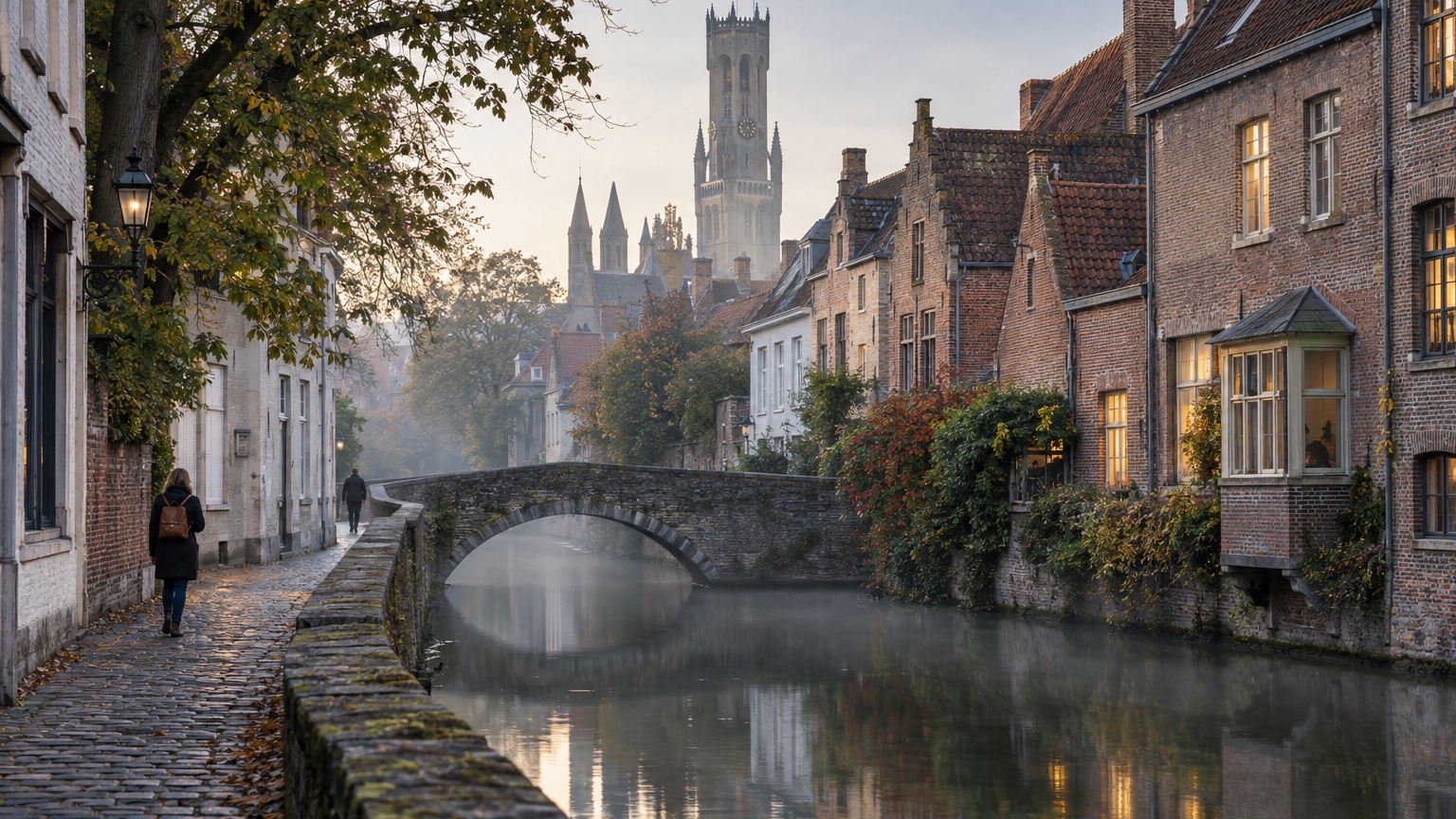

Bruges
Bruges Is Best Before the Day Trips Arrive
Bruges earns its reputation honestly. The canals, stepped gables, and stone bridges are beautiful, but the city feels most convincing before the first day coaches begin to move through the center. Early morning brings the sound of bicycles on the cobbles, light across the water, and a chance to see the medieval streets as part of a living town rather than a set of views.
Stay two or three nights and Bruges becomes quieter than its reputation suggests. You can walk the historic center, visit one serious museum, take the water when the canals are calm, and spend an afternoon in a cafe without trying to complete the entire postcard. The town is small enough for a gentle pace and detailed enough to reward returning to the same street twice.
Know before you go
- Fly into: Brussels Airport, code BRU, then take the direct train to Bruges in about 1 hour 25 minutes. A private transfer makes sense for a family with luggage, but the train is straightforward.
- Trip length: Two nights covers the essentials. Three nights allows the center to empty around you and leaves time for a slower museum, food, or cycling day.
- Best months: April through June and September into October offer good walking weather and softer light. December has atmosphere and demand, so reserve restaurants and hotels early.
- Getting around: Walk in the center and use a taxi for luggage or a hotel outside the old town. The cobbles make rolling bags and delicate shoes poor companions.
- What to reserve: A canal boat, a small dining room, and any private history or chocolate visit that matters to the itinerary. Keep one morning open for the town before it becomes busy.
- Where to sleep: Inside or just outside the old center gives you the best early and late hours. A larger countryside property is better when Bruges is one chapter in a longer Flanders stay.
Use the Markt as an orientation point
Begin in the Markt, then leave it quickly. The square gives you the city’s proportions, but the quieter streets around the canals tell you more. Walk toward the Burg, the Dijver, and the quieter edges near the Begijnhof. The point is not to count landmarks. It is to understand how water, churches, houses, and small squares fit together.
Climb a tower only if you want the view from above. Bruges is just as legible from street level, and the best moments often arrive between the major sights: a side door opening, a local bakery doing its morning trade, or a narrow bridge with nobody standing on it.
Give the museums one clear afternoon
Choose a museum by interest rather than trying to see everything. The Groeninge Museum gives a strong introduction to Flemish painting. The Memling Museum and St. John’s Hospital bring art and architecture together in a more intimate setting. Travelers who want design and craft should ask for a route that includes the city’s quieter interiors and workshops.
Bruges can become visually repetitive if every hour is spent on the same canal. One well-chosen museum, followed by coffee and a long lunch, gives the day a useful change of register.
The right hotel changes the town
A central hotel earns its keep by giving you access to the city before breakfast and after dinner. That matters more here than a long list of facilities. Look for rooms with proper sound insulation, a calm interior, and a staff that can arrange a car or restaurant when the center is full.
Bruges also pairs naturally with Amsterdam, Paris, or a wider Belgium route that includes Antwerp and Brussels. Keep the train connections simple and resist changing hotels for a single night. Bruges is worth staying in, not merely visiting between larger capitals.
Planning brief
Bruges works for travelers who want beauty, history, and a calm European rhythm inside a compact itinerary.
- Best suited to: couples, families with older children, first-time Belgium travelers, photographers, and anyone who enjoys a city at walking pace.
- Settle early: the hotel location, the museum choice, one memorable meal, and whether the trip includes a guide focused on art or architecture.
- Useful pairing: combine with Brussels or Amsterdam by rail, or add Antwerp for a sharper contrast in fashion, design, and contemporary food.
Let the crowds have the middle of the day
Bruges is generous to the traveler who keeps the edges of the day. Walk before breakfast, take lunch slowly, and return to the canals after the day visitors have gone. Tell us whether your priority is art, food, photography, or a quiet base for exploring Belgium.
Our luxury leisure travel planning can arrange the hotel, rail route, private guiding, restaurant reservations, and the practical timing that lets Bruges feel like a stay rather than a stop.
How many nights should we spend in Bruges?
Two nights covers the main center and one museum afternoon. Three nights is better if you want the city at its most peaceful, with an early walk, a long lunch, and time for a private art or architecture visit. A single night turns Bruges into a day-trip version of itself.
Is Bruges worth visiting if we are already going to Brussels?
Yes, because the two cities provide different experiences. Brussels has a broader urban life, larger museums, and more varied neighborhoods. Bruges is smaller, quieter, and organized around canals, medieval streets, and walking. Use the train between them and keep at least two nights in Bruges if the town is part of the point.
When is Bruges least crowded?
The first and last hours of the day are the most reliable answer. Early morning brings the best light and the fewest visitors, while the center settles after the day trips leave. November through February is generally quieter outside the holiday period, though the weather is more changeable and daylight is limited.
Do we need a car in Bruges?
No for a city stay. Walk the center and use a taxi for luggage or a hotel outside the old town. A car becomes useful only when Bruges is the base for a wider Flanders itinerary or a countryside property. The train from Brussels Airport is usually simpler than driving into the historic center.
CONTINUE EXPLORING