


Morocco
Morocco Is a Sequence, and a Week Will Not Hold It
Almost every disappointing Morocco trip has the same cause. Somebody looked at a map, saw a country roughly the size of California, and drew a loop through Marrakech, the desert, Fez and the coast in eight days. The map lies. The roads are slower than the distances suggest, the great dune fields sit far to the east and southeast of Marrakech rather than behind it, and the four landscapes people come for do not sit conveniently on one circle. Morocco is not one destination you tour. It is four or five you choose between, and the first decision is how many of them your days will actually carry.
Know before you go
- Fly into Casablanca Mohammed V, code CMN, which is the country's main gateway and the only one with a full North American schedule. Royal Air Maroc flies nonstop to New York JFK, Washington Dulles, Miami, Los Angeles and Toronto, and Air Canada serves Montreal. It is comfortably the busiest airport in the country.
- Or skip Casablanca Marrakech Menara, code RAK, takes seasonal service from Newark, Atlanta and Montreal. Fez Saiss, code FEZ, and Essaouira Mogador, code ESU, are European short haul airports with no long haul service at all, so both are reached by connection whichever way you come.
- Trip length ten to twelve days for Marrakech, the Atlas, the desert and Fez at a pace that lets you look at anything. A week holds Marrakech and the mountains, or Fez and the north, but not both, and pretending otherwise is the structural mistake this country punishes hardest.
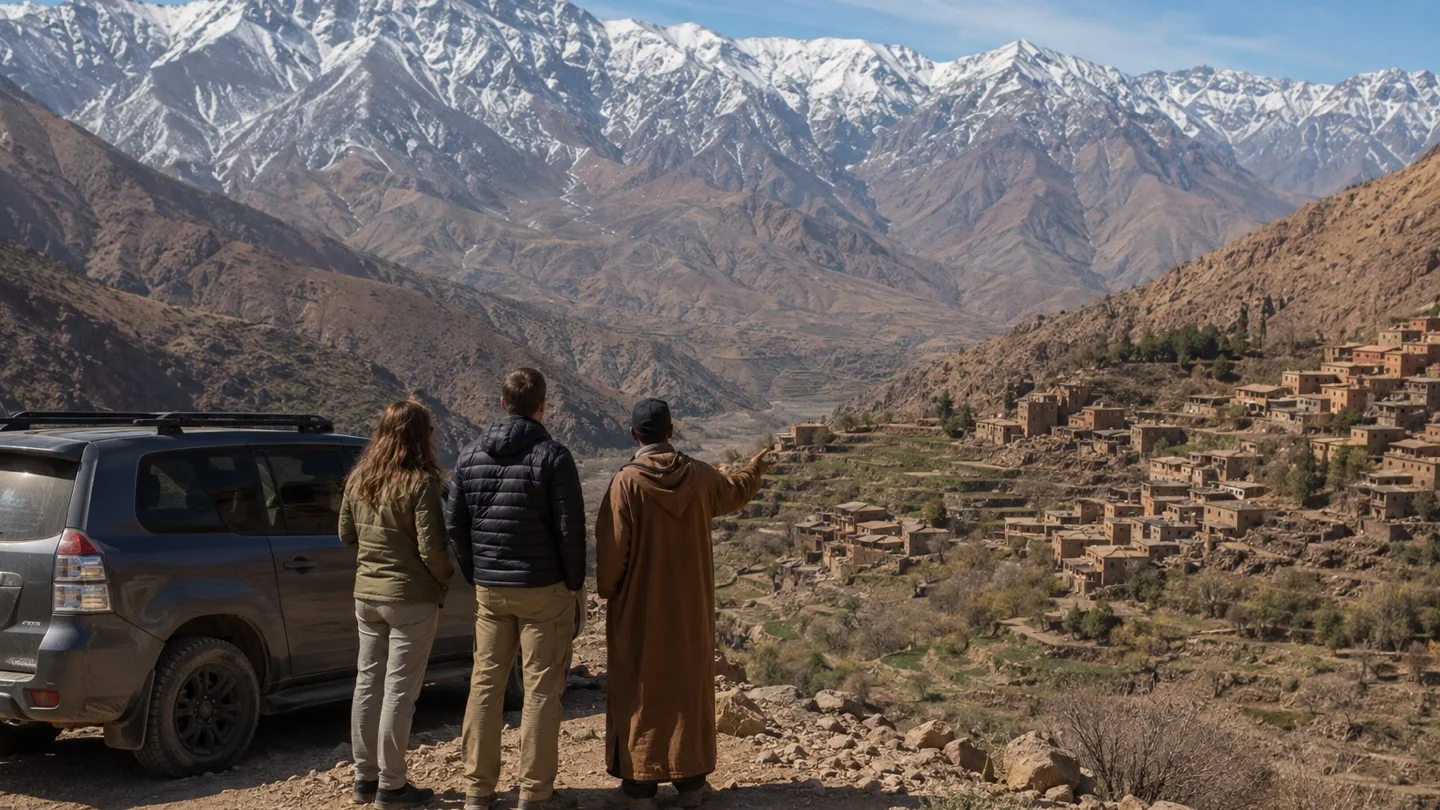
- The desert is the long leg the dunes are a full day's drive from Marrakech and further from Fez. Build them as two nights minimum, broken by an Atlas pass and a valley night, so the driving becomes part of the journey rather than the price of it.
- There is no single climate Fez averages a high near 95F in July while Essaouira on the Atlantic averages 71F in the same month. Marrakech reaches 100F. Plan the country as three weather systems, not one, and use the coast as the summer answer.
- Best months March to May and late September to November nationwide. Fez is wettest in November, which is the shoulder month that reads well on temperature and badly on rain.
- Entry no visa for stays under ninety days on a US passport, with six months of passport validity required at entry and at least one blank page. Overstaying the ninety days means appearing before a judge before you can leave.
- The passport trap Moroccan authorities have refused entry to travelers whose passports are physically damaged. Peeling laminate or water swollen pages are enough. Replace a worn passport before the trip rather than finding out at the border.
- Fast rail goes north, not south the Al Boraq high speed line runs Tangier to Casablanca via Kenitra and Rabat in about two hours and ten minutes, at up to 320 kilometers an hour on the northern section. It does not serve Marrakech, Fez or anywhere in the south, so it shapes a northern itinerary and nothing else. Casablanca airport has its own hourly train, the Al Bidaoui, running roughly 04:00 to 23:00 into Casa Port and Casa Voyageurs.
- The clocks move for Ramadan Morocco sits on UTC+1 all year but falls back to UTC+0 for the month. Preliminary 2027 dates put the clocks back on 7 February and forward again on 14 March, which shifts every transfer and connection inside that window.
- Money, alcohol, dress the dirham runs at several to the dollar and is changed on arrival rather than at home, since it is not sold freely abroad. Alcohol is served in licensed venues only. Loose clothing covering arms, legs and chest is the norm for women in the medinas, and more so during Ramadan.
What each place actually gives you
Marrakech is the theater: the walled city, the palaces, the gardens, the best hotels in the country and the easiest arrival. Fez is the deeper one, an older and far less performed medina whose oldest quarter is car free and where luggage reaches a riad by handcart or mule. Fez is where the craft traditions still live and where a guide changes the day most. Essaouira is the release valve, a windswept Atlantic port whose warmest month is October rather than July, cool when the interior is unbearable and built for fish lunches and walking rather than sightseeing. The High Atlas gives you mountain air, villages and silence within an hour or two of Marrakech. The Sahara gives you the night sky and nothing else, which is the whole point and the reason it cannot be rushed.
Two routes that work, and one that does not
The one that does not work is the eight day grand loop with the desert wedged into a single overnight. You will spend four of the eight days in a vehicle. The first route that does work is twelve days: Marrakech for three, the High Atlas for two, then the long leg east through the valleys with a night on the way, two nights in the dunes, and back north to Fez for two before flying out of Casablanca. The second, for a week, is simply Marrakech and the Atlas with an Essaouira ending, and it is a far better week than the compressed version of the first. Fez and the north then become a separate trip built around the fast rail line, which is a genuinely pleasant way to travel and completely unrelated to the southern circuit.
The season decides the shape more than the route does
Spring and autumn are the answer countrywide, and within them March to May is the strongest because the mountains are green and the desert is still comfortable. High summer forces a decision: either accept that the interior cities become early morning and late evening propositions with a pool in between, or move the whole trip to the coast, where Essaouira sits more than twenty degrees cooler than Fez in the same month. Winter is quietly excellent for the cities and difficult for the desert, where camps drop close to freezing after dark. Older riads can be genuinely cold in January, so heating is a specification to confirm rather than an assumption.
Planning brief
Decide the number of days honestly, then choose which two or three landscapes they will carry. Everything else follows from that.
- Best suited to: craft and design travelers; mountain and desert trips; food led journeys; first time North Africa; private touring with a driver.
- Decisions to settle early: total days and therefore how many regions; whether the desert is essential this time; direction of travel and which airport you leave from; season against the interior heat; riad heating for a winter trip.
- Arrival and routing: Casablanca for nonstop North American service, Marrakech for seasonal direct arrival; no visa under ninety days with six months of passport validity; the Ramadan clock shift in February and March 2027.
Four landscapes, and your days will carry two or three of them
Morocco is one of the very few countries where cutting the itinerary makes it better, so the useful conversation is the one about what waits for a second trip. Send the number of nights and whether the desert is genuinely non negotiable, and you will get an honest answer rather than an accommodating one.
Travelers who already know Morocco sometimes look east to Algiers, a rarer North African city with a grand colonial waterfront.
The cities, the mountains, the desert and the drivers are sequenced as a single plan by our luxury leisure travel planning. For the choice between the medina and the palm groves, our Marrakech guide goes into it properly.
From the journal
More on Morocco: Marrakech: Riad or Resort? and 10 Best Places to Visit in October for Luxury Travel.
Is Casablanca worth a night, or is it only an airport?
For most trips it is only an airport, and there is no shame in landing and driving straight out. It is the commercial capital rather than the beautiful one, and the things worth seeing there fill an afternoon rather than a day. The exception is a northern itinerary. If the trip is Tangier, Rabat and Fez on the fast rail line, a night here at one end makes the routing work and gives you the Hassan II mosque on the Atlantic, which is genuinely worth the stop. Coming from North America on a late arrival, a night by the airport also beats four hours of road in the dark.
Is Fez or Marrakech better for a first trip?
Marrakech, for almost everyone. It has the easier arrival, by far the deeper hotel bench, the gardens, the mountains within an hour and the gentler introduction to a Moroccan medina. Fez is the more serious city and the older one, its craft traditions are more intact and its medina is less performed for visitors, but it is also harder work and it has fewer places to retreat to at the end of the day. Take Marrakech first, and take Fez on the second trip, when the north and the fast train can be built around it.
Is the Sahara worth the driving?
Yes, if you give it two nights and treat the drive as part of it. The route east from Marrakech crosses an Atlas pass and then runs down through valleys and kasbahs that are worth stopping in, so with a night broken on the way it stops being a transfer and becomes the interesting middle of the trip. What is not worth it is the single overnight version, which is many hours of vehicle for a few hours of dune. If your days will not stretch to that, save the desert and spend the time in the mountains instead.
Should I self drive or take a driver?
Take a driver. It costs a fraction of the European equivalent, it removes the two hardest parts of Moroccan road travel, which are navigation into medina edges and the mountain passes, and it means the long legs east are spent looking out of the window rather than at the road. A good driver also functions as a fixer at every stop. Self driving is perfectly possible on the main roads if independence matters more to you than ease, but nobody who has done it both ways chooses the wheel a second time.
How many days do you need in Morocco?
Plan ten to twelve days for Marrakech, the Atlas, the desert and Fez at a pace that lets you look at anything. A week holds Marrakech and the mountains, or Fez and the north, but not both. Give the dunes two nights minimum, broken by an Atlas pass. Start in Marrakech or Fez.
CONTINUE EXPLORING