


Mykonos
Mykonos Is an Economy, and You Should Decide Whether to Buy In
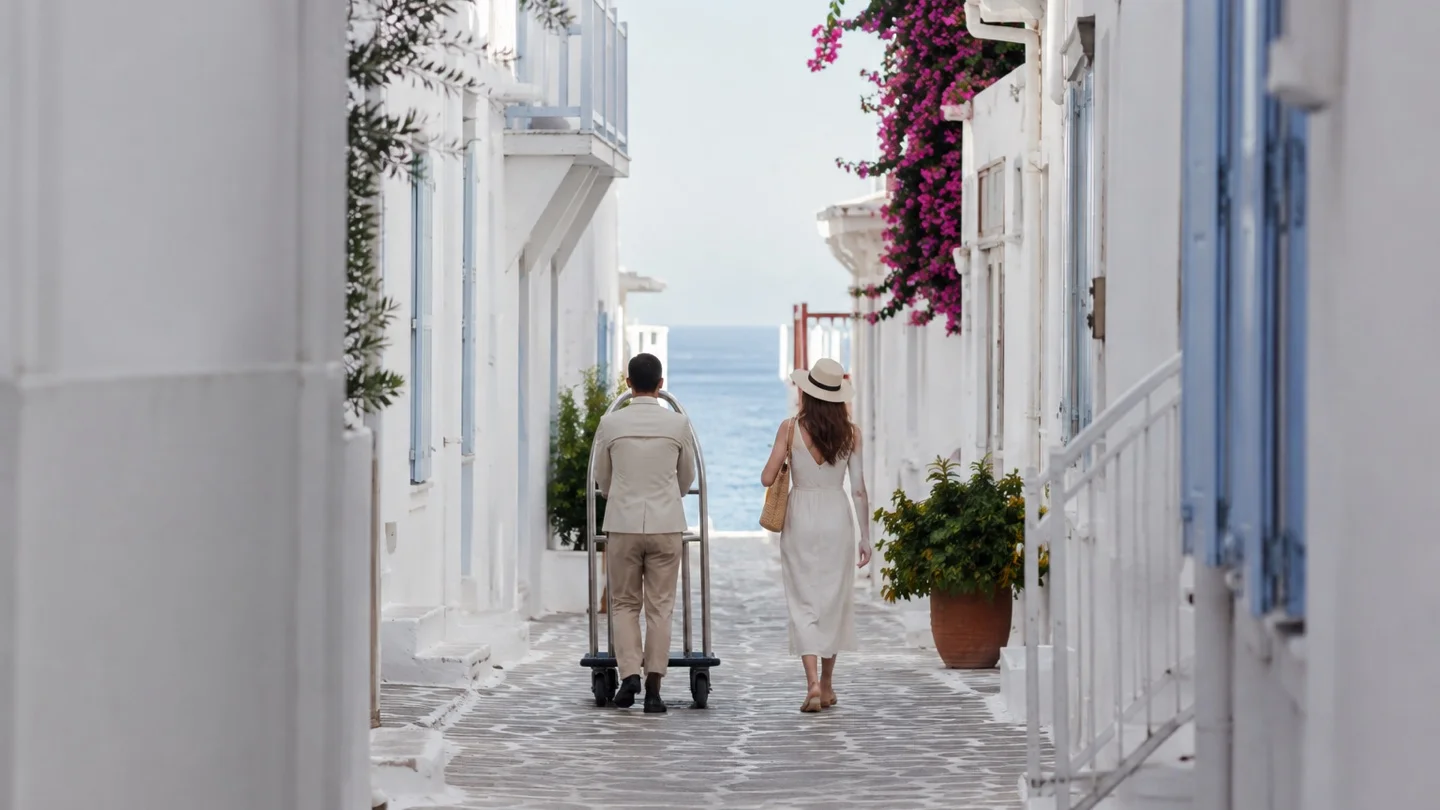
Mykonos is the one Greek island with a full luxury service industry built into it: beach clubs with minimum spends, restaurants that behave like theater bookings, a port town still going at first light. That economy is the island's real product, and it is very good at what it does. Underneath it sits an ordinary and rather beautiful Cycladic island of white lanes, windmills, empty northern beaches and Delos across the water. Both are true, and the month you pick and the coast you sleep on decide which one you get. The honest first question is whether you want the scene at all, because if you do not, Paros is a short hop away and costs less in every direction.
Know before you go
- Fly into Mykonos, code JMK, four kilometers from the town and about ten minutes by car. International services are overwhelmingly seasonal, so out of high summer most routings go through Athens, roughly twenty five minutes away by air.
- The transfer math is simple and worth knowing. A taxi into town averages about €25 over the six kilometer run and a private sedan about €29, plus a €2.85 airport toll and €0.40 for every bag over 10 kg. There is a 50% surcharge after midnight.
- Trip length three nights. Drop to two and Delos goes, which is a half day boat commitment and the only reason this island matters historically.
- Best months June and September. Average highs are 26 °C in June, 28 °C in July, 28 °C in August and 26 °C in September, with January the low at 15 °C. Note that Mykonos peaks a couple of degrees cooler than Santorini in August, which is the wind rather than the latitude.
- The meltemi is the fact that shapes a summer trip here. The northerly blows from late June through early September and peaks in August, reaching Beaufort force seven or eight, at which strength most inter island ferries cannot sail. It arrives suddenly in otherwise clear weather. A beach club day on an exposed coast is a coin toss when it is up.
- Entry, and where the queue is a United States passport needs no visa for ninety days, with three months of validity beyond the day you leave. Under the EU Entry Exit System, in force since 10 April 2026, a facial image and fingerprints replace the stamp, and since most arrivals connect through Athens that is where it happens rather than at JMK. ETIAS is not in operation and no applications are being collected.
- Money and levies start with the euro, which trades a little above the dollar. Greece adds a climate resilience levy per room per night, €15 at five star properties and €10 at four star from April to October, dropping to €4 and €3 from November to March, paid at checkout.
- Getting around comes down to one decision. A car is useless in Chora, a dense pedestrian maze you park outside and walk into, and official taxis are few by European standards. Buses run from three depots in town and cost €1.80. For a stay with dinners and beach days in it, arrange a driver on call or a car with the villa.
- The airport bus window catches people out. The KTEL service runs 09:15 to 22:15 and in high season only. Land outside that and it is a taxi or nothing, on an island that does not have many.
- The season shape is worth memorizing. Everything is open by mid May, beach parties start mid June, the last big club night falls around mid September, closures begin mid October and the island is very quiet by late October. From November to March most of it is shuttered and ferry schedules are thin.
- Ferry from Athens is 86 nautical miles: two hours forty on a high speed boat, four hours forty on a conventional Blue Star, daily and year round, from €43 conventional and €87.70 on the fast service.
Where you sleep decides which Mykonos you get
Ornos is the sensible default: a bay with a beach and restaurants, minutes from the town, letting you be social by choice rather than by proximity. Kalesma sits on the hill above it, suites with their own pools and Cycladic design handled with restraint, and it is the grown up version of the island. Santa Marina, down on the water in the same bay, is the one to take if a private beach matters. Kalafatis and the east coast are the quiet end, where Cali Mykonos has its own beach and behaves like a resort rather than a scene. The town itself is right if you want to walk to dinner. What does not work is sleeping on one of the south coast party beaches, a decision people make once. For groups and families the villa route usually wins.
Mykonos and Paros are the same trip at two volumes
These two are the clearest choice in the Cyclades and it is worth making deliberately. Mykonos has the beach club and dining economy and the prices that come with maintaining it; the scene is the product and it is delivered well. Paros is where people go on their second Greek trip, after they have done the first. It has a working harbor town at Naoussa, inland villages worth a whole day, a rental car that earns its keep, and no minimum spends anywhere. Piraeus to Paros runs 90 nautical miles in two hours forty on a fast catamaran, year round, and several sailings a day connect the two islands in season. Many trips are better as three nights of Mykonos followed by four of Paros than as a week of either.
Delos early, and one day that does not need a boat
Delos is the reason to be here beyond the beaches. It is a half day commitment by boat and the only sensible way to do it is early, before the excursion craft arrive, while the light is still low across the ruins and the unshaded site is walkable. Book it privately if the budget allows. Then build one day into the plan that does not depend on the water. In July and August the meltemi can take the boats out of play at no notice, and the trips that go wrong are the ones where the only plan was a boat. Never put an island to airport ferry leg on the same day as an international August flight.
Planning brief
Mykonos can be loud, quiet, or a deliberate mix of the two. The month and the coast set the balance, and the reservations set the rest.
- Best suited to: celebrations and groups; beach club and restaurant culture; villa stays with staff; a short lively leg inside a calmer Cyclades route.
- Decisions to settle early: scene or calm; hotel or villa; a driver on call; wind exposure of the beach you book; dinner and daybed reservations before you fly.
- Arrival and routing: JMK direct in season or by way of Athens outside it; ferries to Athens daily and year round; the Santorini link only between March and November.
How loud do you want this to be?
Full scene, quiet coast, or a deliberate mix of the two on alternate days. Answer that and say who is traveling with you, and back comes the right bay, the tables that have to be held before you leave home, and a boat day timed to the meltemi rather than to the calendar.
If the scene is not the point at all, read Paros next, and our Greek Islands guide for how the two sit inside one route. Villas, boats, tables and transfers are held together by our luxury leisure travel planning.
From the journal
More on Mykonos: A Luxury Honeymoon Through Greece and Italy: The Perfect Romantic Itinerary.
Is Mykonos worth it if I do not want to party?
Yes, but only if you book against the scene rather than into it. Sleep on the east coast or above Ornos, not on the south coast party beaches, and travel in June or September rather than August. What you get is a genuinely handsome Cycladic island with a beautiful old town, empty northern beaches and Delos next door. What you still pay is Mykonos pricing, because the scene sets the rates for everything. If quiet is the priority and value matters at all, Paros gives you nine tenths of the same island at a fraction of the cost.
Mykonos or Paros for a first trip to Greece?
Mykonos if you want the restaurants, the beach clubs and an island that performs. Paros if you want a place that still functions as a working island, with a harbor town in Naoussa, real inland villages and a rental car that is genuinely useful. Most first timers pick Mykonos and most repeat visitors end up on Paros, which tells you something. The best answer for a ten night trip is often both: two or three nights of Mykonos for the scene, then four on Paros to recover from it, with a short ferry in between.
How much does Mykonos really cost?
More than people budget for, and the gap is almost never the room. It is the extras: beach club daybeds with minimum spends, boat days, and dinner at the tables everyone wants, all of which behave like a second accommodation bill in August. The same hotel in June or September costs a fraction of its August rate, so the single biggest lever on the total is the week you choose. Set the daily spending figure honestly before you set the dates, and let it decide the month.
Can the wind ruin my trip?
It can ruin a day and it can move a departure, so plan for it rather than hope. The meltemi blows from late June through early September, peaks in August, and can reach Beaufort force seven or eight, at which point most inter island ferries cannot sail. It comes up suddenly under a clear sky. The practical answers are to book a beach on a sheltered coast, to keep one land based day in reserve, and never to schedule a ferry to your onward airport on the same day as an international flight in August. Fly that leg instead.
How many days do you need in Mykonos?
Three nights is right. Drop to two and Delos goes, since it is a half day boat commitment and the reason the island matters historically. June and September are the best months. The meltemi blows from late June through early September and peaks in August. Pair it with Paros or Santorini.
CONTINUE EXPLORING