

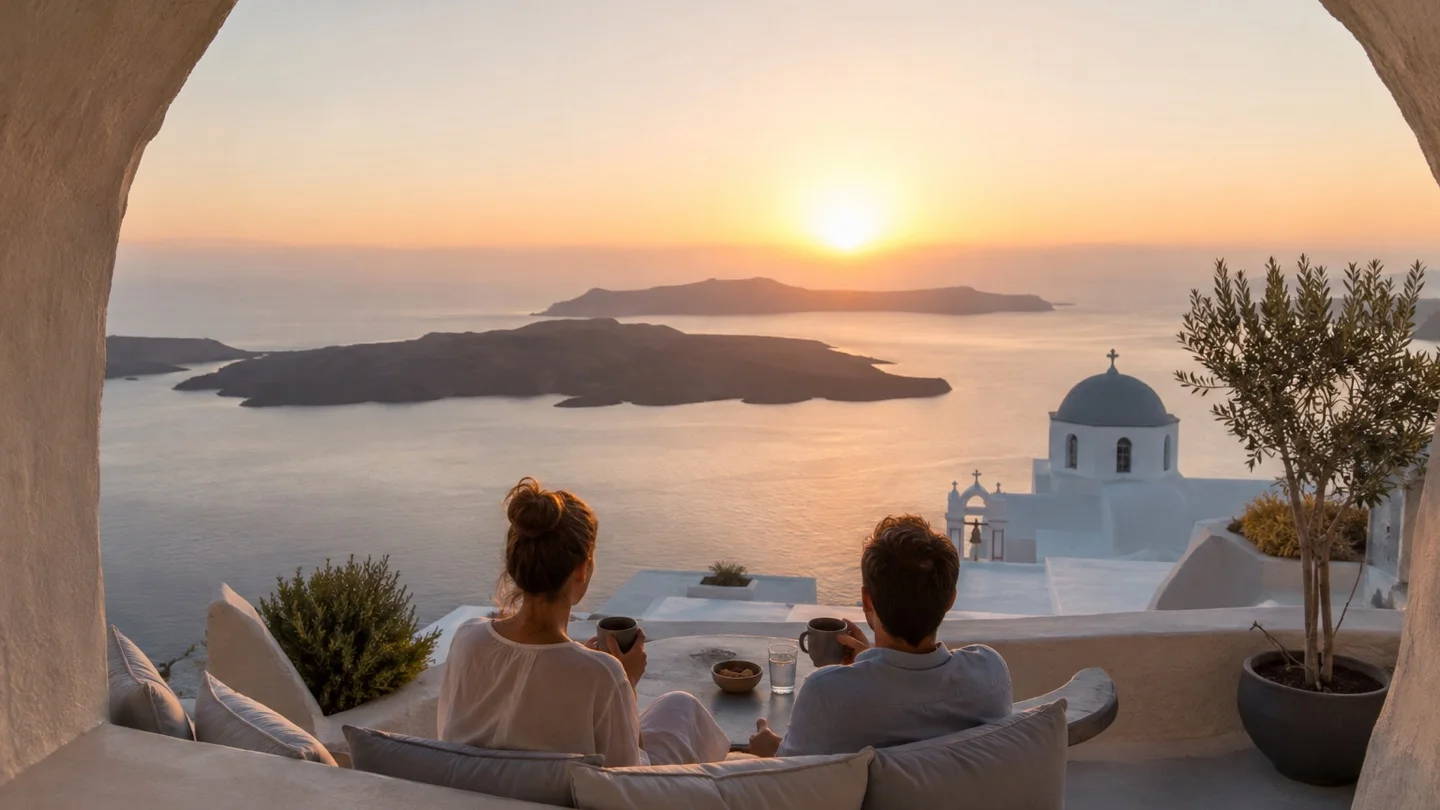

Santorini
Santorini Runs on the Ship Schedule, Not the Calendar
Santorini is a drowned volcano with villages balanced along the rim, and the view has survived every photograph ever taken of it. What has not survived is the middle of the day. The island now caps cruise arrivals at eight thousand passengers a day, and on a heavy day most of those people walk the same kilometer of Oia between late morning and late afternoon. Plan around that one rhythm and Santorini is still among the great sights in Europe. Ignore it and you will spend an evening queuing for a photograph of a sunset you cannot see past the shoulders in front of you. The month you choose matters here. The daily ship schedule matters more.
Know before you go
- Fly into Santorini, code JTR, six kilometers southeast of Fira. The road into Fira takes about ten minutes and the run out to Oia, seventeen kilometers, about twenty five.
- Trip length three or four nights. Two nights buys one caldera evening and costs you either the boat day out to Nea Kameni and Thirassia or the beach and vineyard half of the island entirely, because the arrival day disappears into the transfer.
- Best months late May to mid June and mid September to mid October. Average highs run about 23 °C in May, 28 °C in June, 27 °C in September and a shade under 23 °C in October. July and August both sit at 30 °C, with peak ship volume on top of the heat.
- The sea decides which shoulder you take. September water averages 24 °C and October still holds 22 °C, while May manages barely 18 and June 22. If anyone in the party intends to swim, autumn beats spring by a wide margin.
- Entry and biometrics on a United States passport, no visa is needed for stays up to ninety days, with three months of validity beyond your departure date and a blank page. The EU Entry Exit System has been fully operational since 10 April 2026, so your first arrival into the Schengen area now records a facial image and fingerprints in place of a passport stamp, and the queue is slower for it. ETIAS is not in operation and no applications are being collected.
- Money and levies start with the euro, worth a little more than the dollar. Cards work almost everywhere. Keep coins for the bus, which takes cash only.
- Taxis are the constraint and always have been. The whole island runs on roughly twenty five to forty of them, none metered. Agree the fare before you get in, and prebook every transfer that has a flight attached to it.
- No bus to Oia from the airport. It is two legs by way of Fira at about two euros each, cash only, with the airport service running from 06:25 to 23:10 and the Fira to Oia leg from 07:00 to 23:00. Land after that with nothing booked and you are competing for one of very few taxis.
- Count the steps before you fall for a caldera cave suite. These hotels are stacked down a cliff and reached on foot; the path from Oia down to Ammoudi Bay alone is 300 steps and close to vertical. Ask the hotel in writing how many steps sit between your room and the nearest place a vehicle can stop.
- The accommodation levy is charged per room per night rather than per person: €15 at five star properties from April to October and €4 from November to March, €10 and €3 at four star, €5 and €1.50 at three star. It is settled at checkout, not at booking.
- The closed season is real. Most seasonal businesses shut by the end of October, beach clubs, beachside restaurants and open air pools stay closed from November to April, roughly a fifth of the tavernas keep going and they cluster in Fira, and ferry frequency drops sharply.
Sleep in Imerovigli, visit Oia, and think hard before Fira
Oia is the postcard and it is priced and populated accordingly. It is lovely at seven in the morning and after nine at night, and it belongs to everyone else in between. Canaves Oia and its Epitome property below the village give you that address with real service behind it, and Katikies remains the classic cave suite. Imerovigli is the answer for most couples: the same caldera, higher up the rim, and off the walking route the day visitors take, which is the whole difference. Grace hangs at the highest habitable point of the rim with the crescent laid out below it. Fira is the biggest and best connected village and it takes the hardest hit, because it sits directly above where the tenders land. Sleep there only for the bus links.
Be on the rim early, and somewhere else at noon
The daily plan writes itself once you have the ship calendar for your dates, which is why we read it before recommending a hotel at all. Caldera villages belong to you at breakfast and again after dinner. The middle of the day belongs to the vineyards, where assyrtiko is coiled low in baskets against the wind, or to the black sand coast around Perivolos and Perissa where the actual swimming is, or to a boat under the caldera walls. The one famous thing worth skipping is the sunset from the castle ruin at Oia. It is a crush, you queue an hour to stand in it, and the same sun sets on the same water from an Imerovigli terrace or a catamaran deck, where you can actually see it.
Three or four nights, then move on
A week on one cliff is a long week. Paros sits 43 nautical miles away with up to eight sailings a day in summer, fares from €13 and a service that runs year round, though the crossing is anywhere between one hour forty five minutes and four hours depending on the vessel and whether it calls anywhere. Mykonos is 64 nautical miles, two hours ten at best, up to eight a day, but that route sails only from March to November, which quietly rules out a lot of shoulder season plans. Athens by sea is 127 nautical miles: about five hours on a fast ferry, five and a half to seven and a half on a conventional one, and nine to eleven hours on a multi stop sailing. When the day is tight, fly.
Planning brief
Santorini works when the village, the room position and the hour of the day are all chosen against the ship calendar rather than around it.
- Best suited to: couples and celebrations; caldera views and volcanic wine; short stays of three or four nights; the first leg or last leg of a Cyclades route.
- Decisions to settle early: which village; the step count from the nearest road; sunset exposure; whether you want a plunge pool or a swimmable beach; airport transfer or ferry port.
- Arrival and routing: JTR for the short hop from Athens; Athinios port for the ferries; onward to Paros year round or Mykonos between March and November.
The Santorini worth having
Before a room is held, the dates get read against the cruise calendar, because that one document decides which village and which terrace are worth paying for. After that it is a step count you can live with, and days sequenced so the island is quiet at the hours you are out in it.
If Italy is on the same trip, our Greece and Italy honeymoon itinerary shows how to route the two countries together.
If this is one leg of a longer route, our Greek Islands guide sets out how many islands a trip can actually carry, and Paros is the obvious second stop. Our luxury leisure travel planning handles the suites, the boats and the transfers as one plan.
From the journal
More on Santorini: 7 Luxury Villas in Crete for an Easy Escape and Honeymoon Travel Planning: A Practical Couples Guide.
Is Santorini worth it, or is it ruined?
It is worth it, and the people who say otherwise almost always went in August and stood on the Oia path at six in the evening. The caldera is a genuine geological spectacle and no amount of exposure has changed that. What has changed is the daily volume, which peaks between late morning and late afternoon when the ships are in. Sleep off the main walking route, be on the rim at breakfast and after dinner, and spend the middle of the day on the water or among the vineyards. Planned that way the island still delivers what the photographs promise.
Is the Oia sunset actually worth the effort?
No, not from the castle ruin, which is where everyone goes. You queue for a position an hour or more ahead, you stand shoulder to shoulder, and you watch it over other people's phones. The sun sets over the same water from every west facing terrace on the rim, from Imerovigli in particular, and from the deck of a boat in the caldera, which is the best version of it. Book a table or a catamaran with a sunset slot and skip the scrum entirely. This is the single easiest improvement to make to a Santorini itinerary.
Is the volcano boat trip worth a morning?
The boat is worth it and the volcano itself is the least of it. Nea Kameni is a walk up hot black gravel with no shade to a crater that looks like a quarry, and forty minutes on it is plenty. What justifies the day is being out on the water: the caldera walls only make sense from below, the hot springs are a curiosity worth swimming to once, and Thirassia across the water is the version of this island nobody photographs. Take a small boat or a private one rather than the large excursion, and go in the morning before the wind gets up.
Do I need a rental car on Santorini?
No, and it will get in your way. Oia and Fira are cliff villages of pedestrian lanes and steps, so a car is parked outside and abandoned while you walk. The island has only around twenty five to forty taxis for the whole place and none of them are metered, so the answer is not to improvise either. Prebook your airport transfers, arrange a driver for the vineyard day or the far coast, and use the buses for anything casual. A car earns its keep on Crete and on Paros. Not here.
When is the best time to visit Santorini?
Late May to mid June and mid September to mid October. July and August both sit at 30°C, with peak ship volume on top of the heat. If anyone plans to swim, autumn beats spring, with September water near 24°C against barely 18°C in May. Most seasonal businesses shut by the end of October. Pair it with Paros or read our Greece and Italy honeymoon itinerary.
CONTINUE EXPLORING