

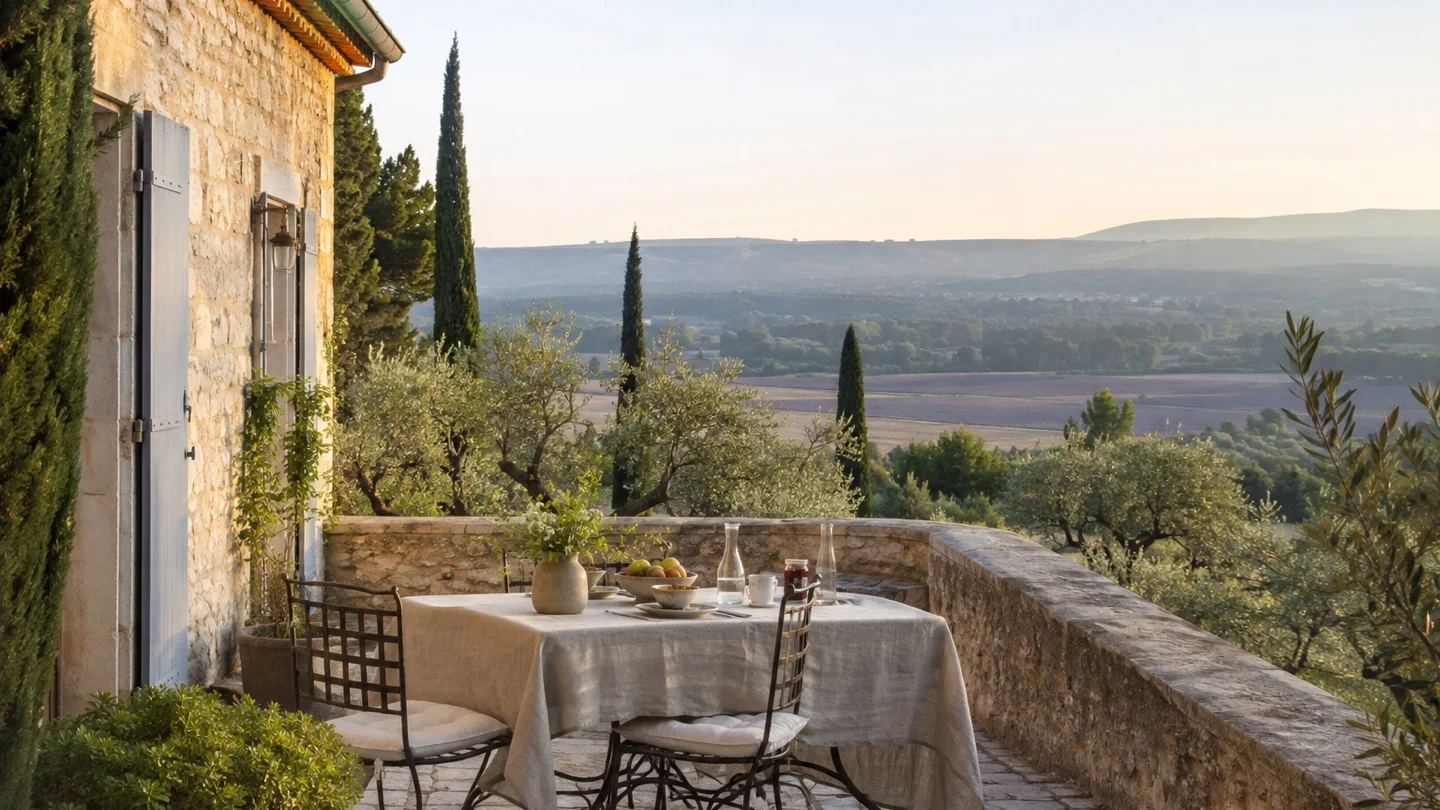

Provence
Provence Is a Region, and the Corner You Pick Is the Whole Trip
People book Provence the way they book a city, then find that the hill village from the photograph sits fifty minutes of two lane road from the hotel, and the next one fifty minutes past that. There is no town called Provence. There is the Luberon, there are the Alpilles, and there is the northern Vaucluse running up to Mont Ventoux and Sault, and they are three different holidays with three different tempos. Choose one and give it three or four nights. The second thing worth knowing before you fix a week is that lavender is governed by altitude rather than by the calendar, which is why so many July trips arrive to bare stubble.
Know before you go
- Fly into Marseille Provence, code MRS, about 15 miles from Aix en Provence and roughly 25 minutes by road, with shuttles running every 30 minutes.
- Or arrive by rail Paris Gare de Lyon to Avignon is 2h40 on the TGV, and Paris to Aix is 2h55 with the station about 9 miles outside the town. Collect the hire car at the TGV station rather than driving down from Paris, which runs to roughly six and a half hours.
- Trip length Five nights. At four you lose the second base, and the distances are real: the Valensole plateau alone is about an hour from Aix.
- Best months Mid April to mid June, with September also good and wetter. Avignon averages highs of about 67°F in April, 75°F in May, 84°F in June and 79°F in September. July and August average 89°F and 88°F, which are averages rather than peaks, and August is the peak French holiday month on top of the heat. January is the low at about 51°F.
- Entry No visa for a United States passport, 90 days in any 180 across the Schengen area. The passport must stay valid at least three months beyond your intended departure from the Schengen area, and six months is the sensible margin.
- Biometric registration The EU Entry Exit System has been fully operational since 10 April 2026, taking a facial image and fingerprints in place of a passport stamp at your first crossing, so allow extra time on arrival. ETIAS is not in operation, no applications are being collected and no start date has been announced.
- Money The euro, worth a little more than the dollar. Village markets and the smaller producers are the places to have cash on you.
- Getting around A car is essential rather than optional. There is no direct train to Valensole village and regional buses are infrequent and slow. Aix to Valensole is about an hour, Marseille about an hour and a quarter. The car becomes a liability only inside the walled centers of Avignon and Aix, so park outside and walk in.
- The lavender trap Altitude sets the timing. The Luberon, at 1,150 to 2,300 feet, peaks from late June into the first week of July and is mostly cut by mid July. Valensole peaks in the first week of July, harvest starts in the second, and the fields are mostly cut by late July. The Pays de Sault, at 2,600 to 3,000 feet, peaks in mid July and is not harvested until after 15 August.
- Farmers cut for oil not for photographs, and in a hot summer a field can go from full bloom to bare stubble in less than a week. These are working farms, so stay on the edges and the paths rather than walking between the rows.
- The Mistral is a cold dry north wind that often blows through the region, most noticeably in winter and spring, and it makes otherwise mild temperatures feel far colder. On an April to September trip it amounts to the occasional blustery day.
The Luberon, the Alpilles and the Vaucluse are three different holidays
The Luberon is the one on the postcards: Gordes, Menerbes, Roussillon and Bonnieux, ochre and gray stone stacked on hillsides, the deepest bench of good hotels and the heaviest July traffic. Airelles La Bastide de Gordes is folded into the top of the village with the valley falling away below. Take it if the villages themselves are the reason you are coming and you accept the driving. The Alpilles are lower, flatter and far easier, with Saint Remy and Les Baux minutes apart and Arles on the doorstep. Oustau de Baumanière beneath the citadel at Les Baux is the great table of the region with rooms attached. This is the better first trip and the shorter driving day. The northern Vaucluse is the quiet one, cooler with altitude and later with the lavender. Crillon le Brave, a hamlet of honey stone houses facing Mont Ventoux, is the address there. What does not work is trying to hold two of the three from one hotel.
Lavender is an altitude problem, not a calendar one
Sault is the insurance policy. Sitting at 2,600 to 3,000 feet, it has a cooler summer, a later bloom and a much longer season than either Valensole or the Luberon, so a late July or early August trip that would find the Luberon cut still finds Sault in flower. That gives you two clean strategies. If your dates are flexible, take the first week of July, which catches the tail of the Luberon and the peak at Valensole in the same trip. If your dates are fixed in the second half of July or the first half of August, base within reach of Sault and treat anything lower as a bonus rather than a plan. What ruins trips is the third approach, which is booking late July for Valensole because a photograph said so.
Hire the car, then hire someone else to drive it
France sets the legal blood alcohol limit at 0.05% and enforces it with no tolerance at all, which matters here more than most people expect, because a proper Provence lunch involves rosé as a matter of course and the roads home are narrow and dark. A driver for the days that involve vineyards and long tables is the difference between a good trip and a careful one. Let the markets set the rest of the week: Saint Remy on Wednesdays, Apt on Saturdays, with everything else built around whichever is nearest. If you prefer to stay in one walkable town and let the region come to you, Villa Gallici puts you a short walk from the Cours Mirabeau in Aix.
Planning brief
The base decides the trip and the altitude decides the lavender. Fix both before you look at hotels.
- Best suited to: slow countryside stays; food and market travel; villa trips for families and groups; gardens, light and Roman sites.
- Decisions to settle early: Luberon, Alpilles or northern Vaucluse; whether lavender is the point of the trip; hotel or villa with staff; a driver for the vineyard days; market days to build around.
- Arrival and routing: Marseille Provence, or the TGV to Avignon or Aix with the car collected at the station; extra time at the border for biometric registration; a single base held for three or four nights.
The photograph in your head belongs to one valley
Naming which one is most of the planning, and it is the step almost everybody skips. Once the corner is fixed the month settles the lavender and the hotels narrow to four or five. We would far rather have that conversation before a villa is held than after.
Before heading south, Mary Jo Shore's Paris guide is a good way to plan the first few nights.
Avignon is 2h40 from Paris by TGV, which makes these days the natural second half of a French trip rather than a separate journey. The villa, the car, the driver and the tables are handled as one piece of work under our luxury leisure travel planning.
From the journal
More on Provence: Paris Is Always a Good Idea: Culture, Couture & Secrets of the City of Light and Cannes, Festival Week, Talent and Crew.
Is Provence a good trip with children?
One of the best in Europe, provided you take a house with a pool and accept that the days are slow. The markets do most of the entertaining, lunch is long and nobody minds a child at the table, and the Roman sites around Arles and Nimes hold the attention of anyone old enough to climb on things. The catch is the car. Villages sit twenty and forty minutes apart on winding roads, and a family that wants to walk out of the door to something will be happier in the Alpilles, where Saint Remy, Les Baux and Arles are close together, than in the Luberon.
Is Provence better than Tuscany for a first countryside trip?
Provence, if you care about light, markets and food, and Tuscany if you care about art and hill towns you can walk between. Provence is flatter, hotter in summer and more spread out, and it demands a car in a way Tuscany does not. Its compensations are the rosé, the produce, the Roman remains around Arles and Nimes, and a landscape that changes completely between one valley and the next. For a first trip with a family or with anyone who wants a pool and a long lunch, Provence is the easier and more comfortable week.
Should I stay in a hotel or rent a villa?
Rent a villa if you are four or more, staying a week, and want the markets to feed you. The region is built for it, the villa market is deep, and a house with a cook turns the shopping into the entertainment. Take a hotel if you are a couple, staying under five nights, or want dinner to be somebody else’s problem. The hybrid that works well is a villa for the first stretch and two nights at a hotel with a serious kitchen at the end, so the trip finishes on a table rather than a supermarket run.
Is Avignon or Aix the better place to be based?
Aix, for most trips. It is the more pleasant town to walk in the evening, it has the better everyday restaurants, and it sits closer to the Valensole side of the region. Avignon earns its keep if you are arriving by TGV, if the northern Vaucluse and Ventoux are your target, or if you are coming for the theater festival that fills the city each July. Neither, though, is really where you want to sleep for a countryside trip. Both are better used as the arrival point and the place you hand the car keys back.
When is the best time to see lavender in Provence?
Altitude sets the timing, not the calendar. The Luberon peaks from late June into the first week of July, Valensole peaks in the first week of July, and the Pays de Sault peaks in mid July. In a hot summer a field can go from full bloom to stubble in under a week. Compare the French Riviera or Tuscany.
CONTINUE EXPLORING