

Berlin Destination Guide

A Capital That Rebuilt Itself in Public
Berlin is not a beautiful city in the way Vienna or Prague are beautiful, and anyone who arrives in Germany's capital expecting that will spend three days confused. What Berlin has instead is weight. This is a city that was destroyed, divided, walled, reunited and rebuilt within living memory, and it has chosen to leave the seams visible rather than plaster over them. Add five world class museums on a single island, an opera and orchestral scene few cities can match, an art market with real depth, and a food culture that has finally caught up with its ambition, and you have the most intellectually rewarding city break in Europe.
Confront the history, or come for the culture
Both are legitimate and they want different itineraries. A history trip is built around the Topography of Terror, the Jewish Museum, the Memorial to the Murdered Jews of Europe, the remaining stretches of the Wall and the Stasi archive, and it should be guided, because a knowledgeable historian turns a difficult day into a coherent one. A culture trip is built around Museum Island, the Gemäldegalerie, the Berliner Philharmonie and the gallery districts, and it moves at a completely different pace. Most travelers want some of each. What does not work is scattering both across four days without a plan, because the sites are physically spread and the emotional register keeps swinging.
Long summer evenings, and a winter with its own case
May through September is the obvious window, and the length of the northern daylight is genuinely part of the appeal, with light lingering past nine in June. The city lives outdoors then, in beer gardens, on the canals and in the parks. September is arguably the best month of all: warm, dry, and the cultural season restarting. October and April are pleasant and quieter. November through February is cold, gray and short on daylight, and it is also when the opera houses, the Philharmonie and the theaters are at full strength and the hotel rates are at their lowest, which makes it a serious option for a certain kind of traveler. The Christmas markets run through December and change the city's mood entirely.
Where to base, and how the two halves still differ
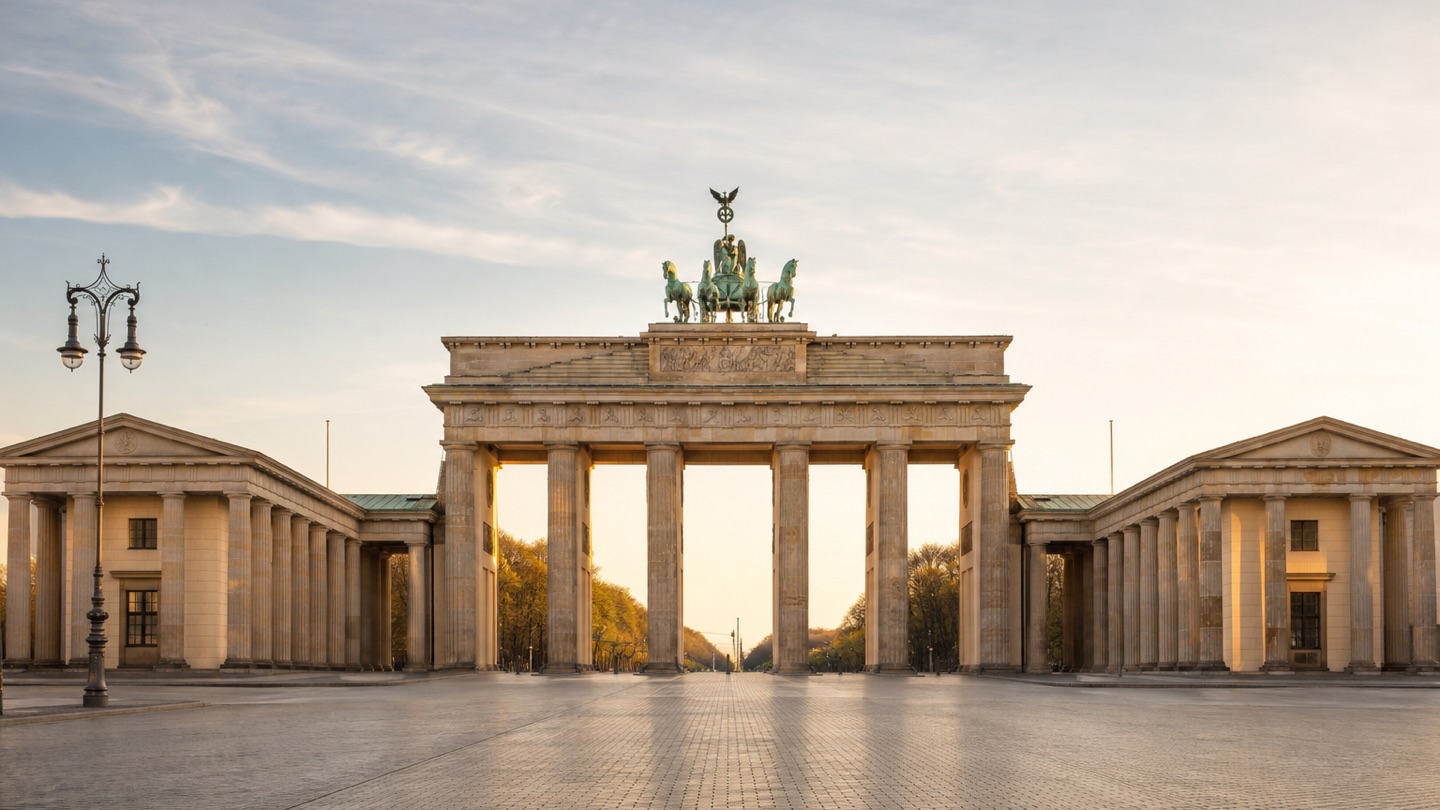
Mitte is the historic center and the practical choice, walking distance to Museum Island, Unter den Linden and the Brandenburg Gate. Charlottenburg, in the former west, is the older money district, calmer and more residential, close to the Kurfürstendamm shopping. Kreuzberg and Neukölln are where the food and nightlife are, better for evenings than for a base with family. Prenzlauer Berg is leafy, restored and popular with families. Brandenburg Airport handles arrivals and sits southeast of the city, roughly forty five minutes in. Berlin is well connected by rail: Hamburg is under two hours, Dresden about two, Prague around four and Munich roughly four by fast train.
Grand old rooms, or something with a view of the Gate
Hotel Adlon Kempinski sits directly beside the Brandenburg Gate and is the historic address, formal and central. Rocco Forte Hotel de Rome occupies a former bank on Bebelplatz with a rooftop over the opera house and the cathedral. The Ritz Carlton Berlin sits at Potsdamer Platz, convenient and modern. Château Royal in Mitte is smaller, design led and the most current choice. Schlosshotel Herrenhaus im Grunewald offers something else entirely out in the western forest for travelers who want quiet. The decision is mostly about whether you want to walk to the museums or to be away from the tourist core.
When to begin
Three months is comfortable for most of the year. Summer weekends, the September window and any date touching a major trade fair or the film festival in February want four to six. Opera and Philharmonie tickets are the constraint rather than the hotels, and the best seats for the strongest programs are gone months ahead, so tell us if a specific performance is the reason you are coming.
Four experiences worth building the days around
- Museum Island with a guide who picks two collections properly rather than five badly, taken at opening or in a late evening slot where the museums offer one.
- A Berliner Philharmoniker concert in Scharoun's hall, which is one of the finest rooms for orchestral sound anywhere and worth planning the trip around.
- A guided half day on the divided city, from Bernauer Strasse to the Stasi archives, with a historian rather than an audio device.
- A boat afternoon on the Spree and the canals, or a day out to Potsdam and Sanssouci, which is under an hour and a complete change of register.
Who this trip suits
Berlin suits readers, historians and people who want to understand the twentieth century rather than just photograph it. It suits classical music and contemporary art collectors. It suits families with teenagers, who tend to engage with this city more than with prettier ones. It suits business travel, and it suits repeat visitors to Europe who have already done the obvious capitals.
When another plan may fit better
Travelers who want beauty, romance and a compact old town will be happier in Prague or Vienna, and we will point you there without hesitation. Berlin is also a large, spread out city, so a two night stop rarely does it justice. And the deep winter here is genuinely dark, which not everyone enjoys.
Plan it with one accountable advisor
Tell us how much history you want, what is on at the opera and who is traveling, and we will set the base, the guide and the ticket bookings that need lead time. Our luxury leisure travel planning handles the sequence when Berlin sits inside a longer European itinerary by rail.