


Luang Prabang Destination Guide

A Royal Town That Never Grew
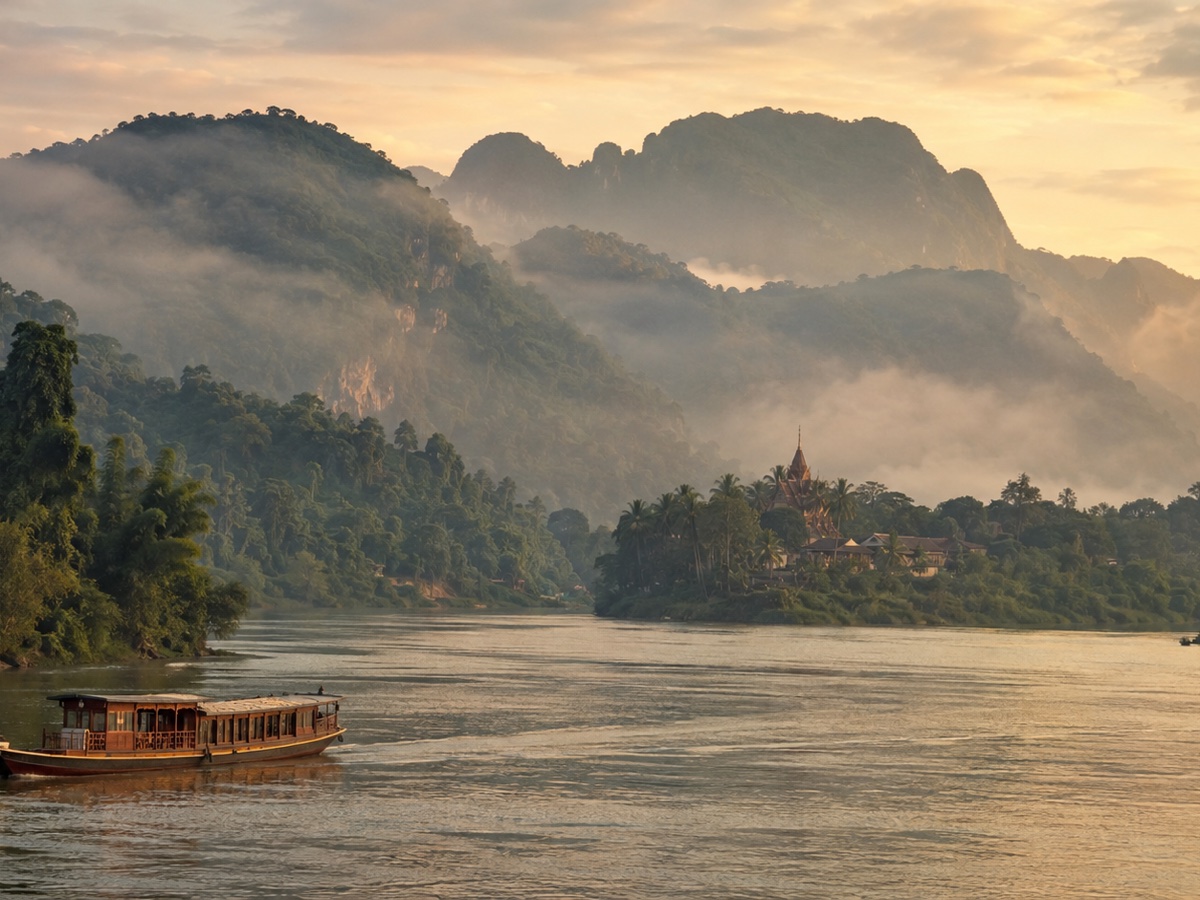
Luang Prabang sits on a narrow peninsula where the Nam Khan runs into the Mekong, in the mountains of northern Laos. It was the royal capital, it holds more than thirty working monasteries inside a very small grid, and the French left behind shuttered villas that sit beside Lao timber houses without arguing with them. The whole peninsula is inscribed by UNESCO, which has kept the building heights low and the streets intact. It is a genuinely quiet town, with a curfew that empties the streets before midnight, and that quietness is the entire point rather than a limitation.
The planning decision: three nights, and how you arrive
Three nights is right for most travelers and four if the waterfalls, a village day and the surrounding countryside all matter. This is not a place that rewards a longer stay for its own sake. The more consequential decision is how you get here. Flying in from Bangkok, Hanoi, Chiang Mai or Vientiane takes an hour or two and is what most people do. The alternative is the Mekong slow boat from the Thai border at Huay Xai, two days on the river with a night at Pakbeng, which is a real experience and a real commitment. There is also now a fast rail link running north to the Chinese border and south to Vientiane, which has changed regional movement considerably.
The dry season, the burning, and the green months
November through March is the window, with clear skies, warm days and cool evenings that can drop enough to want a jacket in December and January. That is when to come. April and May are the hottest months and also carry the regional agricultural burning, which can push haze across northern Laos and materially affect both the air and the views. June through October is the wet season, with heavy afternoon rain, dramatic river levels, waterfalls at their most powerful and the countryside at its greenest, and the town is very quiet. Lao New Year in mid April is a major water festival and the town fills for it.
Where to base, and how small this town is
The peninsula itself is the historic core, with Sisavangvong Road running down the middle, and you can walk end to end in twenty minutes. Staying on or immediately beside the peninsula is right for a first visit, because the morning ritual, the temples, the night market and the river restaurants are all within a few streets. The riverbanks on both the Mekong and the Nam Khan give you the same access with a view and slightly more calm. Properties out along the road towards the airport or across the river are quieter and more resort like but put you in a car for everything. The airport is around ten minutes from the center, which is unusual and welcome, though its runway and connections are limited and schedules should be confirmed for your dates.
Stay strategy in a town of converted houses
Amantaka occupies a restored French hospital compound near the old town in suites around a colonial garden and is the most polished address here. Rosewood Luang Prabang sits up a hill valley outside town with tented and villa accommodation beside a waterfall, and it is the more dramatic setting. Belmond La Résidence Phou Vao looks back at the peninsula from a ridge with the best view in the province. Avani and Sofitel cover the reliable middle. Below that there is an excellent tier of small converted merchant houses on the peninsula itself, family run, with a handful of rooms each. Air conditioning, room size and stairs vary in the historic conversions and are worth specifying.
When to begin
Four months for the November to March window, and five to six for Christmas, New Year and February, because the good properties here are genuinely small and there are not many of them. Slow boat charters and the better guides for village visits book on a similar horizon. Flight connections into Luang Prabang are thin and change seasonally, so the routing usually determines the dates rather than the other way round.
Four experiences worth building the days around
- The dawn alms giving, watched from a respectful distance in silence, without flash, without blocking the procession and without buying food to hand over, which is a ritual and not a performance.
- Kuang Si falls in the early morning before the vans, walking up past the bear sanctuary to the higher pools.
- A sunset boat on the Mekong, or the longer run upriver to the Pak Ou caves and their thousands of abandoned Buddha figures.
- Mount Phousi climbed early rather than at sunset, when the summit is quiet and the view over both rivers is clear.
Who this trip suits
Luang Prabang suits travelers who want to slow down and are not embarrassed to admit it. It suits couples, honeymooners and anyone building a gentle end to a busier Southeast Asian route. It suits people interested in Buddhist practice, textiles and craft. It suits photographers, particularly early. And it suits families with older children, though there is very little here designed for young ones.
When another plan may fit better
If you want nightlife, shopping or variety, this town closes early by law and Bangkok is two hours away and the opposite in every respect. If you want temples with more scale and archaeology, Siem Reap is the stronger single stop. And if you want a beach at the end, Laos is landlocked, so the coast is a separate flight rather than a drive.
Plan it with one accountable advisor
Tell us your month, whether the slow boat or the flight is the arrival and what follows in Thailand, Vietnam or Cambodia, and we will hold the small properties early and route the region properly. Our luxury leisure travel planning treats Laos as part of a sequence rather than a single booking.