


How to Plan a Luxury Italy Trip That Feels Effortless
Most advice about a luxury Italy trip starts with the wrong question. It asks which five-star hotel to book, when the smarter question is how to move through Italy with enough privacy, timing, and access that the trip never feels performative or crowded.
Italy rewards travelers who think in terms of flow, not just famous addresses. A well-designed itinerary can feel calm even in the country's most sought-after places, while a poorly sequenced one can make even the finest hotel feel like a waiting room.
Table of Contents
- Why a Luxury Italy Trip Is About Access, Not Addresses
- What that means for booking strategy
- Region by region, the trade-offs are different
- Choose the shape before you choose the hotels
- Where private access matters most
- Room selection is part of the product
- Pulling It All Together Into One Seamless Plan
Why a Luxury Italy Trip Is About Access, Not Addresses
The easiest way to overspend in Italy is to anchor the whole trip around a legendary hotel in a legendary town and assume the rest will sort itself out. It usually doesn't. If you build around the same icons everyone else wants, at the same time everyone else wants them, luxury turns transactional fast.
The market reality backs that up. Italy's five-star hotels generated over €9 billion in turnover in 2024, drew 4.5 million guests, and logged 12.8 million overnight stays, according to a Demoskopika report cited by ANSA. That same source says luxury hotels represented 16.8% of total hotel-sector earnings, while the segment grew at an average annual rate of 9.2% from 2008 to 2024, faster than the wider hotel sector's 5.2% average annual growth over the same period. ANSA on Italy's luxury tourism segment
That's why luxury planning has shifted from “Where do we stay?” to “How do we move?” Travelers from Germany, the United States, the UK, Switzerland, France, Austria, Spain, the Netherlands, Canada, Australia, and Japan made up 65% of guests at luxury hotels in that same reporting, which tells you how international and demand-heavy the high end already is. When a market is that broad and that full, privacy becomes a design choice, not an accident.
Practical rule: In Italy, the difference between a memorable trip and an exhausting one is often whether you arrive at the right place in the right order, with the right amount of breathing room.
A luxury Italy trip feels expensive in the best sense when it buys time, quiet, and access, not just marble and a view. That's also why itinerary design matters more than brand loyalty. For travelers who want a useful partner in that process, a relationship-led approach like preferred hotel network planning can matter more than chasing a famous name.
The Market Behind the Experience
Italy's high-end travel market is attractive precisely because it's constrained. High demand is visible in the numbers, and once you understand that, a lot of planning decisions become obvious. If premium rooms are filling and rates are moving, then the trip has to be designed around scarcity, not wishful thinking.
The CNR's luxury tourism research says high-end international tourists spend about €25 billion in Italy, including roughly €7 billion on accommodation, €2 billion on dining, and €14 billion on visits, tours, and shopping. It also says luxury tourism accounts for 15% of total hotel revenue and 25% of total tourism spending. More than 45% of high-end travelers have visited Italy at least once in the previous five years, which is a strong signal that repeat visitation and familiarity are part of the appeal. CNR luxury tourism report
What that means for booking strategy
Luxury inventory isn't just expensive, it's competed for. In the top-end market, 5-star hotels recorded 68.1% occupancy with an ADR of €610.46 in 2024, and major cities such as Rome, Milan, Bologna, and Florence all exceeded 75% occupancy. The same market data says 5-star occupancy rose 2.4 points year over year and ADR increased 5.7%, which is a practical way of saying demand is outrunning capacity in the places everyone wants. Grand View Research Italy luxury travel outlook
That creates a simple consequence. You either book early, or you accept less choice in room type, view, and location. The second option is fine for many trips. It's a bad trade if you're paying for a luxury experience.
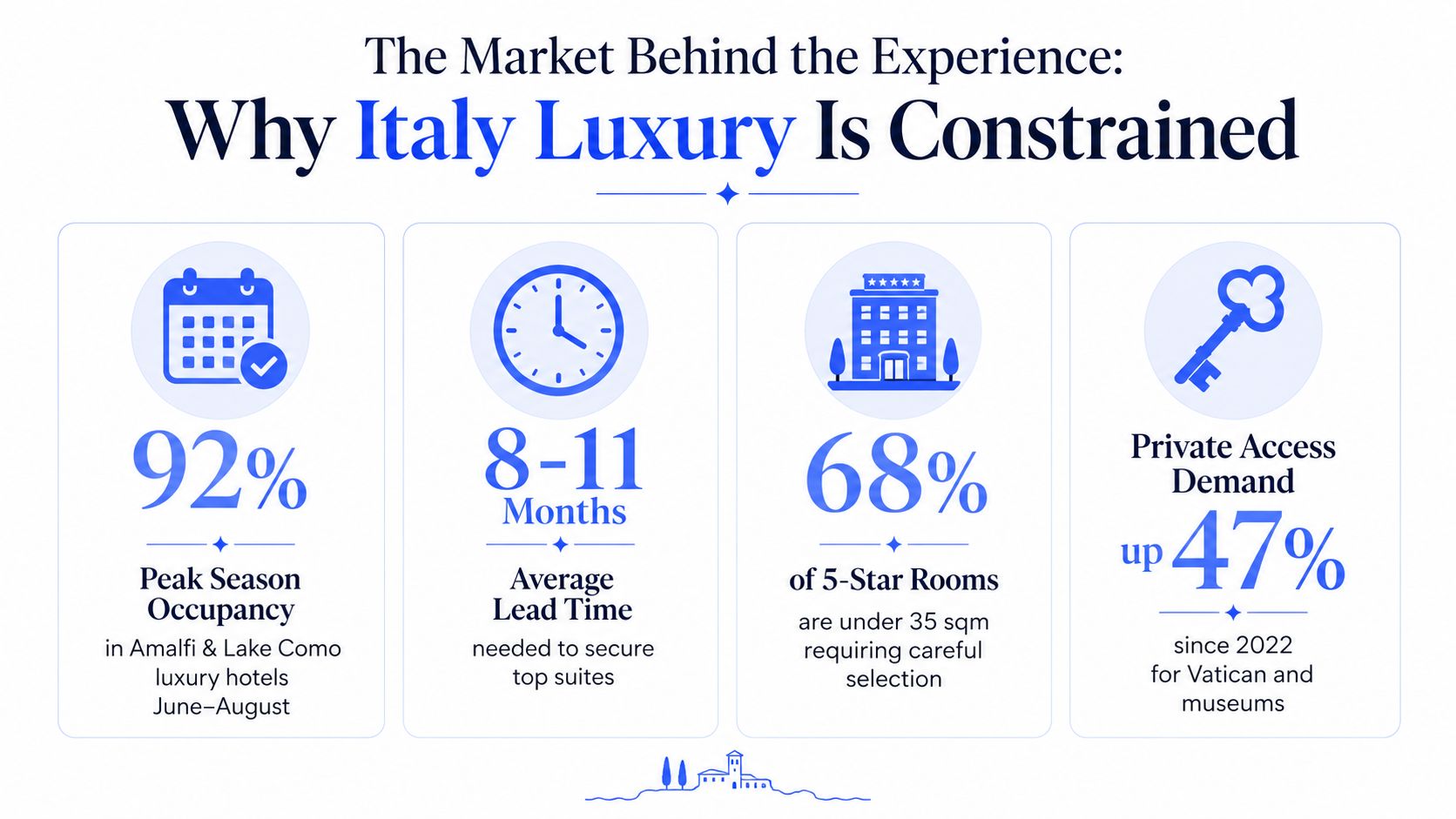
The key planning insight is knowing that Italy's luxury market isn't one experience. It's a set of very different sub-markets, some dense and public-facing, others quieter and more forgiving. A euro spent in a crowded icon does less work than the same euro spent in a place where you can enjoy the setting.
Choosing Your Regions and the Right Time to Go
The best region for a luxury Italy trip depends on what kind of luxury you're after. If you want theatrical city energy, the art cities deliver. If you want privacy and slower mornings, the countryside and less-saturated coastlines usually give you more room to breathe. If you want a trip that feels balanced rather than overpacked, the answer is rarely one place.
Region by region, the trade-offs are different
Rome, Florence, and Venice work best for travelers who want major cultural density and don't mind that popular sites draw crowds. They're strongest when used as anchors for a few polished days, not as places to try to “do everything.” The lakes and mountains, especially Como, Garda, and the Dolomites, suit travelers who want a more restorative pace and strong scenery without constant movement.
The coast is the most seductive and the easiest to get wrong. Amalfi can be gorgeous and frustrating in equal measure, while Puglia, Sicily, and parts of Sardinia tend to reward travelers who care about space, local rhythm, and a less compressed feel. Tuscany and Umbria sit in the middle, which is why they work so well for honeymooners, families, and celebration trips that need elegance without logistical strain.
Shoulder season is the most strategic timing decision in the whole country. Not because peak season is bad, but because Italy's luxury product often improves when you're not competing with the broadest wave of demand. One recent industry analysis noted strong year-over-year booking growth in places such as Sorrento, Cefalù, Rome, Lake Garda, and Taormina, and also pointed to rising interest in luxury rail and coach itineraries and in interrailing, which shows how travelers are building movement into the experience rather than treating every trip as a hotel stay. Italian luxury travel destinations analysis for 2026
| Region | Best Window | Best For | Crowding Level |
|---|---|---|---|
| Rome, Florence, Venice | Shoulder season | Culture-first travelers, first-time visitors | High |
| Amalfi Coast | Shoulder season | Celebration trips, iconic coastal stays | High |
| Puglia, Sicily, Sardinia | Shoulder season | Privacy seekers, slower luxury, beach time | Moderate |
| Tuscany, Umbria | Shoulder season | Couples, families, food and wine travelers | Moderate |
| Lake Como, Garda, Dolomites | Shoulder season | Scenic escapes, restorative itineraries | Moderate to high |
The smartest route is often not the most famous one. It's the one that matches your pace, your tolerance for crowds, and how much movement you actually enjoy.
Designing the Itinerary Shape
A polished trip usually fails for one of two reasons. It has too many stops, or it has the right stops in the wrong order. Luxury travel should feel like a well-paced dinner, where each course has a reason to be there and the timing between courses matters as much as the food.
Choose the shape before you choose the hotels
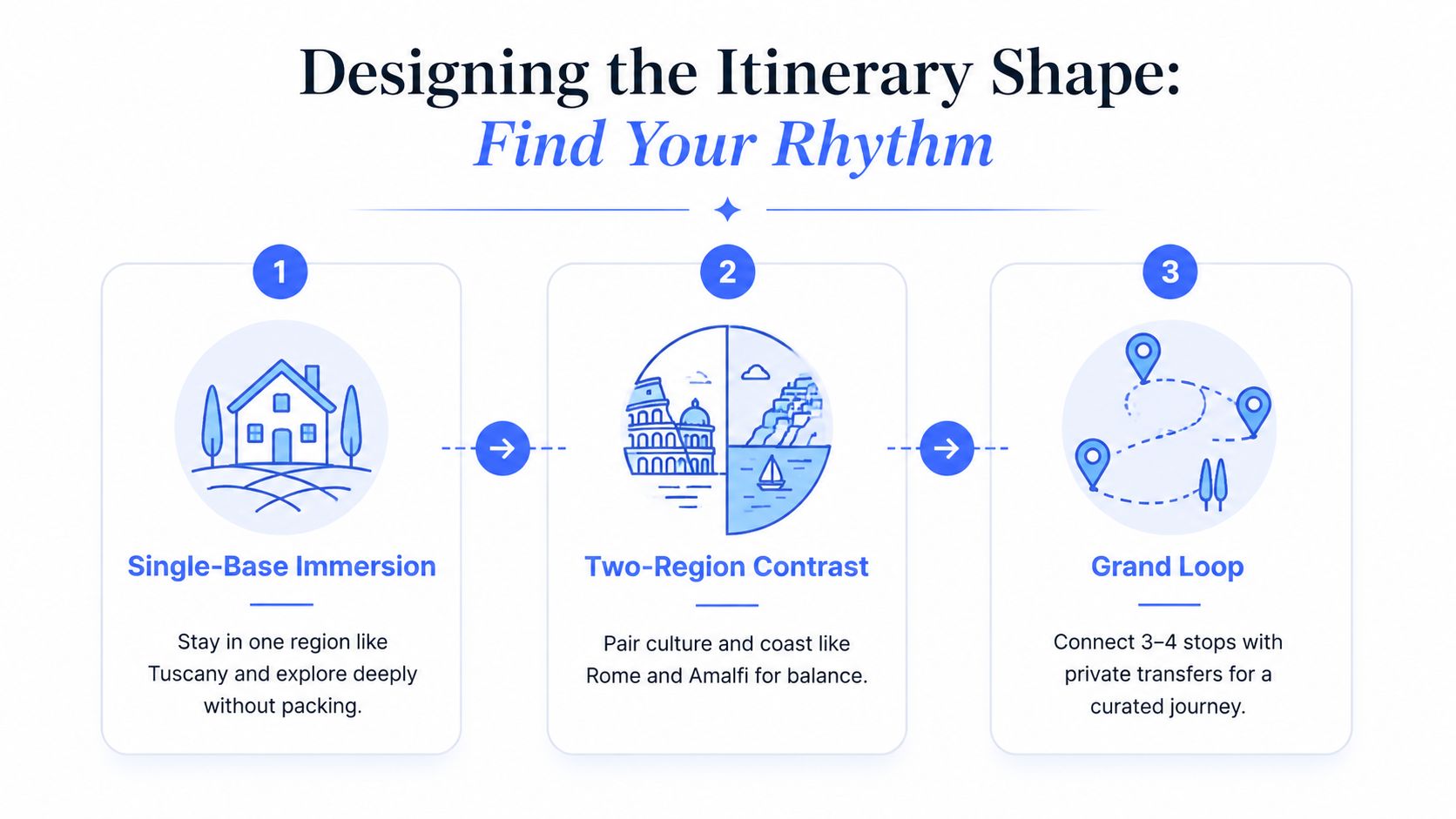
A single-base immersion works when the point is rest, family time, or deep exploration of one region. Tuscany is the obvious example, but the principle matters more than the place. One good base, chosen well, removes transfer fatigue and gives the trip room to breathe.
A two-region contrast is the sweet spot for many travelers. City and coast, or city and countryside, creates rhythm without turning the trip into a checklist. Rome plus Amalfi works because the experience changes enough to feel like a real journey, but not so often that the trip starts feeling chopped up.
A grand loop should be used sparingly and only when the traveler wants motion. It can work beautifully for a celebration or a once-in-a-lifetime itinerary, but every additional stop increases the need for precise sequencing, private transfers, and realistic pacing.
The mistake I see most often is building around attractions instead of nights. When people ask for “10 days in Italy,” they usually mean too much movement and too few actual evenings in each place. Better planning starts with how long you'll stay in each base, then decides what you can sensibly do from there.
If you want a concrete Amalfi example, a concise routing approach can help you see how this logic plays out in practice, and a five-day Amalfi Coast itinerary shows how a compact coastal trip can still feel composed.
Private Experiences That Define the Trip
The best luxury days in Italy usually don't look dramatic on paper. They feel easy in the moment because someone else handled the access, the timing, and the crowd avoidance. That's the difference between being a tourist and being a guest.
One of the most valuable moves is an early-access or after-hours visit to a major site. You don't need to chase novelty for the experience to feel premium, you need the site to feel usable. A private guide can change that completely, especially in museums where a good guide turns a collection into a conversation rather than a march through rooms.
A boat day is another high-yield choice, particularly on the coast. Public ferries and shared departures can work, but they rarely feel luxurious in the way travelers mean when they say they want Italy to be effortless. A private boat changes the pace, gives you control over timing, and keeps the day from being dictated by other people's schedules.
Where private access matters most
Estate visits and vineyard appointments often feel better when they come through relationships rather than public booking channels. The setting matters, but so does the sense that you're being received rather than processed. That's especially true for travelers who care more about atmosphere, wine, and conversation than about ticking off famous labels.
Wellness and longevity-focused stays also fit the current luxury brief better than they used to. So do adults-focused properties and quieter destinations, because many travelers now define luxury as privacy and recovery, not only spectacle. That shift is part of why the more remote corners of Italy are getting more attention from affluent travelers.
Practical rule: Spend on access before you spend on excess. A private guide, a reserved boat, or a hard-to-get tasting often improves the trip more than another layer of décor.
For travelers who want that kind of trip assembled end to end, a service like Justkeeps Travel can coordinate private guides, transfers, dining, and on-trip changes as one itinerary, instead of leaving each piece to be managed separately. That matters most when reservations are scarce and the schedule has to stay fluid.

Logistics and High-Touch Support on the Ground
Luxury falls apart fastest in the small, unglamorous moments. A room with the wrong orientation, a transfer that arrives late, a reservation that was never fully confirmed, or a schedule split across vendors who do not coordinate, all of that chips away at the experience. The answer is a single point of coordination, backed by high-touch concierge support.
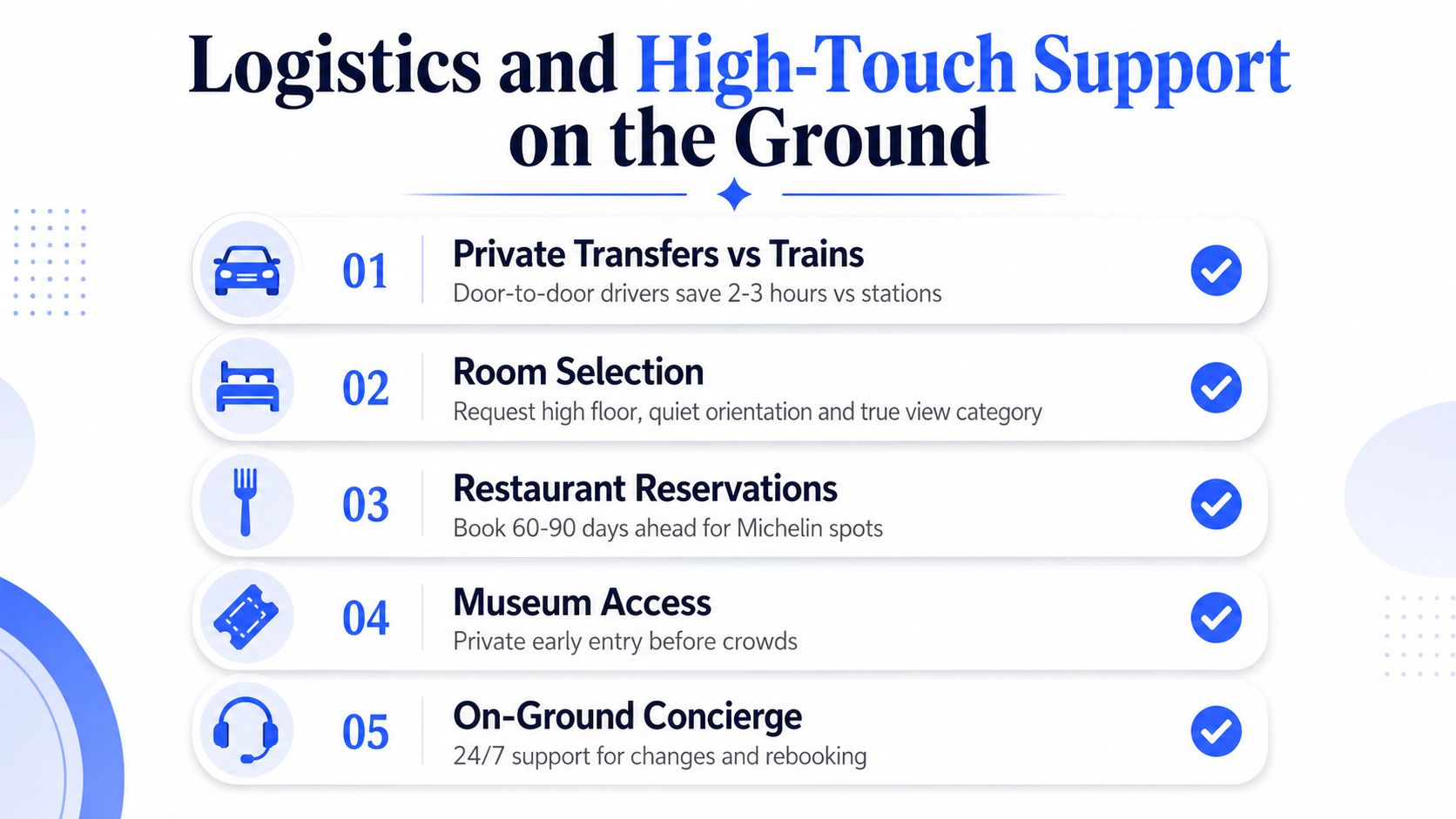
Private transfers are usually worth the cost when routing is complex or time is tight. Trains can still fit well in some itineraries, but stations, luggage, and connections add friction that many travelers do not want on a premium trip. That matters most when the itinerary spans several destinations and the goal is to save energy for the places themselves.
Room selection is part of the product
Booking the right category is only the start. The key question is whether the room sits on a quiet side of the property, whether the view is genuine or partial, and whether the floor affects light and noise. Those details often matter more than the gap between two similar room types online.
Restaurant and museum reservations need the same discipline. The most desirable tables and access slots do not behave like ordinary inventory, and the traveler who waits until arrival is usually choosing from leftovers. A good planning process secures the hard-to-get pieces early, then keeps room for smaller decisions later.
On-trip support turns a decent itinerary into an easy one. When a ferry is delayed, weather changes a boat day, or a traveler wants to reshuffle dinner after a long afternoon, one coordinator can adjust the plan without forcing the guest to negotiate with every supplier directly. Confidentiality and discretion matter here too, especially for privacy-sensitive clients.
A strong support structure does not make a trip fancier. It makes it calmer, and in Italy that is often the ultimate luxury.
Pulling It All Together Into One Seamless Plan
A strong luxury Italy trip starts with three decisions. Pick the region-and-season pairing that fits your tolerance for crowds. Choose the itinerary shape that matches your energy. Then layer in a few private experiences that justify the whole journey.
After that, everything should be coordinated as one plan, not a pile of separate bookings. That's where a dedicated advisor earns the fee, especially for complex groups, scarce inventory, multi-stop routing, and trips where time is the most expensive resource. Bespoke planning is different from templated packages because it can respond to the actual traveler, not just the destination.
The highest-end Italian trips don't feel busy. They feel deliberate, because the pacing is right, the access is private, and the logistics never intrude on the days themselves. That's the standard worth aiming for.
Justkeeps Travel designs bespoke Italy itineraries with private transfers, curated experiences, hotel coordination, and live support while you're on the road. If you want a luxury Italy trip that's built around flow, access, and privacy instead of guesswork, visit Justkeeps Travel to start the conversation.