


Bali
Bali Is A Circuit, Not A Resort
The most common mistake with Bali is treating it as one destination with a choice of hotels. It is not. The jungle interior around Ubud, the beach strip at Seminyak, the surf sprawl of Canggu, the clifftops of Uluwatu, the calm bays at Jimbaran and Sanur, the quiet east around Sidemen, and the islands offshore are effectively eight different holidays sharing one airport. They do not feel alike and they do not suit the same traveler.
So the biggest upgrade we make to a Bali itinerary costs nothing. It is the order. Jungle first, ocean last, so the trip decompresses rather than doubling back. The second is honesty about traffic. Distances here are measured in hours, not kilometers. Uluwatu is forty five minutes from the airport on a good day. Ubud can be two. We route around that rather than pretending it away.
Know before you go
- Fly into Ngurah Rai International in Denpasar, code DPS. Forty five minutes to Uluwatu, up to two hours to Ubud.
- Trip length eight to ten nights across two or three bases. Fewer than seven, pick one base and stay in it.
- Best months April through October. July and August are peak and book out six to nine months ahead.
- Currency the Indonesian rupiah, written IDR or Rp. It runs around 17,500 to the US dollar, so 100,000 rupiah is a little under six dollars and a million is about fifty seven. Prices are quoted in thousands, so a 250k dinner is roughly fourteen dollars. Carry some cash for warungs and drivers, cards are fine everywhere else.
- Entry visa on arrival for most nationalities, plus a one off tourist levy of 150,000 rupiah, about eight and a half dollars, per visit.
- Getting around hire a driver by the day through your hotel. It is the single best value arrangement on the island.
- Time zone UTC plus eight, which is twelve hours ahead of New York in summer and thirteen in winter.
- Power 230 volts, European style two pin plugs, types C and F.
- The date to plan around Nyepi, the day of silence, 8 March in 2027. The airport closes for twenty four hours.
The planning decision: which two or three bases
Read these as personalities rather than places on a map. Getting the pairing right is most of the planning.
Ubud and the interior
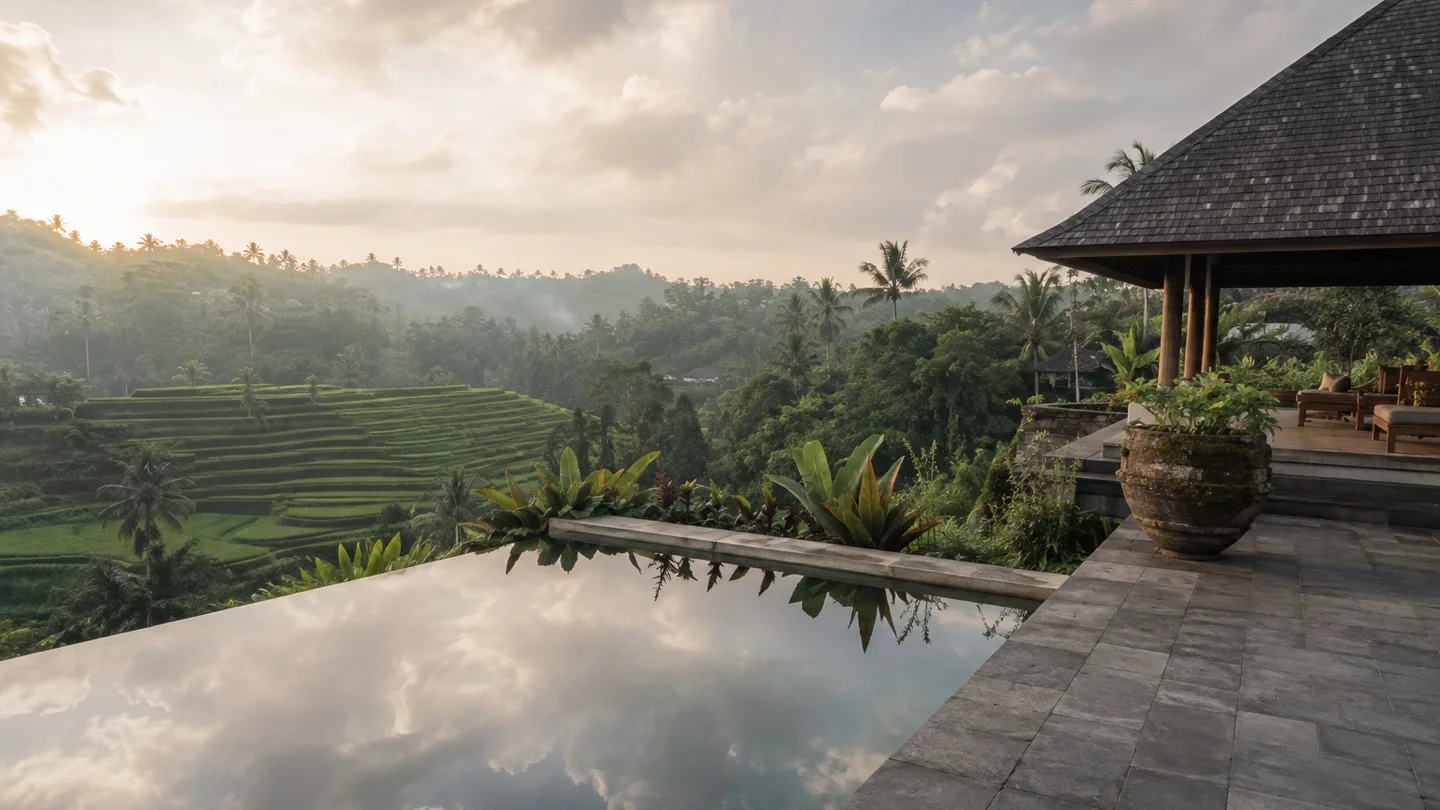
Thirty kilometers inland and three hundred meters up, so it is cooler, greener and quieter than the coast. This is the cultural center of the island, where the temples, the dance and the ceremonies are living practice rather than performance, and it is where the serious wellness addresses are. The town itself has become busy, but almost nobody should stay in the center. The best houses sit along the Ayung and Petanu river gorges, five to twenty minutes out of town, in valleys where you hear water and insects and nothing else. There is no beach. Three or four nights, at the start.
Sidemen and the east
Ninety minutes east of Ubud the country opens under Mount Agung into terraced valleys with almost no tourism in them. Sidemen is the valley people mean when they say Ubud thirty years ago, and it genuinely is that. The coast at Manggis is quiet black sand with a few exceptional properties. This is the part most itineraries skip and the part returning visitors should not.
Seminyak and Canggu
Seminyak is the established beach strip. Gray sand facing west into the sunset, the best restaurants on the island, beach clubs, and the rare virtue of being walkable in parts. The sea has real surf and a current, so it is a sunset coast rather than a swimming one. Canggu, just north, was rice fields fifteen years ago and is now the fastest changing place in Bali. Surf, coffee, a large remote working community and a harder scene. Genuinely fun, also congested and under permanent construction. Right for surfers. Wrong for calm.
Uluwatu and the Bukit
The limestone peninsula at the southern tip is a different landscape altogether. Dry, high, ending in cliffs seventy meters above the Indian Ocean. The most spectacular hotels on the island are cut into that cliff face, and the serious surf breaks are below them. The trade is honest. Beaches are down long staircases or lifts, and dinner means driving. For a honeymoon or a milestone trip, unbeatable. For toddlers, a great many stairs.
Jimbaran, Sanur and Nusa Dua
These are the calm water answers, and most of the island does not have calm water. Jimbaran is a wide east facing bay twenty minutes from the airport, with a fish market and grilled seafood on the sand that is one of the best cheap dinners in Asia. It is the natural last base before a flight. Sanur was the first resort area and has aged into the quietest, with a reef, flat shallow water and the only real seafront promenade on the island. Nusa Dua is a gated enclave with the largest hotels and a protective reef. Easy, comfortable, and almost entirely sealed off from Bali, which is exactly what some people want and exactly what others come here to avoid.
The islands offshore: Nusa Penida and the Gilis
Two very different options, and most people confuse them.
Nusa Penida, Lembongan and Ceningan
Twenty five to forty minutes by fast boat from Sanur. Penida is the big dramatic one, with the headland at Kelingking, the manta cleaning stations at Manta Point and roads that are still rough. Lembongan is small and easy. Both are worth an overnight rather than the very long day trip most people do, which means a boat at dawn, a boat at dusk and a lot of driving between.
The Gili Islands
Three small islands off the northwest corner of Lombok, and the flat turquoise water that Bali itself does not have. No cars and no motorbikes on any of them. You walk, cycle, or take a cidomo, the pony cart, and the absence of engines is the single thing every visitor remembers.
Gili Trawangan is the largest and most developed, with the dive schools, the widest choice of places to eat and a nightlife reputation it has partly outgrown. Gili Meno is the smallest and quietest, has a turtle hatchery and an underwater sculpture installation off its coast, and is the honeymoon island of the three. Gili Air sits between them in every sense. Closest to Lombok, the best food for its size, green turtles on the reef off the east shore, and enough going on in the evening without any of the noise. For most of our travelers, Air is the right answer and Meno is the right answer for a honeymoon.
Getting there is the part worth planning properly. Fast boats run from Padang Bai and Serangan in about two to two and a half hours, and from Amed in the northeast in around ninety minutes, which is why we often pair the Gilis with a night in the east rather than running down from Ubud in one go. The crossing is bumpy even on a good day. Morning departures are calmer than afternoon ones, December and January carry the highest cancellation risk, and we book reputable operators rather than the cheapest seat at the pier. The alternative, for anyone who would rather not do the open water, is the short flight to Lombok and a transfer from there.
A ten day route that works
Ten nights, three bases, and the sequence doing the work. This is the version we build most often for a first trip that wants both the culture and the water.
- Day 1. Arrive Denpasar, drive straight up to the Ubud valleys. Nothing scheduled. Dinner at the hotel.
- Day 2. The Campuhan ridge walk at first light, before the heat, about an hour and free. Breakfast over the gorge afterwards, while the valley still has mist in it. Afternoon at the spa or the pool.
- Day 3. A guided temple morning, starting early while the tour buses are still at breakfast, with someone who reads the ceremony rather than only naming the buildings. Ubud market and the woodcarving villages after.
- Day 4. East through the rice terraces under Mount Agung into Sidemen, then down to the coast at Manggis or Amed for the night. The best driving day in Bali.
- Day 5. Short morning boat from Amed to the Gilis. On the island by lunch, in the water by two.
- Day 6. Snorkel the turtle reef, cycle the island, and watch the sun go down behind Agung across the strait.
- Day 7. Island hop by local boat. Dive or snorkel the Meno sculptures, lunch on Trawangan, back for dinner.
- Day 8. Boat back to Bali and south to the Bukit. Long travel day, so we keep the afternoon empty.
- Day 9. A private boat to Nusa Penida for the manta cleaning stations, or a slow day on the cliff. Uluwatu temple at sunset with the kecak dance, which is touristic and still genuinely stirring.
- Day 10. Down to Jimbaran for the last night. Grilled seafood on the sand, chosen from the market that morning, then a twenty minute run to the airport.
Shorten it by dropping the Gilis and giving the days back to Ubud and the Bukit. Lengthen it by adding two nights in Sidemen. What we do not do is add a fourth base, because every hotel change costs half a day to the road.
Dry season, wet season, and the one day the island stops
April through October is the dry season and the reliable window. July and August are peak, swollen by Australian school holidays, with Easter and the festive weeks close behind, and the named villas at the famous houses are committed six to nine months ahead for those dates. November through March is the wet season, which in practice means green mornings and a heavy afternoon storm rather than all day rain. That is a fair trade for an Ubud and spa weighted trip at gentler rates. The west coast beaches take more plastic on the tide in those months, which affects Seminyak and Canggu more than Sanur or Nusa Dua.
The date to know is Nyepi, the Balinese day of silence each March, which falls on 8 March in 2027. The airport closes for twenty four hours, nobody goes outside, no lights are shown and the island goes completely dark and completely quiet. We either plan around it or plan straight into it, because staying somewhere good on a silent island is an experience nowhere else offers. The Ogoh Ogoh parades the night before are extraordinary.
Stay strategy across a very uneven island
In the Ubud valleys, Four Seasons Sayan is suspended over the Ayung gorge and remains the benchmark. Capella Ubud is a tented camp in the jungle and the most romantic property on the island. Como Shambhala is the serious wellness address.
On the Bukit, Bulgari Resort Bali holds the cliff edge with the most dramatic position in Indonesia, Six Senses Uluwatu and Alila Villas Uluwatu are the design led alternatives, and Four Seasons Jimbaran Bay is the classic ocean finale and the best of the group for families. In the east, Amankila steps three tiers of pool down toward the Lombok Strait. On the Gilis the inventory is small and personal rather than branded, which is the point of going. In Seminyak and Canggu a staffed villa usually beats a hotel for a family, because four bedrooms, a pool and a cook is a different holiday from four hotel rooms.
When to begin
Six to nine months for July, August, Easter and the festive weeks, and longer for a specific villa at the named houses, which repeat guests hold year to year. Four months in the shoulder. Book drivers through the hotels rather than on arrival, because a good driver who knows the back roads is worth more here than almost any other arrangement. Boats to Nusa Penida and any manta diving should be arranged privately and early.
Six experiences worth building the days around
- A guided temple morning, starting early while the tour buses are still at breakfast, with someone who can read the ceremony rather than only name the buildings. Ulun Danu Beratan, on the highland lake, is the one to reach at first light.
- A private boat to Nusa Penida for the manta cleaning stations, which is one of the great snorkeling and diving experiences in Asia.
- Snorkeling the turtle reef off Gili Air, then cycling the whole island before dinner, which takes about an hour and a half.
- Sunset at Uluwatu temple with the kecak dance on the cliff, which is touristic and still genuinely stirring.
- The Campuhan ridge walk out of Ubud at first light, before the heat, which takes about an hour and is free.
- Grilled seafood on the sand at Jimbaran at sunset, chosen from the market that morning.
Who this trip suits
Honeymoons, wellness resets, families with children of any age, groups taking a villa, surfers, divers and returning visitors all have a version of this island that works, and they are not the same version, which is exactly why the area choice matters more here than the hotel choice. It also pairs well as a beach and culture leg on a longer Asian route alongside Singapore or the wider region.
When another plan may fit better
If the priority is a flat turquoise lagoon and nothing else, the Maldives does that and Bali does not, because the water on most of this island has surf, current or reef. The Gilis are the closest Bali comes. If you want somewhere undiscovered, the south is genuinely busy and Lombok, Sumba or Flores are the honest answer. And with fewer than seven nights, pick one base and stay in it rather than trying to see the island.
Planning brief
Bali is eight holidays sharing one airport, so the order of your bases does more for the trip than any single hotel choice.
- Best suited to: honeymoons; wellness resets; families with children of any age; groups taking a staffed villa; surfers and divers; returning visitors who want Sidemen and the Gilis rather than the south again.
- Decisions to settle early: which two or three bases and in what order, jungle first and ocean last; whether the Gilis earn three or four nights; the dry season against gentler wet season rates; July, August, Easter and the festive weeks, which commit six to nine months out; Nyepi, when the airport closes.
- Arrival and routing: Ngurah Rai in Denpasar, forty five minutes to Uluwatu and up to two hours to Ubud; a driver hired by the day through the hotel; the fast boat to the Gilis from Amed rather than the longer southern crossings; Jimbaran as the last base before the flight.
Jungle First, Ocean Last
A honeymoon, a family trip with teenagers and a wellness reset that needs real quiet point to completely different pairs of bases, and getting that pairing right is most of the work. The month, the occasion and your tolerance for winding roads are enough to begin with. What comes back is the order, the drive times stated honestly, the rooms and villas worth holding, and the drivers, boats and guides booked before you arrive rather than after.
The route, the hotels, the guides and the transfers arrive as one itinerary through our luxury leisure travel planning, which covers villa weeks and multi family trips on the same basis.
From the journal
More on Bali: How to Plan Bali: Ubud, the Coast, and the Space Between and Private Villa Vacation: A Complete Planning Guide.
Villa or hotel in Bali?
A villa if you are a family or a group of four or more, a hotel if you are two. A staffed villa with a pool and a cook gives you breakfast at your own hour and a kitchen that does not need booking, which with young children decides the holiday, and it is usually the better value once you are counting four bedrooms rather than four rooms. Where hotels win is position and service depth, particularly on the Bukit cliffs and in the Ubud river valleys, where the best properties hold ground no private house can. Many good itineraries do both: a hotel for the jungle and the cliff, a villa for the beach half.
Is Ubud or Uluwatu better for a first trip?
Both, in that order. Ubud is jungle, culture and cooler air with no beach, and it works best at the start. Uluwatu is clifftop drama and serious surf, and it works best at the end. Doing them in reverse means finishing your holiday inland.
Are the Gili Islands worth adding, and which one should you stay on?
They are worth it if you want flat turquoise water, because most of Bali does not have it. Three or four nights is the right length. Gili Air suits most people, with the best food for its size and green turtles on the reef off the east shore. Gili Meno is the smallest and quietest and is the honeymoon choice. Gili Trawangan is the largest, has the dive schools and the widest choice of restaurants, and still carries a party reputation it has partly outgrown. None of the three allows cars or motorbikes, so you walk, cycle or take a pony cart.
Where should a family with young children stay in Bali?
Jimbaran or Sanur, both of which have calm swimming water, which most of the island does not. Nusa Dua is the easiest of all if you genuinely want a resort week. Uluwatu is spectacular and involves a great many stairs down to the sand.
How many days do you need in Bali?
Plan eight to ten nights across two or three bases. With fewer than seven, pick one base and stay in it. Go jungle first and ocean last, and remember that distances here are measured in hours. Read our Bali planning guide or start in Ubud.
CONTINUE EXPLORING