

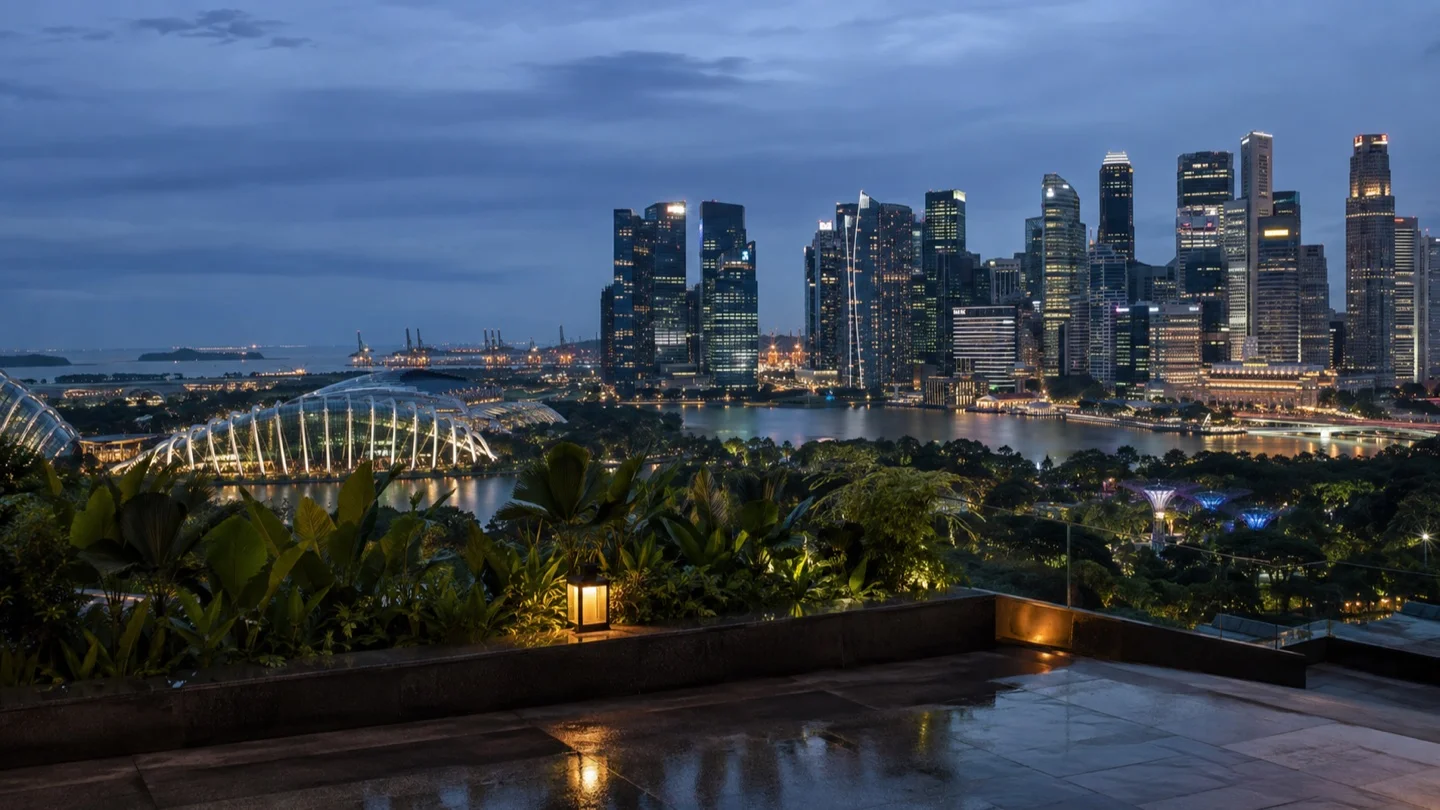

Singapore
Singapore Has No Season, So Let the Rest of the Trip Pick the Week
One degree north of the equator, Singapore is effectively seasonless. Nights rarely fall below 23 to 25°C, days rarely climb above 31 to 33°C, and the gap between the warmest month, May, and the coolest, December and January, is barely two degrees. Rain falls on roughly 171 days a year and totals about 2,113 mm, which sounds forbidding until you understand that most of it arrives as afternoon convection lasting an hour. So there is no month to plan around here. Slot Singapore wherever the wider itinerary wants it, and plan the days rather than the season.
Know before you go
- Fly into Changi, code SIN, about 24 km east of the Central Area and served by over 100 international carriers, which is why the city works as the hinge of almost any Southeast Asia or Australia routing.
- Trip length Three nights. Two covers the essentials and treats the city as a stopover, which is how it earned its reputation as a place to change planes. The third night is where the eating opens up.
- Best months February is the driest month of the year. March through May is the inter monsoon stretch, bringing afternoon thunderstorms rather than settled rain, which for a city that is largely indoors or under cover is easy to plan around. November through January is the wettest run, and the northeast monsoon from December to early March carries the heaviest rainfall early on.
- Humidity, not heat Annual humidity averages around 82%, but the daily curve is the useful part: over 90% in the early morning, easing to about 60% by mid afternoon. That is the opposite of the temperature curve, which is why outdoor walking is more comfortable at five in the afternoon than at eight in the morning.
- Entry US passport holders enter visa free for 90 days, with a passport valid six months beyond departure and one blank page per stamp. Amounts over SGD 20,000 carried in or out have to be declared.
- Arrival card The SG Arrival Card is free, is filed on the ICA website or through the MyICA app, and the window is three days including the day you arrive. The health declaration is built into it and is compulsory for everyone entering. ICA states plainly that it does not endorse the commercial sites that charge for this.
- Money The Singapore dollar runs a little below the US dollar, so mental arithmetic is easy: a Singapore dollar price is close to what it looks like in American money.
- Plugs and clocks Singapore is the outlier on any regional routing. It runs on UTC+8, an hour ahead of Bangkok, Hanoi and Phnom Penh, and it uses the British three pin socket, which works nowhere else on a Southeast Asia trip. Voltage is 230 V, so single voltage American appliances need a converter and not just an adapter.
- Getting around The MRT is fast, cold, cheap and reaches almost everything worth reaching, and the taxis are metered and plentiful. The transport decision is not how to move but where to sleep, because town and Sentosa are twenty minutes and two entirely different trips apart.
- Chinese New Year In 2027 it falls on 6 and 7 February, squarely inside the best weather window. The city keeps running, unlike much of the region, but Chinatown is at full crush and many independent restaurants close for several days. Either build the itinerary around it deliberately or move a week later.
- Book the tables first The counters and tasting rooms take reservations weeks ahead and the good ones are small. Book those first, then leave lunches entirely open for the hawker centers.
There is no bad month, only a wetter one
The gap between Singapore's best and worst weather is smaller than anyone expects. February is driest, November through January is wettest, and everything in between is a rounding error. What changes the experience is not rainfall totals but rainfall shape. In the inter monsoon months of March to May and October to November, rain arrives as short, predictable afternoon convection, so the correct response is to put your indoor anchors into the two to five window: the museums, the conservatories at Gardens by the Bay, a long hawker lunch, the shophouse cafés. Treat the storm as an intermission and you lose nothing. In the northeast monsoon from December into early March the rain is heavier and less obliging, which is the one genuine argument for shifting dates. Otherwise, schedule Singapore around the rest of the trip, not around itself.
Plan the day against the humidity curve, not the clock
The single most useful local fact is that humidity peaks above 90% in the early morning and drops to around 60% by mid afternoon. Every instinct imported from a temperate climate says to walk early and hide from the afternoon; here it is closer to the reverse. Mornings are for the museums, the covered markets and the long breakfast. Late afternoon, when the air has dried out and the light has softened, is for the botanic gardens, the Southern Ridges walk, the waterfront and the rooftops. Evening is when the city is at its best and its most comfortable. Build the itinerary that way and Singapore stops being a place you endure between cold rooms and becomes an outdoor city.
Town or Sentosa, and how the answer changes with nights
The split is clean. On two or three nights, stay in town, where the city is out the door and you are not spending twenty minutes each way to reach dinner. Raffles is a reason to come in its own right, an all suite landmark in the colonial quarter that kept its theater through restoration. Mandarin Oriental gives you the Marina Bay view everyone photographs. Four Seasons, up towards Orchard Road, is the settled choice for families and for shopping. On four nights or more, or traveling with children, the island earns its place: Capella on Sentosa is rainforest quiet twenty minutes from downtown, and Raffles Sentosa is all villas, each with its own pool. What does not work is booking Sentosa for two nights and then trying to do the city properly, because the commute eats the trip.
Planning brief
Singapore is not a weather decision, it is a sequencing and nights decision. Fix its place in the route and its length, and the rest is easy.
- Best suited to: food travelers; first trips to Asia; families; business travel with days attached; anyone opening or closing a wider Southeast Asia or Australia route.
- Decisions to settle early: number of nights, and whether the third and fourth exist; town versus Sentosa; restaurant reservations; whether Chinese New Year is deliberate; where Singapore sits in the sequence.
- Arrival and routing: file the arrival card inside its three day window with the health declaration; pack a British style adapter that will work nowhere else on the trip; allow an hour's time shift crossing to or from Bangkok; hold tables before rooms.
Where does Singapore sit in the route?
What it connects, how many nights it gets and how seriously you want to eat are the three answers that shape everything else. From those we can name the right side of the island, a table list that runs from a four dollar laksa to a tasting counter in the same afternoon, and a sequence that puts the city where it does the most good.
Singapore works best as the opening or closing move of a wider route, most often alongside Bangkok or a Thai island week on Koh Samui; our Southeast Asia guide sets out how the region sequences. Our luxury leisure travel planning gives the stop the nights it deserves.
Is Singapore a good first stop in Asia with children?
It is the easiest one there is. Everything a family struggles with elsewhere in the region is solved here: tap water you can drink, a metro that is cold and simple, taxis with seatbelts, sidewalks you can push a stroller along and hospitals of a standard nobody worries about. The zoo and the river safari are genuinely good rather than dutiful, the Gardens by the Bay conservatories give you a cool hour in the middle of the afternoon, and hawker centers suit fussy eaters better than restaurants do. Use it as the soft landing at the front of a longer trip, while the time difference is still doing its worst.
Should I stay in town or on Sentosa?
Town on two or three nights, Sentosa on four or more, and with children the island wins earlier. Staying in town means the city is out the door and you are not adding twenty minutes each way to every dinner, which on a short stay is the whole difference. Sentosa gives you rainforest quiet, resort space and pools, and downtown is a short ride when you want it. The combination that disappoints is a short stay booked on the island, where the commute eats the evenings and you end up seeing less of the city than a transit passenger would.
Is the hawker food really as good as people say?
Better, and it is the reason to come. Hawker centers are covered, open through the day and organized as clusters of tiny specialist stalls, several of which hold serious recognition, and a plate costs a few dollars. The way to use them is to leave every lunch unbooked and simply go, then spend the reservation effort on the tasting counters and the small dining rooms, which fill weeks ahead. Maxwell and Lau Pa Sat are the obvious starting points. Order across several stalls at one table rather than committing to a single queue.
When is the cheapest time to visit Singapore, and is it a false economy?
Rates track events far more than weather here, so the cheapest weeks are the ones with nothing on rather than the wettest ones. That makes low season a genuine saving rather than a false economy, because the weather penalty is small: November through January is the wettest stretch and February the driest, but the temperature barely moves all year and the rain mostly arrives as brief afternoon storms. What you should avoid on price grounds is a major event week, when marina hotel rates multiply and the good rooms are gone the better part of a year ahead.
How many days should you spend in Singapore?
Three nights is right. Two covers the essentials and treats the city as a stopover. The third night is where the eating opens up. There is no real season to plan around, so slot Singapore wherever the wider trip wants it. Continue to Bali or Bangkok.
CONTINUE EXPLORING