

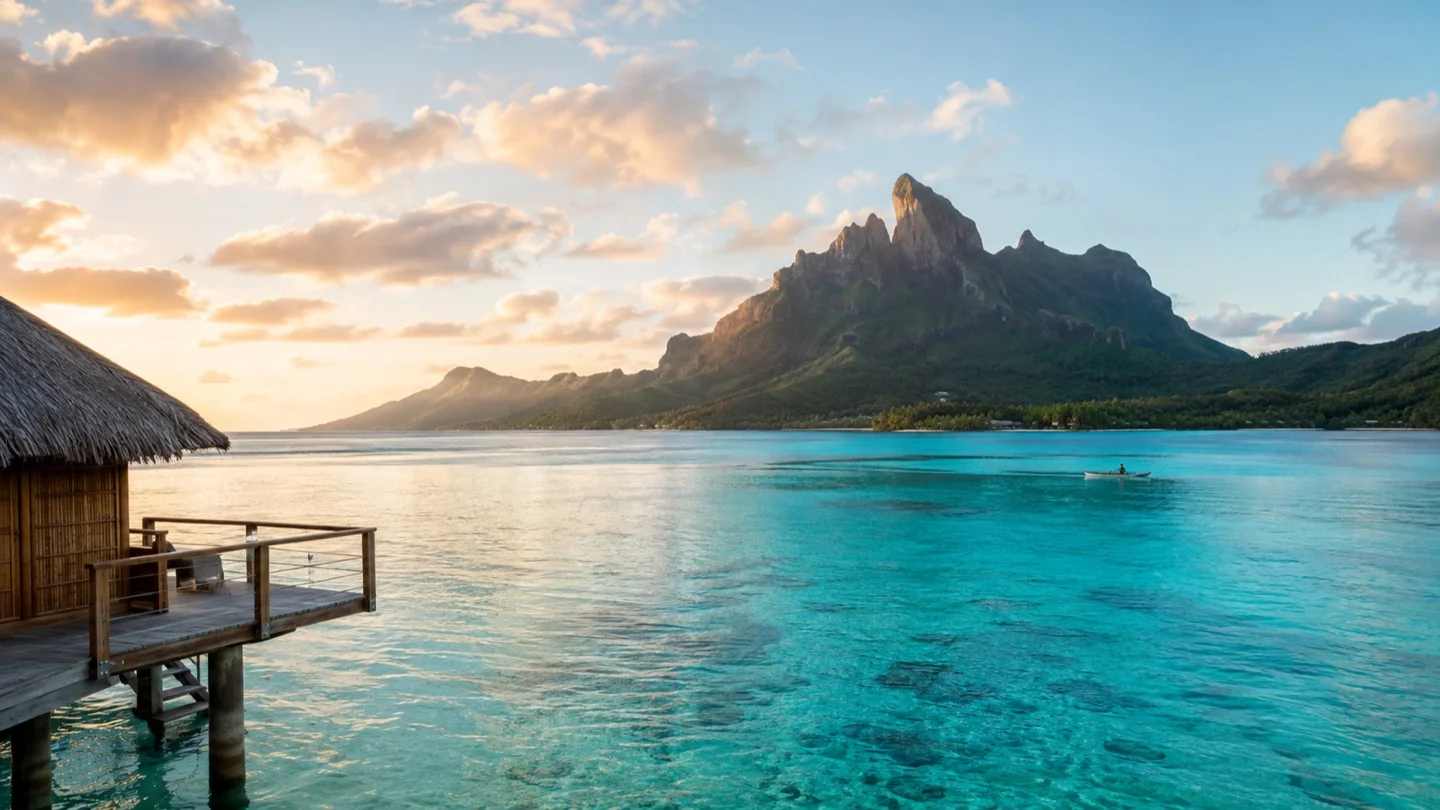

Bora Bora
Bora Bora Is a Lagoon With an Island in the Middle
Bora Bora is smaller than its reputation and simpler than most people expect. One volcanic peak, one enormous lagoon, and a ring of low coral islets called motu where nearly every resort sits. The resorts are on the ring, the town and the local life are on the main island in the middle, and the water between them is the reason anyone comes. That geography settles almost every question worth asking, including which resort, which side of the lagoon, whether your villa faces Mount Otemanu or the sunset, and how much boat time your week involves. Nobody arrives here by accident either. Every trip runs through Tahiti and then a domestic flight, and the airport itself sits on its own islet.
Know before you go
- Fly into Papeete on Tahiti, code PPT, the only international gateway to French Polynesia, then connect on a domestic flight to Bora Bora, code BOB. There is no international service into Bora Bora itself.
- The last leg is by boat, because Bora Bora's airport occupies Motu Mute, a separate islet out on the reef, so every arrival crosses the lagoon by water. Resorts on the motu collect their guests directly, and the main island is reached by a public shuttle boat.
- Entry for Americans United States passport holders need no visa for tourism stays of no more than ninety days in any six months. French Polynesia is a French overseas collectivity with its own arrangements, so do not assume a rule you read about mainland France applies here.
- Passport rule six months of validity is required, with at least one blank page for the stamp, and a return or onward ticket must be shown. The twelve page emergency United States passport is not accepted for visa free entry.
- Trip length four or five nights is right for Bora Bora on its own. Ten nights here is too many, and the fix is to add Moorea for mountains and easy family days, or Taha'a for vanilla and near silence.
- Best months April to October is the austral winter and the dry season, with steady trade winds, lower humidity and the clearest water of the year. November to March is the warm, wet half and also the South Pacific cyclone season, which is why the rates soften across it.
- The quiet window late October into early December is the value stretch worth knowing about. The lagoon settles, the peak honeymoon traffic has gone and the wet season has not properly arrived.
- Money and rates the currency is the CFP franc, code XPF, issued for French Polynesia, New Caledonia and Wallis and Futuna, and fixed against the euro rather than floating, so the dollar rate moves only as the euro moves. Cards work at the resorts and cash is useful on the main island.
- Book far ahead because the premium overwater categories at the best resorts go the better part of a year ahead for the June to September peak. If a wedding date is fixed, start the villa search the same month you set it.
- The nightly tax every property here collects a stay tax per guest per night on behalf of the commune, added to the folio at the end rather than folded into the rate you booked. On a week in an overwater villa it is a rounding error, but it surprises people who paid in full in advance and expected nothing further.
- What the lagoon asks the water is the activity here, from snorkeling the coral gardens to a full day boat circuit with a picnic on a motu. If nobody in the party swims, this is the wrong island.
Motu or main island, and what each actually gives you
Nearly every serious resort sits on the outer ring rather than on Bora Bora itself, and that is a real decision rather than a detail. A motu resort gives you the classic view back across the lagoon to Mount Otemanu, shallow clear water directly under the villa, and a private beach that stays yours. It also means every trip to a restaurant, a shop or the town runs on a resort boat that keeps its own schedule. Staying on the main island at Matira or above Vaitape gives you a pharmacy, a supermarket, local restaurants at local prices and a car to drive the ring road, at the cost of the postcard view, because from the main island you are looking out at the ring rather than in at the mountain. Most people want the motu. The ones who should think again are travelers who dislike being on somebody else's timetable.
The villa row matters more than the resort name
Within a single resort the difference between one overwater row and another is larger than the difference between two resorts. Water depth changes what you see when you look down from the deck, and the villas closest to shore often sit over sand rather than coral. Orientation decides whether you get the mountain at breakfast or the sun going down at the end of the day, and you rarely get both. Position along the pontoon decides how far you walk to dinner and how much boat traffic passes your steps. The resorts on the sunset side of the island trade the classic Otemanu view for the better evening, and some travelers prefer that once they understand it is a trade rather than a compromise. None of this shows up in a booking engine, which is exactly why it is worth a conversation.
Bora Bora on its own is not quite a holiday
The lagoon is the whole show and it is a magnificent one, but four or five days of it is the natural length. The strongest French Polynesian trips pair Bora Bora with a second island and let each do what it is good at. Moorea, close to Tahiti, has jagged mountains, hiking, a real local population and prices that are not resort prices, and it is the better island with children. Taha'a, which shares a lagoon with Raiatea, is vanilla farms and almost complete quiet. Tahiti itself holds the black sand, the surf coast and the only city in the territory, and an overnight in Papeete is sometimes forced by the flight schedule anyway. The second island costs one more domestic flight and buys a trip with texture rather than a week of one view.
Planning brief
One decision made four times over, across island, motu, villa row and transfer. They are worth comparing together rather than one at a time.
- Best suited to: honeymoons; anniversaries; overwater stays; snorkeling and lagoon days; private boat charters; couples ahead of families.
- Decisions to settle early: motu or main island; Otemanu view or the sunset side; villa row and water depth; whether a second island joins the trip; the season.
- Arrival and routing: Papeete as the only international gateway; a domestic flight onward; the airport on its own islet with a boat to the resort; a Papeete overnight where the schedule forces one.
Which Way Does the Deck Face?
On an island this small the differences between one villa and the next are small, which is exactly why they decide the week. The occasion, the dates, and whether the deck matters more than the water, are enough to settle the resort, the specific row along the pontoon, and a connection that puts you on the lagoon in daylight rather than at midnight.
Read our Four Seasons Bora Bora review for what the overwater bungalows are really like.
The resort, the villa category, the domestic connection and the lagoon transfers are all handled by our leisure travel planning team. For a South Pacific trip built around choosing between island groups rather than a single lagoon, compare Fiji.
From the journal
More on Bora Bora: Four Seasons Bora Bora Guide: Villas, Dining and Island Setting and Honeymoon Travel Planning: A Practical Couples Guide.
Is a private boat day worth it on top of the resort excursions?
It is the one thing here worth paying for beyond the room. The resort lagoon tours are competent and they run to a fixed circuit with other guests, arriving at the coral gardens and the sandbar at the same hour as every other boat on the water. A private skipper for a day goes at your hour, moves when the light or the wind changes, stops where nobody else is, and cooks lunch on a motu instead of delivering you back for the buffet. On a four night stay give one whole day to it and keep the rest for the deck. If snorkeling is the point of the holiday, make it two.
Overwater bungalow or beach villa?
Overwater for at least part of the stay, because it is why people come here and it does not translate from photographs. What matters more than the category name is the row. Water depth changes what you see from the deck, the villas nearest the shore often sit over sand rather than coral, and orientation decides whether you get Mount Otemanu at breakfast or the sunset in the evening. A common and sensible pattern is a few nights in a beach villa with a plunge pool followed by a few overwater, which costs less than the full run and gives you both halves of the island.
Do I have to overnight in Papeete on the way?
Sometimes, and it depends entirely on when your international flight lands and when the domestic connection leaves. Many long haul services arrive at night and the domestic flights to Bora Bora do not run around the clock, so a night on Tahiti is occasionally unavoidable. Treat it as an opportunity rather than a loss, because Tahiti has black sand beaches, a serious surf coast and the only real city in the territory, and a night there before the lagoon is a gentler start than arriving in the dark. If the schedule does not require it, skip it.
Is Bora Bora better than the Maldives?
They are different trips, and the honest split is scenery against water. Bora Bora has a mountain in the middle of its lagoon, which gives every villa a view with a shape to it, and the sense of a real place with a town and a population behind the resorts. The Maldives has better house reefs on average, better diving and a far wider choice of islands and price points. If the picture in your head is a peak rising behind the water, only French Polynesia does that. If it is a reef you can swim to from your own steps, the odds favor the other one.
When is the best time to visit Bora Bora?
April to October is the austral winter and the dry season. It brings steady trade winds, lower humidity and the clearest water of the year. November to March is the warm, wet half and also cyclone season, which is why rates soften. Read our Four Seasons Bora Bora guide or add Tahiti.
CONTINUE EXPLORING