

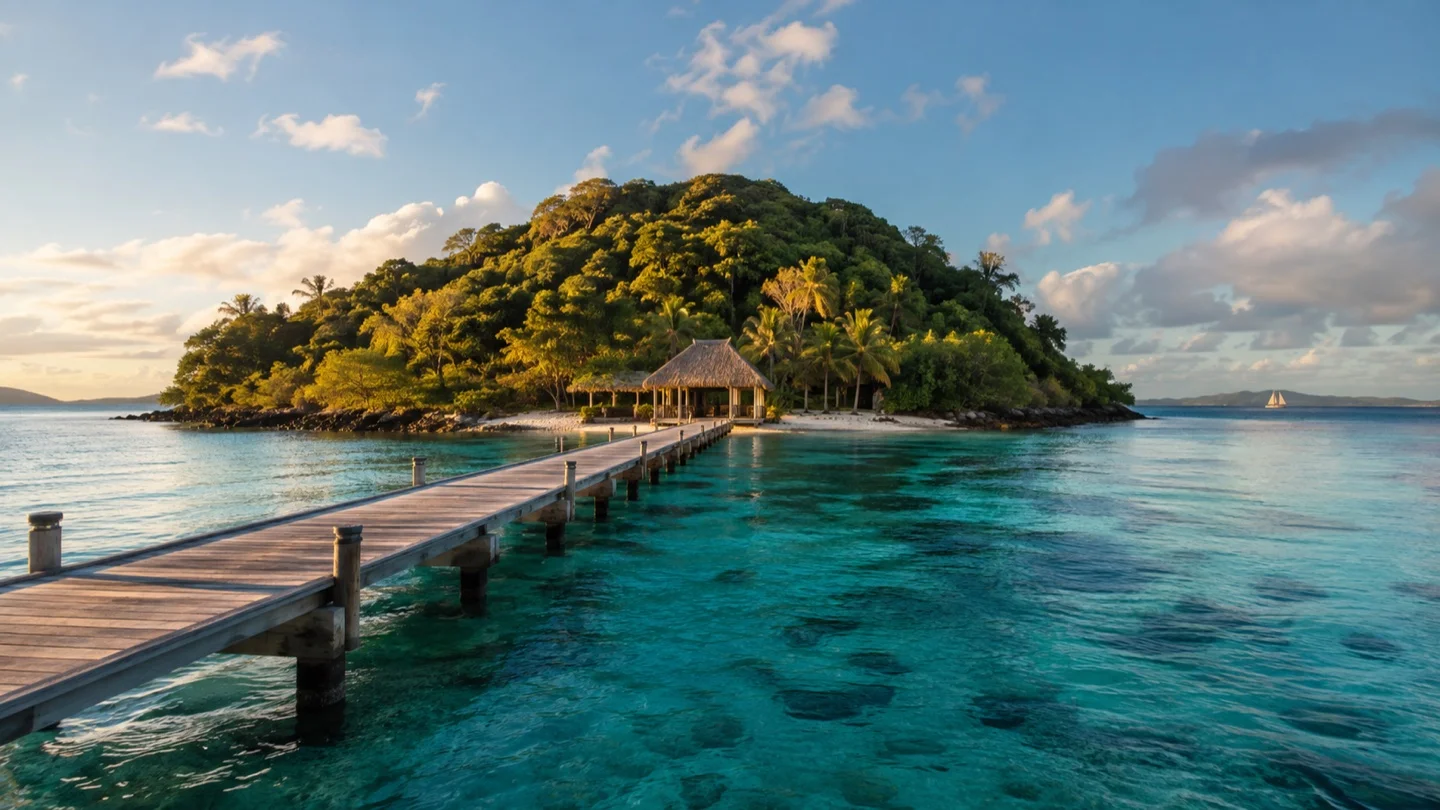

Fiji
Nadi Is Where You Land, Not Where You Stay
Fiji is more than three hundred islands, and the decision that shapes a trip here is not the resort but the island group. Choose the wrong one and a day of the holiday goes to transit. The Mamanucas and Yasawas lie just off the western coast of the main island and are reached quickly. The northern islands around Vanua Levu and Taveuni are where the diving turns serious, and getting to them is a proper journey with another connection inside it. Everyone lands at Nadi, and almost nobody should stay there beyond a night forced by a flight time. Nadi is a gateway rather than a destination. The trip starts when you leave it.
Know before you go
- Fly into Nadi, code NAN, on the dry western side of Viti Levu, where every international arrival and every onward connection begins. Suva, the capital on the wet eastern side, has a second airport that matters mainly for domestic routes.
- Entry for Americans United States passport holders need no visa for a tourist stay of less than four months. A passport valid for at least six months beyond your departure from Fiji is required, along with proof of an onward or return ticket and of funds for the stay.
- Vaccination requirements none, since no vaccinations are required for entry to Fiji, and there is no yellow fever certificate to organize unless your own routing has taken you through a country that triggers one.
- Choose the group first the Mamanucas sit closest to Nadi and are the quickest transfer of all, the Yasawas run north from them in a long chain, and the northern islands and Kadavu are a separate journey altogether. Pick the group, then the resort.
- Trip length five to seven nights for one island group. Adding a second group properly needs ten nights or more, because the crossing between them is a travel day rather than a transfer.
- Best months May to October is the dry season, with trade winds, lower humidity and the clearest water. November to April is the warm, wet half of the year, greener and cheaper, and it is the South Pacific cyclone season, which is precisely why the calendar prices the way it does.
- The school holiday trap late June and July overlap the winter school holidays across Australia and New Zealand, and the multi bedroom family villas on the private islands commit a long way ahead for those weeks. Exact dates vary by state and by year.
- Money and cards the Fiji dollar, code FJD. Resorts take cards, but the small islands run on very little infrastructure and cash is genuinely useful once you leave Viti Levu.
- Transfers are the itinerary islands are reached by seaplane, helicopter, domestic flight or boat depending on the resort, and the mode is set by the island rather than by your preference. Confirm it at the moment you confirm the resort, not afterwards.
- Arrival timing matters seaplane and helicopter transfers do not fly after dark, so a late landing at Nadi can turn into a night on the mainland whether you planned one or not. Check the last transfer of the day against your inbound flight before you book either.
- What to bring reef shoes, a rash guard and more sun protection than you think you need, because the resorts are small and the shop is a shelf.
The Mamanucas and Yasawas are the easy answer, and usually the right one
These two chains run west and then north from Nadi, and between them they hold most of the resorts worth crossing the Pacific for. The Mamanucas are closest, which makes them the choice when the arrival is late, when children are traveling, or when the trip is short and every hour counts. The Yasawas are wilder, drier and more dramatic, a long chain of steep volcanic islands with fewer resorts spread along them and better beaches at the northern end. Both can be reached within a morning of landing, and both let you add a second island without losing a day to it. The trade is that they are also the busiest part of the country. If solitude is the point, that argues for the far north, and the far north argues for a longer trip.
Go north only if you are going for the water
Vanua Levu, Taveuni and the Somosomo Strait between them hold the soft coral diving that Fiji is genuinely famous for, and the manta season in the strait falls in the same dry months as the best weather. This is a different trip from a Mamanuca beach week. The islands are bigger and greener, there are far fewer resorts, and reaching them takes a domestic flight and then a transfer rather than a boat ride out of Nadi. Kadavu to the south is quieter still and harder again to reach. None of that is a reason to avoid the north. It is a reason to give the trip enough nights that the journey earns itself, and to be honest about whether you are coming to dive or coming to lie down.
The welcome is what people actually remember
Every island nation claims warmth and most of those claims are marketing. Fiji's holds up, and it is why the country keeps a repeat clientele that more fashionable destinations do not. By the second morning the staff know the children's names and which chair you took, and none of it reads as rehearsed. There is a practical consequence worth planning around, which is that the small resorts do this far better than the large ones, and a twenty room island will look after a family in a way that a large mainland property cannot. A kava ceremony in a village, and a Sunday church service with the singing that goes with it, are both easy to arrange from most islands and are worth more than another day on a boat.
Planning brief
Pick the island group, and the resort shortlist writes itself. The transfer belongs inside that first decision rather than after it.
- Best suited to: private island stays; families; honeymoons; diving and snorkeling; travelers who want a real cultural connection; a civilized pause on a long Pacific routing.
- Decisions to settle early: Mamanucas, Yasawas or the north; air or boat transfer; reef against beach; the family villa configuration; dry season or wet.
- Arrival and routing: Nadi as the gateway; the inbound arrival time checked against the last daylight transfer; one island group or two; a Nadi night taken by design rather than by accident.
The Group, Then the Island, Then the Boat
Ages, swimmers or divers, one island or two, and whether the point of the week is the reef or the hammock. Those four answers give us the group first, the resort second, and a transfer timed against a flight that actually puts you on the sand in daylight.
Our leisure travel planning matches the island group, the resort and the crossing to the reason for the trip. For a different South Pacific shape, built around a single lagoon rather than an archipelago, compare Bora Bora.
Which Fiji island group should I choose for a first trip?
The Mamanucas or the Yasawas, almost always. Both lie off the western coast within easy reach of Nadi, both hold the best concentration of resorts in the country, and both let you be on the sand within a morning of landing. The Mamanucas are closest and the surest choice with children or a late arrival. The Yasawas are drier, steeper and more dramatic, with better beaches further north. Save Vanua Levu, Taveuni and Kadavu for a second trip, or for a stay long enough to justify the extra journey, because reaching them takes a domestic flight and then another transfer.
Is an overwater bure worth the premium here?
Less often than people assume, and Fiji is the place to say so. There are relatively few of them, they sit on lagoons that are rarely as clear as the marketing implies, and you are paying a large premium for a ladder into water you could walk into from a beach thirty meters away. What this country does better than almost anywhere is the beachfront bure: more space, direct sand, shade from real trees and a good deal more privacy. Take the overwater room for two or three nights of a honeymoon if the idea matters to you, and put the rest of the budget into the beach villa and a private boat day.
Is Fiji good for families?
It is among the best in the Pacific, and the reason is the staffing rather than the facilities. Small island resorts here look after children in a way that reads as genuine rather than programmed, and by the second morning the staff know their names. Look for a resort with multi bedroom villas rather than connecting rooms, and choose the Mamanucas so that the transfer is short and the arrival is not a battle. The one thing to book far ahead is late June and July, when Australian and New Zealand school holidays take the family villas first.
Should I plan a night in Nadi?
Only if the flight schedule forces it, and then plan it deliberately rather than finding out at the airport. Seaplane and helicopter transfers do not operate after dark, so an evening arrival can leave you on the mainland whether you intended it or not. Check the last transfer of the day against your inbound flight before booking either one. If a night is needed, take it on the coast north of Nadi rather than in the town itself, and treat the following morning's transfer as the real start of the trip.
When is the best time to visit Fiji?
May to October is the dry season, with trade winds, lower humidity and the clearest water. November to April is warm and wet, greener and cheaper, and it is the South Pacific cyclone season. Late June and July overlap Australian and New Zealand school holidays, so family villas commit early. Compare Bora Bora or plan a honeymoon here.
CONTINUE EXPLORING