


Tanzania: Serengeti & Beyond
The Serengeti Has Twelve Chapters and Most People Book the Wrong One
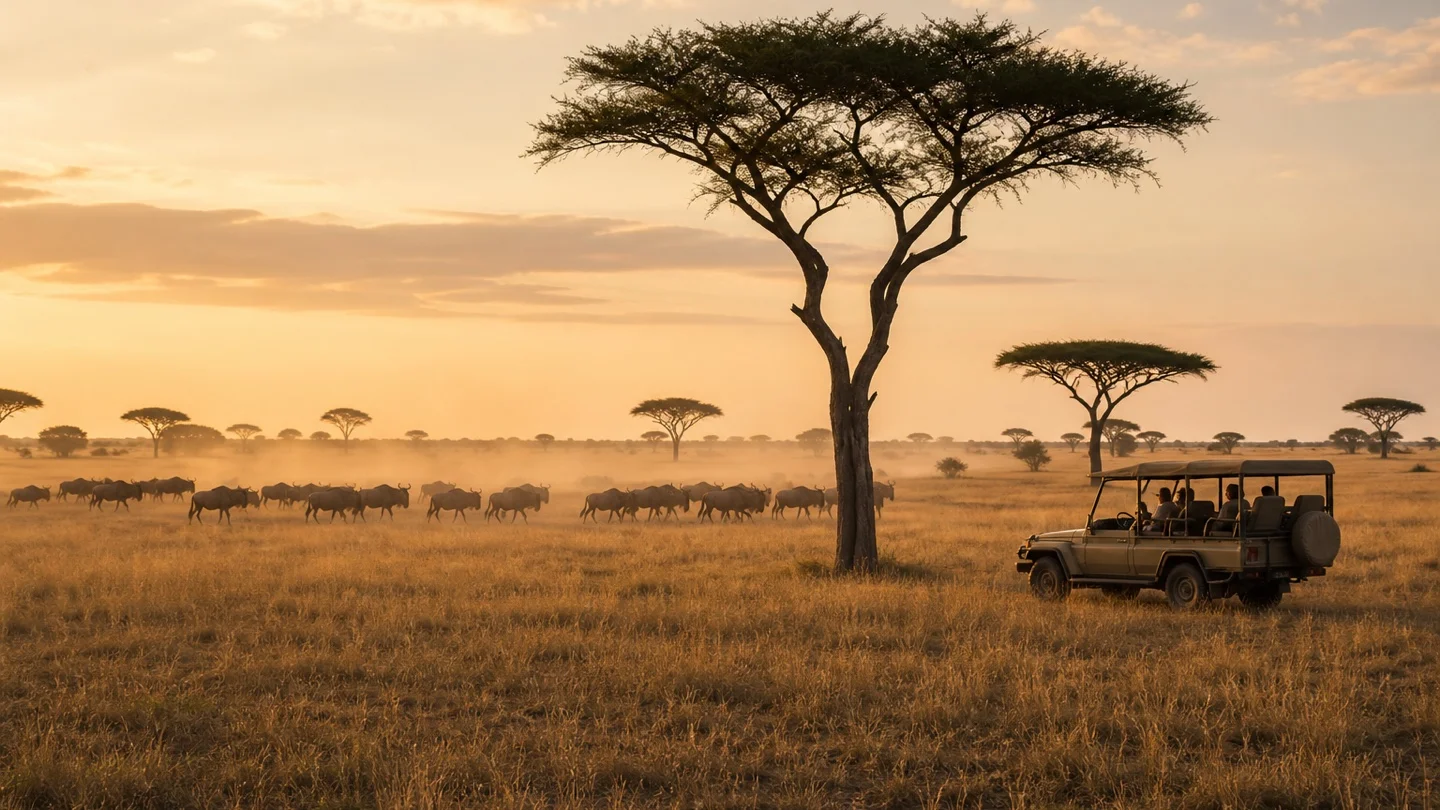
Everyone arrives wanting the same six weeks. Two million wildebeest and several hundred thousand zebra move through the Serengeti ecosystem in a continuous loop, and the loop pays no attention to school holidays or to the photograph that made you want to come. Plan around where the herds will be in the month you can travel and the country opens up: quieter camps, better rates, sightings you are not sharing with a line of vehicles. Plan around a crossing you cannot schedule and you have built a trip on a lottery ticket. Tanzania rewards whoever books a chapter rather than a brochure.
Know before you go
- Fly into Kilimanjaro, code JRO, for the northern circuit and Arusha, or Julius Nyerere in Dar es Salaam, code DAR, for the southern parks and the coast. Past either, everything is light aircraft onto bush strips.
- Trip length seven to nine nights. Below six the flying outweighs the finding, and Tanzania punishes a rushed itinerary more than Kenya does because the distances inside the Serengeti are genuinely large.
- The scale of it Serengeti National Park covers 1,476,300 hectares and was inscribed as a World Heritage site in 1981. UNESCO puts the herds at around two million wildebeest, 300,000 zebra and 900,000 Thomson's gazelle. Not a park you sample in two nights.
- Book the chapter the migration is a year round loop, not a season. February on the southern short grass plains for calving. June and July for the Grumeti and Western Corridor. August into October for the far north and the Mara River. March into May brings the long rains, lower rates and some closures.
- Calving in February several hundred thousand wildebeest are born on the southern plains inside a few weeks, with every predator in the ecosystem in attendance. Arguably the best wildlife viewing of the cycle, and the chapter almost nobody books, because the photographs everyone has seen were taken at a river far north.
- Crossings are not bookable the Mara River crossings happen when rain and grazing say so. Herds gather on a bank, wait hours or days, then go or turn back. Four nights within reach of the river inside the season buys good odds and nothing more. Anyone promising a crossing is selling something.
- Ngorongoro crater inscribed in 1979, covering 809,440 hectares, holding what UNESCO calls the largest unbroken caldera in the world with some 25,000 large animals on the floor. Descend at first light and give it one night on the rim rather than three.
- Entry paperwork United States passport holders need a visa. Apply for the eVisa online before you travel rather than relying on arrival, though the US State Department lists a visa on arrival as available. Passport valid six months beyond arrival, a blank page per stamp.
- Yellow fever trap Tanzania requires a certificate from anyone arriving from a country where yellow fever is endemic, which catches travelers landing at Kilimanjaro after a week in Kenya or Uganda. Sort it at home and the question disappears.
- Money and notes park fees, permits and tips run on US dollars; the shilling covers anything you buy yourself. Bring recent, clean, unmarked bills in a mix of denominations, because older and worn US notes are routinely refused. Cards work at camps and almost nowhere between them.
- Baggage and fees light aircraft run a soft bag allowance including hand luggage, in the region of fifteen kilograms, and bags are weighed. Hard cases are refused. Conservation fees are per person and there is a vehicle charge for each crater descent, so ask whether your quote includes them.
February in the south is the chapter nobody books
From December into March the herds mass on the short grass plains of the southern Serengeti and around Ndutu, on volcanic soil that grows grass rich enough to raise a calf. Calving concentrates into a few weeks around February, when several hundred thousand wildebeest are born in the open, and every lion, cheetah, hyena and wild dog for a hundred kilometers works the edges of it.
The result is the highest density of predator activity in the cycle, on open plains with clean sightlines and superb light, when the northern camps are quiet and rates are lower than August. Photographers who have done both usually rate calving above the crossings. It is the strongest single argument in East African safari planning and it goes largely unmade, because the images that sell Tanzania were taken at a river in a different quarter of the year.
The north from August, and what four nights near the river actually buys
From roughly August into October the herds are in the far north around Kogatende and the Mara River, and that is where the crossings happen. Real theater, and worth building a trip around provided you understand what you are buying.
You are buying proximity and time. A camp genuinely within reach of the river, not merely inside the northern Serengeti, and four nights rather than two, so the herds have room to decide. Even then, some parties see three crossings in four days and some see none and spend the week watching lion. Both trips are excellent. Only one matches the brochure, and the difference is weather, not planning.
The north is also a long way from Arusha. Fly it. Driving the Serengeti end to end is a full day of corrugated road for people who came to look at animals.
Beyond the herds, and where you actually sleep
Ngorongoro deserves a dawn descent and one night on the rim. Tarangire is the elephant park, best from July into October when the river pulls herds in from a wide area. South and west, Tanzania empties out. Ruaha and Nyerere give you large lion prides, wild dog and almost no other vehicles, and Mahale is chimpanzees on a forested mountain above Lake Tanganyika, reached by boat. None of these are add ons. Each needs three nights and its own flight.
On camps, the ones that move with the herds are the scarcest beds in the country and often the better experience, because they relocate several times a year and are therefore in the right place in February and again in September. Permanent lodges give comfort, a pool and a fixed address, which suits families and the crater rim. Balloon flights sell out early in peak months, so reserve them when the camps are confirmed.
Planning brief
Planned from the calendar backwards. The month decides the region, the region decides the camp, the camp decides little.
- Best suited to: travelers with fixed dates who want the best chapter available in them; photographers, especially in February; second safaris looking at the southern parks; anyone who wants scale over convenience.
- Decisions to settle early: which migration chapter the trip is for; northern circuit or southern parks; mobile camp or permanent lodge; nights near the Mara River; a coastal ending; the yellow fever certificate if Kenya or Uganda comes first.
- Arrival and routing: Kilimanjaro, code JRO, for the north, or Dar es Salaam, code DAR, for the south and coast; light aircraft between strips; Zanzibar or Mafia at the end rather than the beginning.
The herds are somewhere in every month
Almost every good Tanzanian itinerary starts with a date rather than a destination. Give us the weeks you can travel and whether the trip is about the migration, about being alone, or about chimpanzees, and back comes the region that is working then and the camps worth their rate.
Our East Africa guide places the Serengeti beside the Mara and the gorillas, and our luxury leisure travel planning holds the camps, bush flights, guiding and coastal ending as one trip.
Our East Africa safari guide explains how the Serengeti fits alongside the rest of the region.
For the Serengeti, Ngorongoro and a Zanzibar finish built as a single itinerary rather than booked in pieces, see our Safari & Zanzibar route.
Is a mobile camp or a permanent lodge the better booking?
A mobile camp, if the migration is the reason for the trip. These camps move with the herds several times a year, which means they are on the southern plains in February and in the north in September, so you wake up where the animals are rather than driving two hours to reach them. The tents are comfortable rather than luxurious, and the trade is bucket showers and no pool. Permanent lodges give you plumbing, a swimming pool and a fixed address, which matters on the Ngorongoro rim, with children, or at the end of a long trip. Most good itineraries use one of each.
Is the Serengeti better than the Masai Mara?
They are the same ecosystem divided by a border, so the wildlife argument is close to a draw. The practical differences are real. The Serengeti is far larger, less developed and holds herds for most of the year rather than a few months, which makes it the better answer if your dates are fixed outside July to October. Kenya is easier to reach, cheaper to move around and has the private conservancies, which permit night drives and walking that Tanzanian national parks do not. For a first safari with flexible dates, Kenya. For scale, quiet and February calving, Tanzania.
Are the balloon flights worth what they cost?
Once, and take the first flight of the season you can. A balloon lifts at first light, drifts low over the plains at the hour when the light is at its best and lands to a breakfast in the grass, and the point is not the game viewing, which is better from a vehicle, but the scale of the country seen from a few hundred feet. It is expensive and it is over in about an hour. Book it when the camps are confirmed rather than on arrival, because the peak months sell out early, and take it in the middle of the stay so weather leaves you a second chance.
Is Ngorongoro Crater worth it, or is it too busy?
Worth it once, done early, and given one night rather than three. The Conservation Area was inscribed by UNESCO in 1979 and the caldera floor holds some 25,000 large animals resident all year, including black rhino, which are hard to find elsewhere on the northern circuit. The vehicle traffic is genuine and it builds through the morning as day trippers arrive from Arusha, so the whole game is to descend at first light and be finished before the crowd forms. Sleep on the rim the night before, take breakfast in the vehicle, and treat it as one outstanding morning rather than a destination.
When is the best time to visit the Serengeti?
The migration is a year round loop, so pick the chapter that fits your month. February brings calving on the southern plains. June and July cover the Grumeti and Western Corridor, and August into October the far north and the Mara River. March into May brings the long rains and lower rates. Plan seven to nine nights and read our East Africa safari guide.
CONTINUE EXPLORING