

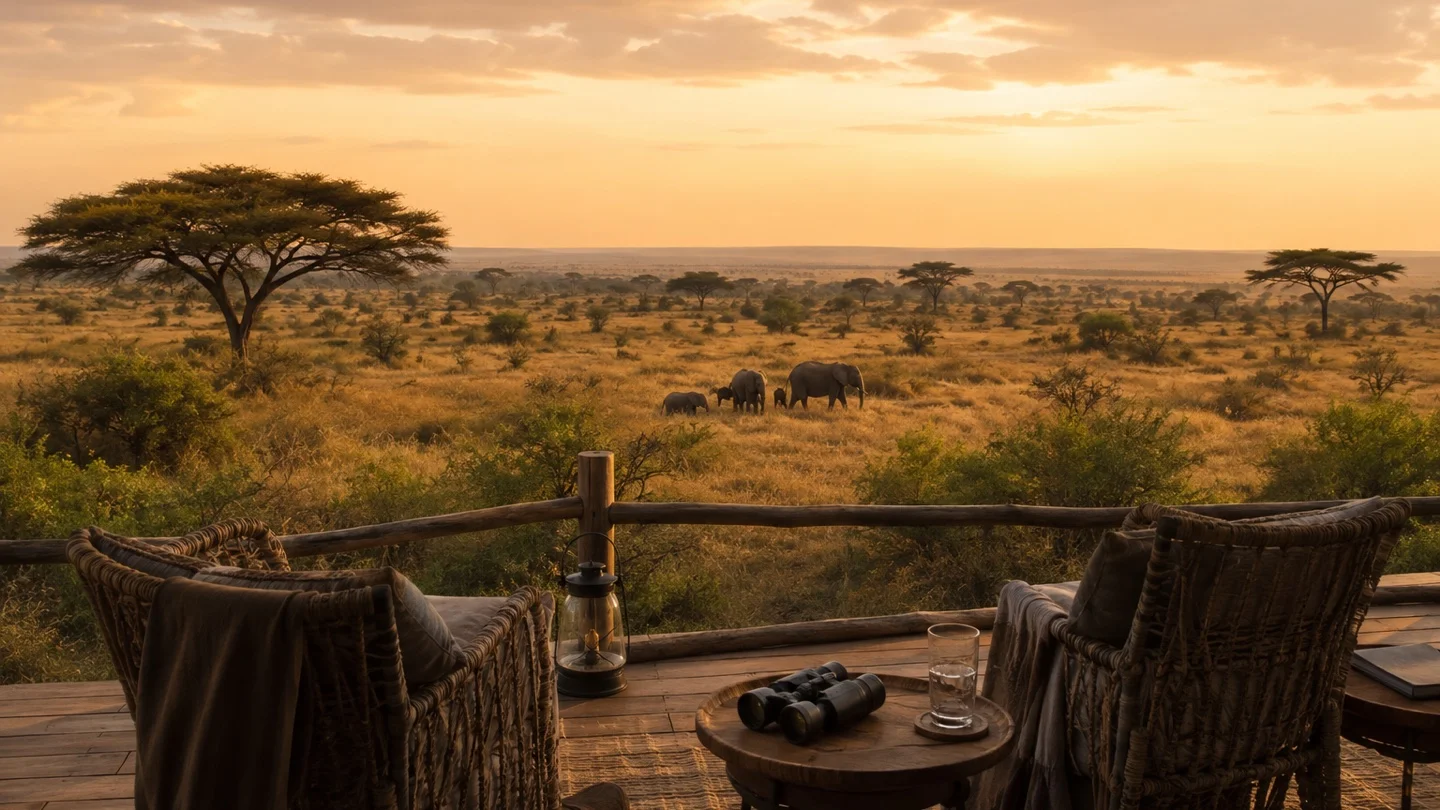

East Africa
East Africa Is Four Trips Sharing A Border
Kenya's Masai Mara and the private conservancies around it. Tanzania's Serengeti and the Ngorongoro crater to the south. Rwanda and Uganda, where the mountain gorillas live. The Indian Ocean coast for the barefoot ending. These are not variations on one holiday, they are four different journeys that happen to sit next to each other, and the distances between them are short by air and punishing by road.
Which is why sequencing does almost all the work here. The same fourteen nights can produce a pleasant trip or the one your family measures everything else against, and the difference is rarely the camps. It is the order, the month, and how many times you get on a light aircraft. We would rather give you three places properly than five in passing, because every move costs a morning and a bag weight limit.
Know before you go
- Fly into there is no single gateway, and this is the first real decision. Nairobi for Kenya, Kilimanjaro for northern Tanzania, Kigali for Rwanda, Entebbe for Uganda. Nairobi is the hub for most combinations, and the bush flights leave from Wilson Airport across the city rather than the international terminal, so allow properly for that transfer.
- Trip length ten to fourteen nights. Ten covers the Mara, a conservancy and Rwanda without rushing. Under eight nights, do one country.
- Best months July through October for the river crossings and the driest ground, January and February for warm quiet days and excellent light, March through May for the long rains when rates fall and some camps close. November's short rains usually pass through in an afternoon.
- Currency the US dollar is the working currency for park fees, permits, tips and most extras, and it is worth carrying more small bills than feels sensible. Kenya uses the shilling at roughly 129 to the dollar for anything you buy yourself. Tanzania will refuse US notes printed before 2009. Cards work at the camps and almost nowhere else.
- Entry Kenya requires an eTA at 30 dollars, Tanzania an eVisa at 50 dollars and 100 for US passport holders, Uganda an eVisa at 50, and Rwanda 50 for a single entry with visa on arrival available. The East Africa Tourist Visa at 100 dollars covers Kenya, Uganda and Rwanda on one multiple entry document. It does not cover Tanzania.
- Health a yellow fever certificate is mandatory for Uganda and is required if you enter Tanzania having been in Kenya, which catches a lot of people on combined itineraries. Malaria prophylaxis is needed throughout except at altitude in Rwanda. Start both conversations with a travel clinic at least six weeks out.
- Baggage bush flights typically allow fifteen kilograms in a soft bag with no frame, and that figure includes your hand luggage. This is enforced. Camps do laundry daily, which is how it works.
- Park fees, which have moved the Masai Mara reserve now charges 200 dollars per adult per day in peak season, on a twelve hour ticket running six in the morning to six in the evening, so a dawn drive and an evening drive can bill as two days. Serengeti and Ngorongoro run about 82 dollars per person per twenty four hours including VAT, with a separate 295 dollar vehicle charge for each descent into the crater. Private conservancies fold their fees into the nightly rate instead.
- Time zone UTC plus three, which is seven hours ahead of New York in summer and eight in winter.
- Power Kenya, Tanzania and Uganda use 240 volts with the British three pin plug, type G. Rwanda uses 230 volts with the European two pin, types C and J. Camps run on solar and generators, so charging is slower than at home and hairdryers are often not permitted.
The planning decision: which countries, and in what order
Read these as different holidays rather than adjacent map squares. Choosing two properly beats sampling four.
Kenya's Mara and the conservancies
The Masai Mara national reserve is where the river crossings happen and where every photograph you have seen was taken. It is also busy, and now expensive by the day. The more interesting answer for most travelers is the ring of private conservancies bordering it, Olare Motorogi, Naboisho, Mara North and others, which hold resident lions, leopards and cheetah all year, limit the number of vehicles at a sighting, and allow night drives and walking that the reserve does not. Fees are built into the nightly rate. For a first safari or a photographer, this is usually the right base.
Tanzania's Serengeti and the crater
Bigger, emptier and less developed than the Mara, with the herds present for most of the year rather than three months of it. The southern Serengeti in February is the calving season, which means several hundred thousand newborn wildebeest and the most concentrated predator activity of the year, and it is the great underrated window. Ngorongoro crater is extraordinary and heavily managed, a caldera floor you descend into for a few hours with a great many other vehicles. Worth doing once, and worth doing first thing.
Rwanda and Uganda for the gorillas
An hour with a mountain gorilla family changes how people talk about travel, and it is worth reorganizing a trip around. Rwanda is the efficient choice, with Volcanoes National Park under three hours by road from Kigali, so you can land and be trekking the following morning. Uganda's Bwindi costs less, feels wilder and takes considerably longer to reach. Neither is a casual add on. The trek itself can be two hours of steep, wet, high altitude walking before you see anything.
The Indian Ocean coast
Zanzibar, Lamu, the Kenyan coast at Watamu, or across to Mozambique. This is the decompression leg and it exists because a safari is not restful. You are up at half past five every day, in a vehicle, being magnificently overstimulated. Three or four nights of flat warm water afterwards is not indulgence, it is what makes the trip feel long. Note that Zanzibar requires its own mandatory travel insurance, a little over 40 dollars per adult, bought through the government portal before arrival.
The migration is a circuit, not an event
This is the single most useful thing to understand before you plan. The wildebeest never stop moving. Roughly one and a half million of them travel a continuous loop through the Serengeti and Mara ecosystem all year, and the famous Mara river crossings are one moment on that loop, broadly July to October. They cannot be scheduled. The herds arrive at a bank, mill about for hours or days, and go when they go.
So we build in enough nights for the crossings to come to you rather than chasing them, and we are honest that some trips see three and some see none. The more important point is that the ecosystem is superb outside those months. February calving in the southern Serengeti is arguably better wildlife viewing than a crossing, and the Mara conservancies hold big cats every month of the year. If your dates are fixed, we design around what will actually be happening then rather than selling you the brochure month.
A twelve day route that works
Twelve nights, three regions, one country border, and the order doing the work. This is the version we build most often for a first trip that wants both the plains and the gorillas.
- Day 1. Arrive Nairobi. Overnight in the city, because the bush flights go in the morning and nobody should connect straight onto one after a long haul.
- Day 2. Morning flight from Wilson into the Mara conservancies. In camp for lunch, out on a game drive by four.
- Days 3 to 5. Three full days in the conservancy. Night drives, a walking morning, and the flexibility to sit with a leopard for an hour because there are only two other vehicles in the whole area.
- Day 6. Into the reserve itself for the day, timed against the crossing points if the herds are in, then back to camp.
- Day 7. Fly back to Nairobi and on to Kigali. A travel day, and we keep it that way.
- Day 8. Drive to Volcanoes National Park through the terraced hills, which is one of the most beautiful road journeys in Africa. Afternoon at the lodge, early night.
- Day 9. Gorilla trek. Briefing at seven, on the mountain by half past eight, one hour with the family, back by mid afternoon. Nothing else scheduled.
- Day 10. A second trek for anyone who wants it, or golden monkeys and the Dian Fossey memorial hike for anyone who does not.
- Days 11 and 12. Kigali, which deserves an afternoon and the Genocide Memorial, then home. Or fly to the coast and add four nights of flat water before you do.
Shorten it by dropping Rwanda and giving the days to the conservancy. Lengthen it with the coast, or with the southern Serengeti in February. What we do not do is add a fourth region, because each one costs a full travel day and a bag weight limit.
Gorillas, and what the permits actually cost
Rwanda charges 1,500 dollars per person per trek in Volcanoes National Park. Uganda charges 800 dollars in Bwindi, dropping to 600 in April, May and November, with a longer four hour habituation experience at 1,500. Only eight visitors are allowed with each gorilla family per day, which is what makes the hour feel like a private audience and also what makes good dates disappear months ahead.
Two practical notes. The permit is separate from the lodge and separate from the transfer, so the headline number is not the cost of the day. And permits are allocated to specific families and specific dates, so they are booked before anything else in the itinerary and everything else is arranged around them, not the other way round.
Stay strategy
A camp positioned on the right side of the river for the month you are there matters more than the thread count. In the Mara, Angama Mara sits high on the Oloololo escarpment with the whole reserve laid out below it, and it is the strongest choice for families and first safaris. Mara Plains in Olare Motorogi is the photographer's answer, small and serious, with the vehicle limits that matter. Bateleur Camp holds the classic tented safari style at the foot of the escarpment.
In Tanzania, the Singita properties in Grumeti and the mobile camps that follow the herds south are two very different approaches, and the mobile camps are the better value and the more authentic experience. In Rwanda, Singita Kwitonda and One and Only Gorilla's Nest both border the park itself, which means the trek morning starts gently rather than in the dark. Camp inventory across the region is tiny, six to twelve tents at the good ones, which is the whole reason peak dates go a year ahead.
When to begin
Twelve months for July through October in the Mara, and for the named tents at the small conservancy camps, which repeat guests hold year to year. Gorilla permits at the same time or earlier, because they are the fixed point everything else bends around. Nine months for February calving. Four to six months in the green season. Giraffe Manor in Nairobi, if it is on the list, books roughly a year out for the breakfast.
Six experiences worth building the days around
- An hour with a mountain gorilla family, which is the single most affecting wildlife encounter available anywhere.
- A walking safari in a conservancy with an armed Maasai guide, on foot at the level of the animals rather than above them in a vehicle.
- The southern Serengeti in February during calving, with predators working the herds in every direction.
- A night drive in a private conservancy, which the national reserves do not permit, for the genets, aardvark and hunting cats.
- Breakfast cooked in the bush at a river bend after a dawn drive, which sounds like a set piece and is not.
- A hot air balloon over the Mara at first light, then landing for champagne on the plain, which is expensive and worth it once.
Who this trip suits
First safaris, returning travelers who want conservancies rather than reserves, families with children old enough for long vehicle days, photographers, and anyone who has been putting off the gorillas. It combines naturally with the coast, and for a longer route with Tanzania or a few nights in Cape Town on the way home.
When another plan may fit better
If you have a week or less, this is not the trip, because two days of it are flying. If anyone in the party cannot manage a steep two hour walk at altitude, the gorillas are the wrong centerpiece and the plains alone are a better itinerary. If the priority is big game with short travel and no light aircraft, Botswana and Victoria Falls do that more easily. And if you want a rest, put the coast at the end, because the safari itself is not one.
Planning brief
East Africa is four separate journeys sharing a border, and the order you put them in does more work than the choice of camp. Settle the sequence and the month first, and the rest follows.
- Best suited to: first safaris; returning travelers who want conservancies rather than reserves; families with children old enough for long vehicle days; photographers; anyone who has been putting off the gorillas
- Decisions to settle early: gorilla permits, which are held before anything else in the itinerary; reserve or private conservancy in the Mara; how many regions the nights will honestly carry; whether the coast goes at the end; the fifteen kilogram soft bag limit on bush flights
- Arrival and routing: Nairobi for most combinations, with the bush flights leaving from Wilson rather than the international terminal; Kilimanjaro for northern Tanzania, Kigali for Rwanda, Entebbe for Uganda; ten to fourteen nights and three regions at most; a night in Nairobi before the first light aircraft
The Month Decides More Than the Budget Does
Gorilla trekking runs through Rwanda and Uganda, with Kigali the usual starting point. Our East Africa safari guide covers when to go and how to choose between Kenya and Tanzania.
So start there. Tell us when you can travel, who is coming, and the one thing that would make the trip: crossings, gorillas, calving, or simply unhurried time somewhere extraordinary. Those four answers produce four quite different itineraries. We come back with the right region for your dates, the camps that are actually good rather than the ones that market well, the permits and bush flights held, and the drive times stated honestly. Our luxury leisure travel planning coordinates the flights, camps, permits, guides and coastal extension as one trip, including multi family safaris and private camp buyouts.
From the journal
More on East Africa: East Africa Safari Guide: Best Time to Visit, Where to Go & What to Expect.
Is a private vehicle and guide worth paying for?
In a private conservancy, often not. The camps there already cap the number of vehicles at a sighting and put four or six guests in a car built for nine, so you are largely buying what you have. In the national reserve it changes the day completely, because a shared vehicle moves to the group's timetable and a private one lets you sit with a leopard for an hour, leave before dawn and eat when you feel like it. Photographers should take it everywhere without discussion, since the seat you need is the one nobody else wants. Families of four or more usually find they have filled a vehicle anyway, which is the same thing at no extra cost.
What is the difference between the Mara reserve and the conservancies, and does it matter?
It matters a great deal. The national reserve is public, anyone can drive in, vehicles cluster at sightings and entry now costs 200 dollars per adult per day in peak season on a twelve hour ticket. The private conservancies that ring it are leased from Maasai landowners, cap the number of beds and vehicles, include the fees in your nightly rate, and permit night drives and walking safaris that the reserve does not. You see the same animals with a fraction of the company. Most experienced travelers now base in a conservancy and visit the reserve for a day when the herds are in.
Can you actually plan to see a river crossing?
You can plan to be in the right place at the right time, and that is all. The crossings happen broadly July through October, but the herds arrive at a bank and then wait, sometimes for days, and go without warning. Nobody can schedule one. What we do is build in enough nights in the right camps so the odds are genuinely good, and be clear that some trips see three crossings and some see none. Anyone promising you a crossing is selling something.
How much does gorilla trekking cost and is it worth it?
Rwanda charges 1,500 dollars per person per trek at Volcanoes National Park. Uganda charges 800 at Bwindi, dropping to 600 in April, May and November. That is the permit only, separate from the lodge and the transfer. Only eight people are allowed with each gorilla family per day. As for worth it, this is the one thing on which almost every traveler we have sent agrees, including the skeptical ones. The hour does not feel like wildlife viewing. It feels like being allowed somewhere.
When is the best time to go on safari in East Africa?
July through October brings the river crossings and the driest ground. January and February give warm, quiet days and excellent light. March through May is the long rains, when rates fall and some camps close. November's short rains usually pass in an afternoon. Read our East Africa safari guide or see the Masai Mara.
CONTINUE EXPLORING