

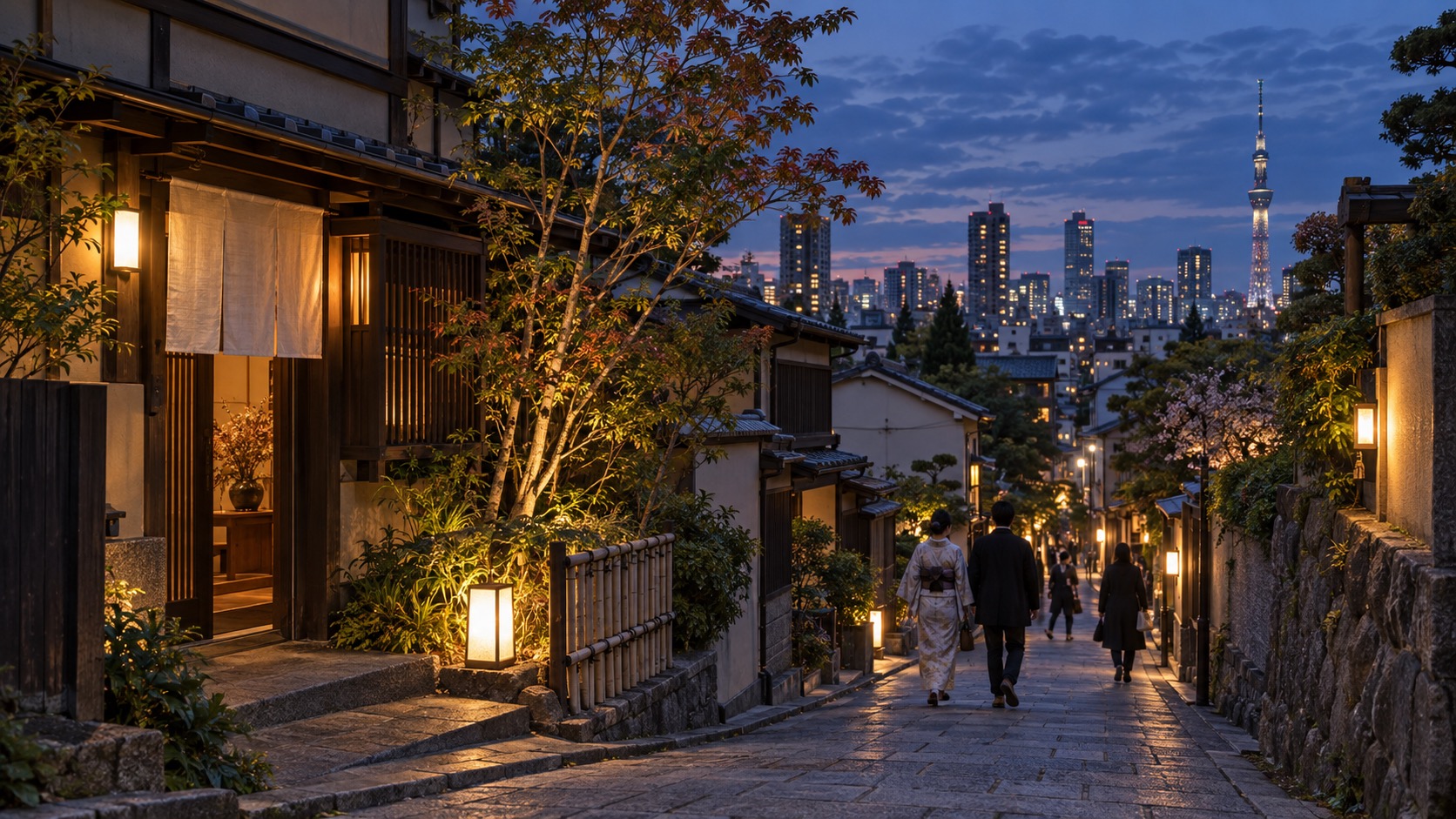

Tokyo
Tokyo, A City That Rewards a Point of View
Tokyo is too large to approach as a list of sights. It is a city of distinct neighbourhoods, excellent small restaurants, serious design, old temples, and an almost absurd ability to make ordinary things feel considered.
Four nights gives a first visit enough shape. Longer is better if food, shopping, art, or the quieter western neighbourhoods matter. The best Tokyo itinerary chooses a few areas and lets them breathe.
Know before you go
- Fly into: Haneda is the most convenient airport for central Tokyo. Narita works well for some international schedules but requires more time into the city.
- Trip length: Four to six nights for a first visit. Add two or three nights for day trips, a serious food calendar, or a slower family itinerary.
- Best months: March to May and October to November are the easiest windows. Cherry blossom weeks and autumn colour bring heavier demand. Summer is hot and humid.
- Getting around: Trains and the metro are the backbone. Use taxis when the group is tired, the route is short, or the evening deserves a clean finish.
- Money: Japan uses the yen. Cards are common in hotels and better restaurants, while smaller bars, taxis, and local shops may still prefer cash.
- What to reserve: The hotel district, hard-to-book restaurants, a private guide for the first day, and any museum or exhibition with timed entry.
Choose the neighbourhood before the hotel
Where you sleep changes the feel of the trip. Ginza is polished and useful for central access. Aoyama and Omotesando bring architecture, galleries, and shopping. Shibuya is energetic and well connected. Asakusa and Ueno give you older Tokyo and easier access to the east. There is no universally correct answer, which is why a hotel list without a daily shape is not much help.
Build the first day around the city’s scale
Tokyo is forgiving after a long flight if the first day stays close to one district. Walk, eat, sit somewhere quiet, and let the city’s rhythm arrive before you attempt a cross-town grand tour. A private guide is most useful here, especially when the group wants context without losing the pleasure of wandering.
Food is the itinerary
The strongest meals may be a counter with eight seats, a neighbourhood soba shop, or a restaurant hidden above a station arcade. Reserve the few places that truly matter, then leave gaps. Tokyo is better when one meal is planned and the next is found. A good food guide can also explain the etiquette and ordering logic without turning dinner into a lesson.
Give the quieter Tokyo a day
Yanaka, Kiyosumi-Shirakawa, Kagurazaka, and the gardens around the Imperial Palace show another city. They are good choices when the group has had enough of crossings and crowds. For a wider Japan route, pair Tokyo with Kyoto and Osaka, or use Hakone for a short change of pace.
Planning brief
Tokyo suits travellers who want food, design, shopping, art, and the pleasure of a city that keeps revealing another layer.
- Best suited to: food travellers, design lovers, couples, families, first visits to Japan, and repeat visitors who want a more local rhythm.
- Settle early: hotel district, restaurant priorities, guide support, airport transfer, and whether the trip continues west by rail.
- Useful pairing: Kyoto, Osaka, Hakone, Kanazawa, or a longer route through the Japanese Alps.
Plan the shape, then leave room
Tokyo works when the trip has a point of view but does not try to control every hour. Tell us what you want to eat, see, buy, and understand, and we will give the city a route that holds together.
Our luxury leisure travel planning can arrange the right hotel, private guides, hard-to-find tables, rail tickets, and the rest of Japan.
How many nights do you need in Tokyo?
Four nights is the honest minimum for a first visit, and five or six is better if food, shopping, and quieter neighbourhoods matter. Tokyo is so large that fewer nights usually means spending the trip in transit between a list of famous places.
Where should we stay in Tokyo?
Ginza is polished and central, Aoyama is strong for design and galleries, Shibuya suits travellers who want energy, and Asakusa or Ueno give the trip an older eastern edge. Choose the district around the days you want, not around a hotel ranking.
Do we need a private guide?
One well planned day with a private guide is valuable, particularly at the start. It helps with scale, food etiquette, neighbourhood context, and the practical details that are hard to learn while moving through a crowded city.
Should Tokyo be combined with Kyoto?
Usually, yes. The contrast is part of the reason to do both. Tokyo gives you contemporary Japan, while Kyoto gives you temples, gardens, craft, and a slower visual language. Four nights in Tokyo followed by three or four in Kyoto is a strong first shape.
CONTINUE EXPLORING