


Kyoto
Kyoto Is A Calendar, Not A Checklist
There are roughly two thousand temples and shrines in this city and seventeen component properties inside its UNESCO listing. You could spend two weeks ticking them off and come home having seen very little, because Kyoto does not reward coverage. It rewards timing. The same temple that feels like a railway concourse at eleven in the morning is close to silent at seven, and the two weeks everyone wants, blossom and foliage, are short, movable and contested a year ahead.
So the planning here is temporal rather than geographic. The city is small and you can cross it in twenty minutes. What you are really choosing is the month, the hour you start each day, and the neighborhood you sleep in so the best hours are walkable rather than a taxi ride away. Get those three right and Kyoto is the finest city in Japan. Get them wrong and it is a queue with a thousand years of history behind it.
Know before you go
- Fly into Kansai International, code KIX. The Haruka limited express reaches Kyoto Station in about eighty minutes. Itami, code ITM, is domestic and closer, roughly fifty five minutes by airport bus. The efficient Japan routing flies into Tokyo and home from Kansai so you never double back.
- Trip length four nights in Kyoto. Three is the floor and it costs you a morning. This is a base, not a day trip from Osaka.
- Best months late March into early April for blossom, mid November into early December for foliage. Both are extraordinary and both are the hardest weeks of the year to book. May, June, early September and January give you the same city at a fraction of the price.
- Currency the Japanese yen, written JPY. It is weak against the dollar, trading around one hundred and sixty to it, so 1,000 yen is a little over six dollars, 10,000 yen is a little over sixty, and a 30,000 yen kaiseki dinner is under two hundred. Cards work almost everywhere now. Keep 20,000 yen in cash for shrine entries, small counters and taxis.
- Entry no visa for US, UK, EU and most other nationalities for stays up to ninety days. Japan has legislated an electronic travel authorization called JESTA, but it is not expected before the 2028 fiscal year, so there is nothing to file today.
- The tax nobody warns you about Kyoto raised its lodging tax in March 2026. A room at 100,000 yen or more a night now carries 10,000 yen per person per night, ten times the old rate. On four nights for two that is 80,000 yen, a little over five hundred dollars, collected at the hotel and not included in the rate you were quoted.
- Getting around taxis and your own feet. The buses are comprehensive and slow, the two subway lines miss most of what you want, and a rental car is a liability. Stay central and budget for taxis.
- Time zone UTC plus nine, which is thirteen hours ahead of New York in summer and fourteen in winter.
- Power 100 volts, flat two pin sockets, types A and B, so American plugs fit and American chargers work.
- The dates to plan around Gion Matsuri, whose great float processions fall on 17 and 24 July, and Golden Week from roughly 29 April to 5 May, when the entire country travels at once.
The planning decision: which neighborhood
Kyoto sits in a basin ringed by hills, and the four areas worth sleeping in are genuinely different trips. This choice matters more than the hotel choice, because it decides what you can reach on foot before the city wakes up.
Higashiyama and Gion
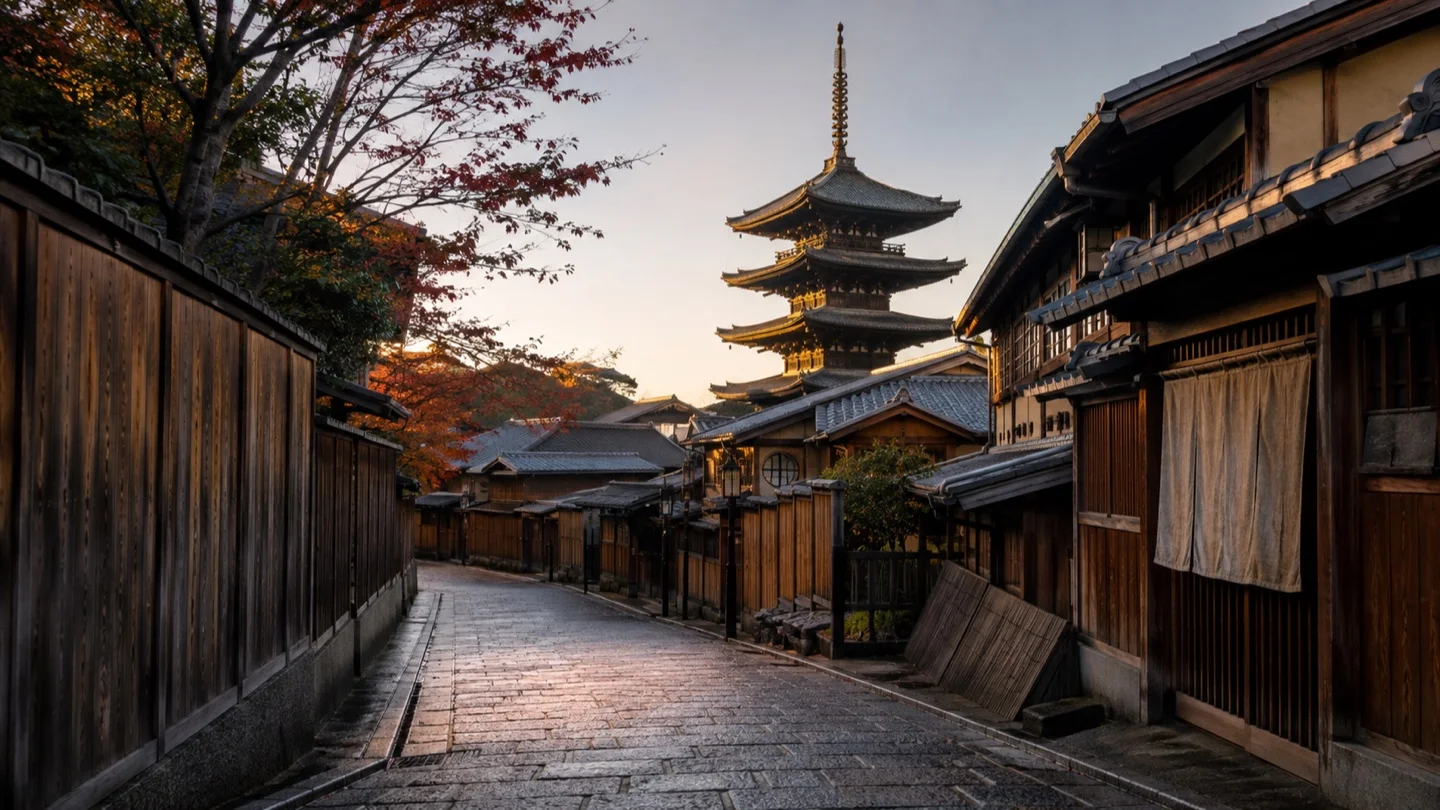
The eastern foothills, and the reason most people come. Kiyomizudera, Kodaiji, Chionin and Nanzenji are strung along a walkable slope, the lanes are stone and timber, and if you are staying here you can be at a temple gate at opening without getting into a car. Gion, at the foot of it, is the machiya district where the geiko and maiko still work. Two things to know. The famous alleys off Hanamikoji are private property and have been closed to visitors since 2024, with a 10,000 yen fine for photography on them, so keep to the public streets. And the area empties completely after about nine in the evening, which is when it is at its best.
Central Kyoto and the Kamogawa
Flat, practical and where the food is. The river runs north to south through the middle of the city with Pontocho on one bank, a lane barely wide enough for two people, lined with counters. This is the right base if dinner is the point of your trip, if you are combining Kyoto with rail travel, or if anyone in the party would rather not walk up a hill twice a day. Less atmospheric by daylight, considerably more convenient.
The northern hills
Twenty minutes up from the center and a different climate. This is where the retreat properties are, in forested grounds with moss and maples and almost no passing traffic. You trade walkability for quiet, so every dinner is a drive. Right for a second visit, a honeymoon, or anyone whose priority is the room rather than the city.
Arashiyama and the west
The bamboo grove, the Hozu river, the monkeys on the hill above it. Spectacular before eight in the morning and unbearable by ten, which makes it a superb place to stay and a frustrating place to visit. A night here at one of the riverside ryokan buys you the grove at dawn with nobody in it.
The blossom and foliage arithmetic
Kyoto's cherry blossom averages first flowering around 28 March and full bloom around 4 April, running three to five days behind Tokyo. But that is a thirty year average, not a forecast. The real dates firm up only a few weeks ahead, and they have moved earlier over the past decade. So the working method is to book the hotel nine to twelve months out for the first week of April, then keep the rest of the trip flexible rather than betting the whole itinerary on one week of trees.
Autumn runs later than most people expect. Foliage peaks from mid November into early December, a window of about three weeks, and now books almost as hard as spring, partly because the dates are more predictable. If you want this city without the contest, May and October give you good weather and open tables, and January is the quiet secret, with frost on the temple gardens and the best availability of the year. July and August are hot and humid, redeemed by Gion Matsuri.
A four day route that works
Four nights, one base in Higashiyama, and early starts doing the work. This is the version we build most often for a first visit.
- Day 1. Arrive from Kansai, settle, and walk the Kamogawa at dusk. Dinner near the hotel. Nothing scheduled, because the jet lag is the real obstacle to the mornings that follow.
- Day 2. Fushimi Inari at first light. The shrine is open around the clock and free, and at six in the morning the vermilion gates are yours. Back for breakfast, then the Higashiyama slope on foot in the afternoon while everyone else is at the famous sites.
- Day 3. Arashiyama before eight for the bamboo and the river, then back into the city for lunch. Afternoon at a craft studio, indigo or ceramics or knives, with someone who works there rather than a demonstration laid on for visitors.
- Day 4. The northern temples, Kinkakuji at opening and the moss and dry gardens after, all of which are quieter than the eastern circuit. Kaiseki in the evening at a counter booked with the room, months ago.
- Day 5. Nara or Uji as a half day if you are staying on, or the train to Tokyo. Uji is the better of the two for anyone who cares about tea.
Add a fifth night and it goes to a ryokan, not another hotel. Add a sixth and it goes to Kanazawa or Naoshima rather than more temples.
Stay strategy
Aman Kyoto sits in a forested garden at the northern edge, and it is the retreat answer rather than the city one. Four Seasons is built around an eight hundred year old pond garden in Higashiyama and is the strongest choice for a first visit or a family. Park Hyatt is folded into the hillside by Kodaiji with the best views in the city. The Ritz Carlton holds the Kamogawa riverbank and is the most convenient of the group. Six Senses opened in 2024 with a wellness led spa, and Capella arrived in Higashiyama in March 2026, a Kengo Kuma building near Kenninji that is already contending for the top tier.
Then the ryokan question. A night at a house like Tawaraya is not accommodation, it is the experience itself, because the room, the bath, the kaiseki dinner and the breakfast are one continuous thing. One night is usually right, with a hotel carrying the rest of the stay. Two nights of tatami and set meal times is more commitment than most people want in the middle of a busy trip.
When to begin
Nine to twelve months for the blossom and foliage weeks, and for a specific room at any of the houses above. Four to six months in the shoulder. The tables need the same lead time as the room. The best kaiseki counters seat eight or ten people and confirm months ahead, and no concierge can conjure them the week you arrive, which is why we book restaurants and rooms in the same conversation rather than treating dinner as something to sort out later.
Six experiences worth building the days around
- Fushimi Inari at six in the morning, before the light and before anybody else, walking far enough up the mountain that the gates thin out.
- A kaiseki dinner at a counter of eight seats, booked with the room, where the chef explains the season on the plate rather than the technique.
- A craft morning with a working artisan, indigo dyeing, ceramics or knife making, in a studio rather than a showroom.
- The Arashiyama bamboo grove at dawn from a room on the river, which is the only way it lives up to the photographs.
- A tea ceremony in Uji, where the tea actually comes from, rather than the abbreviated version offered in the city.
- The Higashiyama lanes after nine at night, lit and empty, which costs nothing and is the thing people remember.
Who this trip suits
First visits to Japan, returning travelers who want depth rather than breadth, food led trips, families with children old enough to walk a slope, and anyone building a rail itinerary through the country. It pairs naturally with Tokyo, two and a quarter hours north by bullet train, and increasingly with Kanazawa, Naoshima or the Kiso valley for a second, quieter leg.
When another plan may fit better
If you want Japan without crowds at any cost, the answer is not a different Kyoto strategy, it is a different city, and Kanazawa, Takayama or the Seto inland sea will give you more of what you are after. If you have fewer than three nights, stay in Tokyo and take the day trip rather than moving hotels for two nights. And if the whole point is the blossom, understand before you book that you are buying a probability rather than a date.
Planning brief
The city is small enough to cross in twenty minutes, so nothing here is decided by distance. It is decided by the month and by the hour you are willing to start.
- Best suited to: first visits to Japan; returning travelers who want depth rather than breadth; food led trips; families with children old enough to walk a slope; anyone building a rail itinerary through the country.
- Decisions to settle early: which neighborhood, since Higashiyama, the river, the northern hills and Arashiyama are four different trips; blossom against foliage, or May, October and January for the same city far cheaper; four nights rather than three; the one ryokan night and where it sits; the lodging tax raised in March 2026.
- Arrival and routing: Kansai International, about eighty minutes to Kyoto Station on the Haruka; into Tokyo and home from Kansai so you never double back; taxis and your own feet, never a rental car; Tokyo two and a quarter hours north by bullet train.
Kyoto Gives Up Its Best Hours Early
Tell us the month, who is traveling and whether this is a first visit to Japan. A blossom trip, an autumn trip and a January trip are three itineraries in the same city, and the neighborhood that suits a honeymoon is not the one that suits a family with teenagers.
What comes back is the base, the mornings mapped against the crowd flow, the ryokan night placed where it belongs and the counters held before you arrive rather than after. Our luxury leisure travel planning brings the rail, the hotels, the guides and the restaurants into one itinerary, and it is also where the Osaka question gets settled properly rather than by default.
Our cherry blossom guide and Kyoto beyond the blossom cover how the city changes with each season.
For a first visit built around Tokyo, Kyoto, Hakone and Osaka as one route rather than four separate bookings, see our 10 Days in Japan itinerary.
From the journal
More on Kyoto: Kyoto Beyond Cherry Blossom Season and Aman Tokyo Guide: Rooms, Dining, Wellness and Location.
Is a ryokan night worth giving up a hotel night for?
Yes, once, and one night is usually the right number. A house of that kind is not accommodation with dinner attached; the room, the bath, the kaiseki and the breakfast are a single continuous thing, and taking only part of it misses the point. What people underestimate is the commitment. Meals arrive at set times, the room is tatami, and there is nowhere to retreat to in the middle of the day. Two nights of that in the middle of a busy trip is more discipline than most travelers want. Put the ryokan late in the stay, when the temple mornings are behind you and slowness reads as a reward rather than a constraint.
Should you stay in Kyoto or day trip from Osaka?
Stay in Kyoto. This is the single most common mistake and it is expensive in the only currency that matters here, which is time. Day tripping from Osaka puts you in the city at ten in the morning and out by six, which is precisely the window when the famous sites are at their worst. The whole strategy in Kyoto is being at a temple gate at opening, and you cannot do that from another city.
How do you actually avoid the crowds at Fushimi Inari and Arashiyama?
Go at dawn and go far. Fushimi Inari has no gate and no ticket and is open around the clock, so at six in the morning the lower gates are empty, and most visitors turn back at the halfway viewpoint, which means the upper mountain is quiet even at midday. Arashiyama's bamboo grove is only worth it before eight, which realistically means sleeping in Arashiyama. The crowds concentrate at about a dozen sites between ten and four, so the rest of the day belongs to anyone willing to start early.
When is cherry blossom in Kyoto and can you book around it?
The thirty year average is first flowering around 28 March and full bloom around 4 April, which puts Kyoto three to five days behind Tokyo. But that is an average, not a forecast, and the actual dates only firm up a few weeks ahead. The practical approach is to book the hotel nine to twelve months out for the first week of April and treat the blossom as a probability rather than a promise. If the trees are the entire reason for the trip, understand that going in.
How many days do you need in Kyoto?
Plan four nights. Three is the floor, and it costs you a morning. Treat Kyoto as a base, not a day trip from Osaka, and sleep in a neighborhood where the best early hours are walkable. Fly into Tokyo and home from Kansai so you never double back. Add Nara or read Kyoto beyond cherry blossom season.
CONTINUE EXPLORING