



Corporate Travel Planner: Role, Services, and Best Practices
Your 7 a.m. flight just got cancelled, the CEO still has a board meeting at 11, and the assistant on the thread is asking for a new itinerary before the taxi reaches the curb. That's the core job of a corporate travel planner, not calendar management, but keeping a trip alive when the day goes sideways. In a market where global business travel spending reached about USD 1.47 trillion in 2024 and is projected to hit USD 1.71 trillion in 2026 with more than 1.84 billion business trips worldwide, even small decisions in policy, vendor choice, and recovery speed carry outsized consequences for a travel program GBTA BTI 2025 Executive Summary.
A strong planner doesn't just book the ticket that looks clean on paper. The role sits inside managed travel, which exists because companies need someone to balance policy, procurement, traveler productivity, and duty of care while keeping executives moving and costs contained. The work is part operator, part negotiator, part crisis manager, and part translator between finance, executive assistants, and the traveler who needs an answer now.
Table of Contents
What a Corporate Travel Planner Really Does
A corporate travel planner owns the trip before, during, and after the booking. On a bad Tuesday, that means the 7 a.m. cancellation isn't treated like a nuisance, it's treated like a meeting risk, a budget risk, and a support issue at the same time. The planner's real value shows up in the first 10 minutes, when someone has to decide whether to rebook, reroute, or escalate.
The job is program ownership, not just booking
The role usually covers travel policy, supplier management, approvals, traveler support, and reporting. It also includes day-of-travel judgment, especially when the traveler is an executive, a board member, or a senior leader who can't spend two hours in a queue or wait for a manager to reply. In practical terms, the planner is responsible for keeping the managed-travel program coherent when the itinerary, the budget, and the calendar all pull in different directions.
That's why the job has grown alongside managed travel programs that centralize booking, policy enforcement, and supplier negotiation. Industry forecasts also show how institutional the function has become, with one estimate placing the business travel market at about USD 1.38 trillion in 2025 and projecting USD 2.77 trillion by 2034, while another places it at USD 1.85 trillion in 2025 and USD 3.26 trillion by 2033 Fortune Business Insights.
Practical rule: If the planner only appears at booking time, the program is probably underbuilt. The real work starts when something changes.
For teams that want a managed, end-to-end service model, a single-vendor travel partner can sit inside the same workflow as policy, executive support, and disruption response. One example is JustKeeps Travel's corporate services, which is relevant because senior-traveler support often lives or dies on response speed and coordination quality.
The planner also sits between people who don't always share the same priorities. Finance wants consistency. The traveler wants flexibility. Security wants visibility. The executive assistant wants a clean handoff. The planner keeps those lanes moving without pretending they're identical.
Core Services Inside the Corporate Travel Planner Role
The best way to understand the role is to look at the outputs. A good planner doesn't just “handle travel,” they produce specific outcomes that reduce friction across the trip lifecycle. When one part is weak, the failure usually shows up somewhere else the same week.
Booking, profiles, and trip construction
The first layer is itinerary construction and reservation management. That means choosing flights, hotels, and ground transport that fit policy while still preserving the meeting objective. It also means maintaining traveler profiles, seat preferences, loyalty numbers, passport details, and emergency contacts so check-in doesn't fail at the worst possible time.
A rebooked connection that still gets the CEO to a board meeting on time is a good deliverable. So is a hotel room that's held with the right cancellation terms when the schedule is still moving.
A traveler profile error is never just an admin error. It becomes a 2 a.m. problem when the front desk can't verify a name, a document, or a preference that should already be in the system.
Support, systems, and reporting
Other services sit behind the scenes but matter just as much. Expense system integration, visa and documentation support, and stakeholder reporting all keep the program usable. That reporting isn't vanity data, it helps leadership see where policy is working, where exceptions are piling up, and where a preferred supplier is failing in practice.
| Service | Typical Deliverable | Program Outcome |
|---|---|---|
| Itinerary construction | Trip built inside policy with viable routing | Fewer misses and cleaner approvals |
| Hotel and ground sourcing | Confirmed lodging and transfers | Lower friction at arrival and departure |
| Profile management | Updated traveler data and document details | Fewer check-in failures and support tickets |
| Disruption response | Rebooking and traveler communication | Faster recovery and less lost time |
| Reporting | Summary of spend, exceptions, and service issues | Better program decisions |
A useful benchmark for hotel planning is lead time. A university study found business travelers' willingness to pay for more lenient cancellation terms stays fairly stable from 60 days out to 7 days out, then drops 3 days before check-in, while industry reporting showed average business-hotel lead time rose to 16.13 days in 2024 and 17.35 days in Q4 2024. That makes advance planning and cancellation windows a practical control point, not a theory exercise University of Delaware study and industry reporting.
Building a Travel Policy That Survives Friction
A travel policy only matters when someone has to use it under pressure. A coordinator making a call at 9 p.m. on a Friday needs rules that are clear enough to apply, but flexible enough to handle the trip that does not fit the script. Good policy sets boundaries, gives room for common exceptions, and stays short enough that executives will read it.
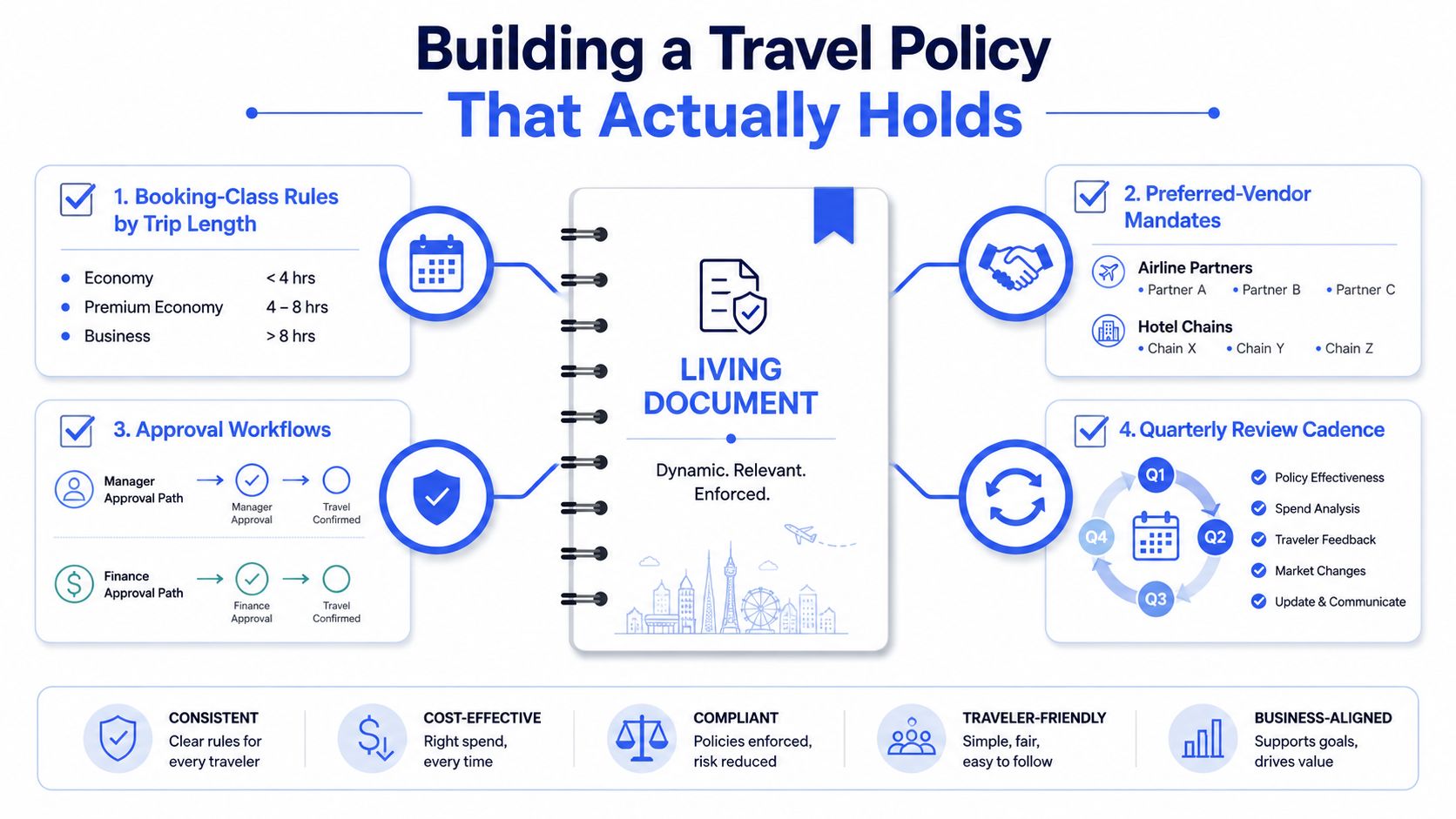
What belongs in the policy
A workable policy usually covers booking-class rules by trip length, preferred-vendor mandates, advance-purchase windows, approval thresholds, expense guidance, and traveler-behavior standards. Those rules do not need to be elaborate, but they do need to be unambiguous. If “economy only” turns into executive exceptions, the policy is no longer a policy, it is a suggestion.
The approval path matters just as much as the rule itself. Pre-trip approval, mid-trip changes, and post-trip exception review should each have a named owner. That keeps the policy usable after tickets are issued and plans start to move.
Where policy fails in practice
Policy fails in three common ways. It can be too rigid, which pushes people to work around it when a route, visa, or medical issue makes compliance impractical. It can be too vague, which gives every requester a different answer. Or it can be so long that the people enforcing it stop reading it.
A useful test is simple. Can a junior coordinator apply the policy without calling the planner? If the answer is no, the policy needs work.
Working rule: Write policy for the person who has to execute it on a busy evening, not for the person who wants to admire it in a meeting.
Approval language should also reflect who the traveler is. An executive trip, a group offsite, and routine staff travel do not belong in the same workflow. Programs get clumsy when they force one rulebook onto trip types that carry different urgency, risk, and tolerance for flexibility.
Duty of Care and Traveler Risk Management
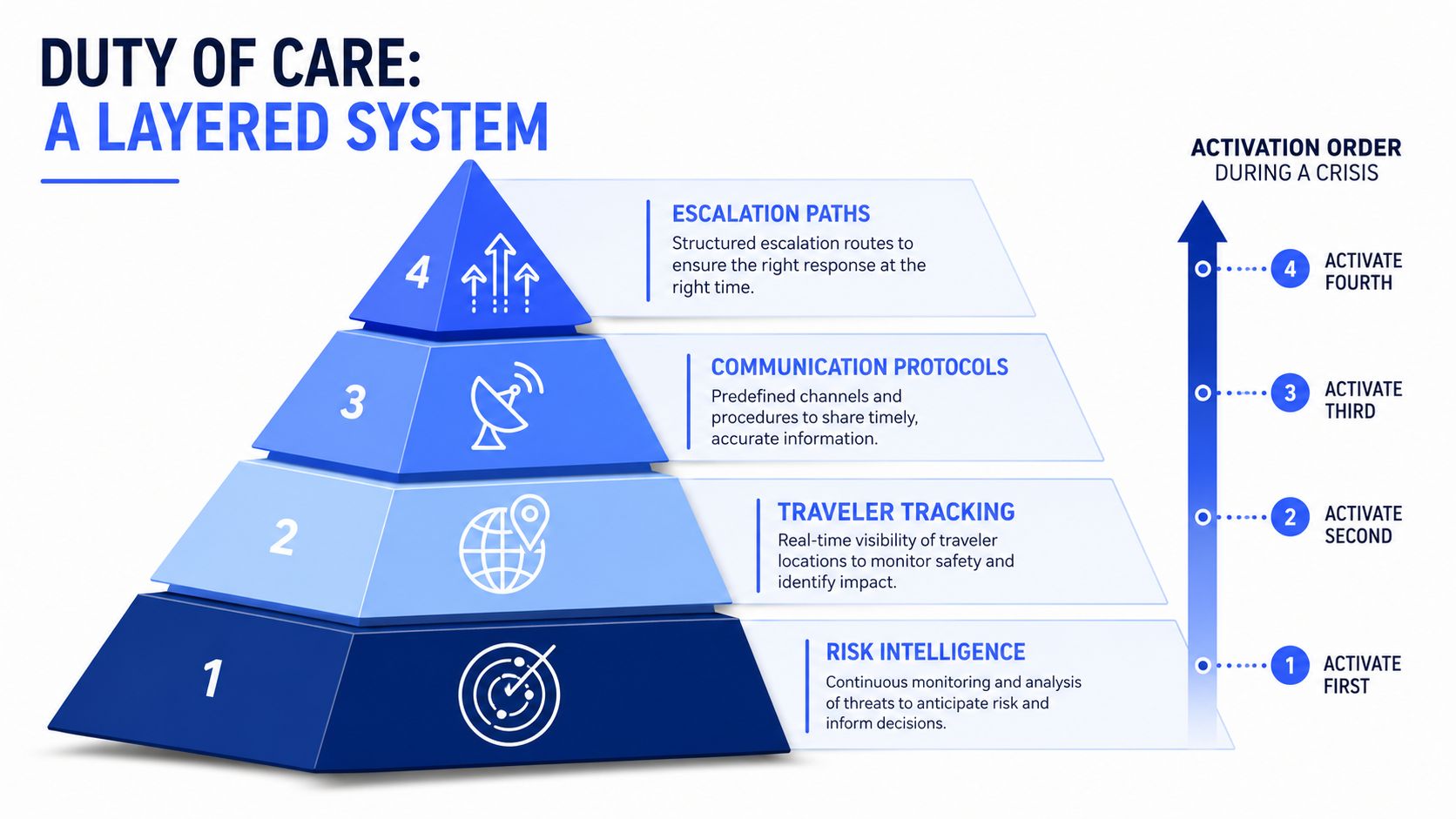
Duty of care is not a checkbox. It's a layered operating system that only proves its worth when a flight cancels, a city shuts down, or a traveler goes unreachable. In a live incident, the sequence matters, because the response is only as strong as the handoff between risk intel, tracking, communication, and escalation.
The layers that have to work together
The first layer is risk intelligence, which means the planner knows where people are going and what's happening there. The second is traveler tracking, so the team can identify who's affected. The third is communication protocols, so alerts reach the traveler quickly and consistently. The fourth is escalation paths, so security, legal, HR, and the travel partner know when to step in.
When a regional weather shutdown hits a hub, the planner should already know who is in the air, who's about to board, and who still has a path home. The right move may be a reroute, a hold, or a same-day hotel reissue, depending on the traveler's risk, the company's response policy, and whether the itinerary can still support the business purpose.
What good incident handling looks like
Good programs keep emergency contacts current, document itineraries, and push pre-trip advisories where needed. They also verify traveler whereabouts after a disruption and keep records that support insurance, liability, and internal follow-up. The travel ops team usually coordinates with HR, security vendors, and the TMC when a traveler can't be reached.
The operational detail matters here. If the app alert goes out but no one confirms receipt, the process isn't done. If security gets involved but the traveler profile is stale, the response slows down. If legal needs a record and the itinerary was never documented cleanly, the program creates its own problem.
For a more service-led version of this handoff, some firms extend concierge support around active itineraries, including executive-facing recovery and coordination. JustKeeps Travel's concierge approach is a relevant example of how support can be organized when the travel pattern is more complex than standard point-to-point booking.
In-House Teams, TMCs, and Boutique Advisors Compared
The right operating model depends on the trip mix. A routine staff program, a high-touch executive portfolio, and a globally distributed leadership team don't all need the same shape of support. What works for one can frustrate the others.
Three models against the same brief
An in-house team excels at policy ownership, data ownership, and internal alignment. It's usually the best fit when the company wants strong control and close coordination with finance or security. The trade-off is coverage, because after-hours support can become thin unless the team is built for it.
A traditional TMC brings scale, booking technology, and negotiated rates. It's strong when the company wants standardized service and centralized reporting. The trade-off is that senior travelers can feel processed, especially when the trip is messy or the request doesn't fit a standard workflow.
A boutique advisor tends to win on discretion, complex routing, and relationship-led service. That matters for executives, assistants, estate managers, and public-facing principals. The limit is enterprise reporting, since that model usually isn't designed to replace a full corporate analytics stack.
| Capability | In-House Team | Traditional TMC | Boutique Advisor |
|---|---|---|---|
| Policy control | Strong | Strong | Variable |
| Reporting | Strong | Strong | Limited |
| After-hours coverage | Depends on staffing | Usually broad | Often high-touch |
| Executive discretion | Medium | Medium | Strong |
| Complex routing | Medium | Medium | Strong |
| Enterprise consistency | Strong | Strong | Variable |
The cleanest programs are often hybrid. A company may keep policy and reporting in-house, use a TMC for scale and booking infrastructure, and reserve boutique support for executive travel or sensitive itineraries. That mix usually beats forcing one model to do every job badly.
Vendor Management and Preferred Partner Programs
Vendor management is where policy turns into real-world advantage. Airlines, hotels, ground transport, and ancillary suppliers all behave differently once an itinerary is disrupted, and a planner who understands those mechanics can recover value that a generic booking flow can't touch.
Why preferred partners matter in practice
Preferred programs help consolidate spend, which can strengthen access to inventory and service recovery when supply gets tight. They also make it easier to secure amenities that matter on business trips, like late checkout, better cancellation terms, or room continuity during a multi-night stay. The planner's job is to know when those benefits are useful and when they're just decoration.
RFP cycles and rate reviews should be tied to actual usage patterns, not tradition. If a hotel chain looks good on paper but fails every time a city is sold out, the relationship needs a hard review. The same applies to carriers, ground partners, and local transfer teams that are supposed to answer quickly but don't.
Clauses and backups that change outcomes
The contract language that matters most is usually the boring part. Cancellation flexibility, rebooking priority, and duty-of-care cooperation matter far more than a glossy rate sheet. Planners also need secondary suppliers for redundancy, plus direct agent contacts that bypass hold queues when time is short.
Supplier relationships are built during calm weeks and cashed in during disruption. If the only time a vendor hears from you is renewal season, the relationship won't save a stranded traveler.
For a perspective on how network effects shape service recovery, preferred partner networks are worth studying as part of the broader vendor strategy. The point isn't to chase perks, it's to make sure the program has options when inventory is scarce or the itinerary can't wait.
Planners also have to know when to break preferred status. If the preferred airline can't get an executive home for an urgent meeting, or if the traveler's risk profile calls for a different route, policy should allow a controlled exception. Rigid loyalty to vendors is expensive when the trip itself is the thing at stake.
Turning Disruption into a Core Operating Skill
Most corporate travel content still treats disruption like an exception. That's a mistake. Disruption is now a normal operating condition, and the planner who handles it well has usually built the habit before the problem starts.
The decision tree that actually works
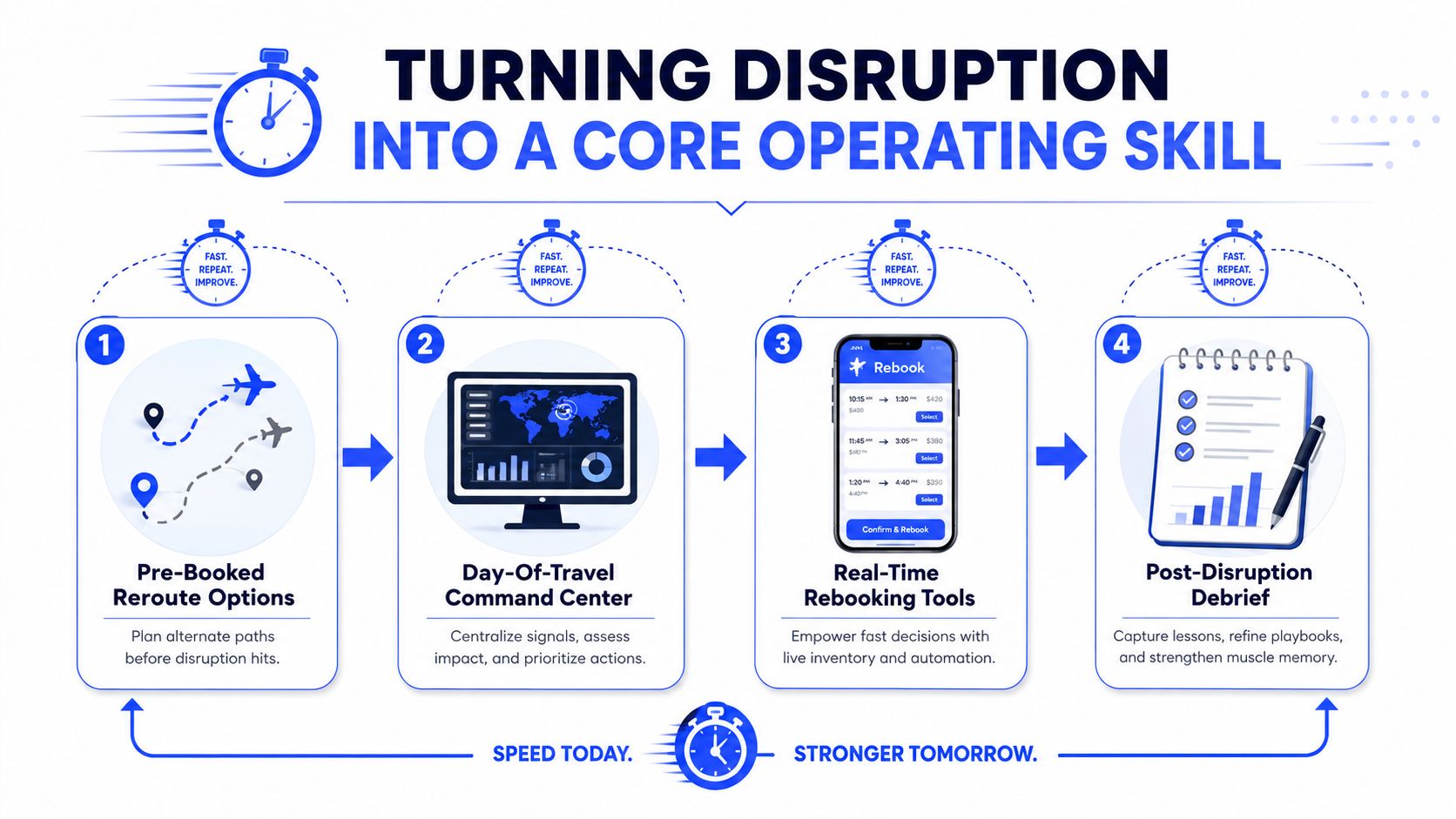
A resilient program should have pre-booked reroute options ready before departure, especially for critical travelers. It should also have fare classes and ticket rules that survive a schedule change without triggering a full reset. If the traveler is already on the move, the response has to happen through templates, tools, and escalation paths that can be used in minutes.
Weather, mechanical issues, political events, and medical triggers don't follow the same route, so the re-routing playbook shouldn't either. Weather may call for holding the traveler and preserving the return leg. Mechanical issues may justify a direct reaccommodation with the same carrier. Political or security events may require a broader duty-of-care response. Medical events need fast coordination with local support and the employee's emergency contacts.
The operating difference is speed. Fragile programs wait for approval while a traveler is stranded. Strong programs pre-authorize spend thresholds and keep 24/7 contacts live so someone can act immediately.
Why disruption readiness is a competitive skill
The numbers make the point. A 2025 analysis estimated U.S. companies spend more than $17 billion annually on fallout from travel disruption, about 4% of the country's total business travel budget. It also found disrupted travelers incurred average add-on costs of $502 for unplanned accommodation, $371 for local transportation, $356 for meals, and $497 for overtime, while 77% of affected travelers had to rebook at an average 27% higher cost Perk disruption analysis.
In a separate survey, 89% of business travelers were affected by disruptions, 56% had delays over an hour, 36% experienced cancellations, and 26% missed connections. Another outlook found 80% of respondents experienced at least one disruption in 2025 and 53% encountered an incident or emergency abroad Perk business travel chaos survey. That doesn't make travel impossible, it just means the planner's advantage comes from preparation, not hope.
Best Practices and the Road Ahead for 2026
The next planning cycle should tighten the basics instead of chasing shiny tools first. Policy, vendor discipline, duty of care, and disruption response all improve when the program is reviewed on a fixed rhythm and judged by how it performs when plans break.
What to do in the next cycle
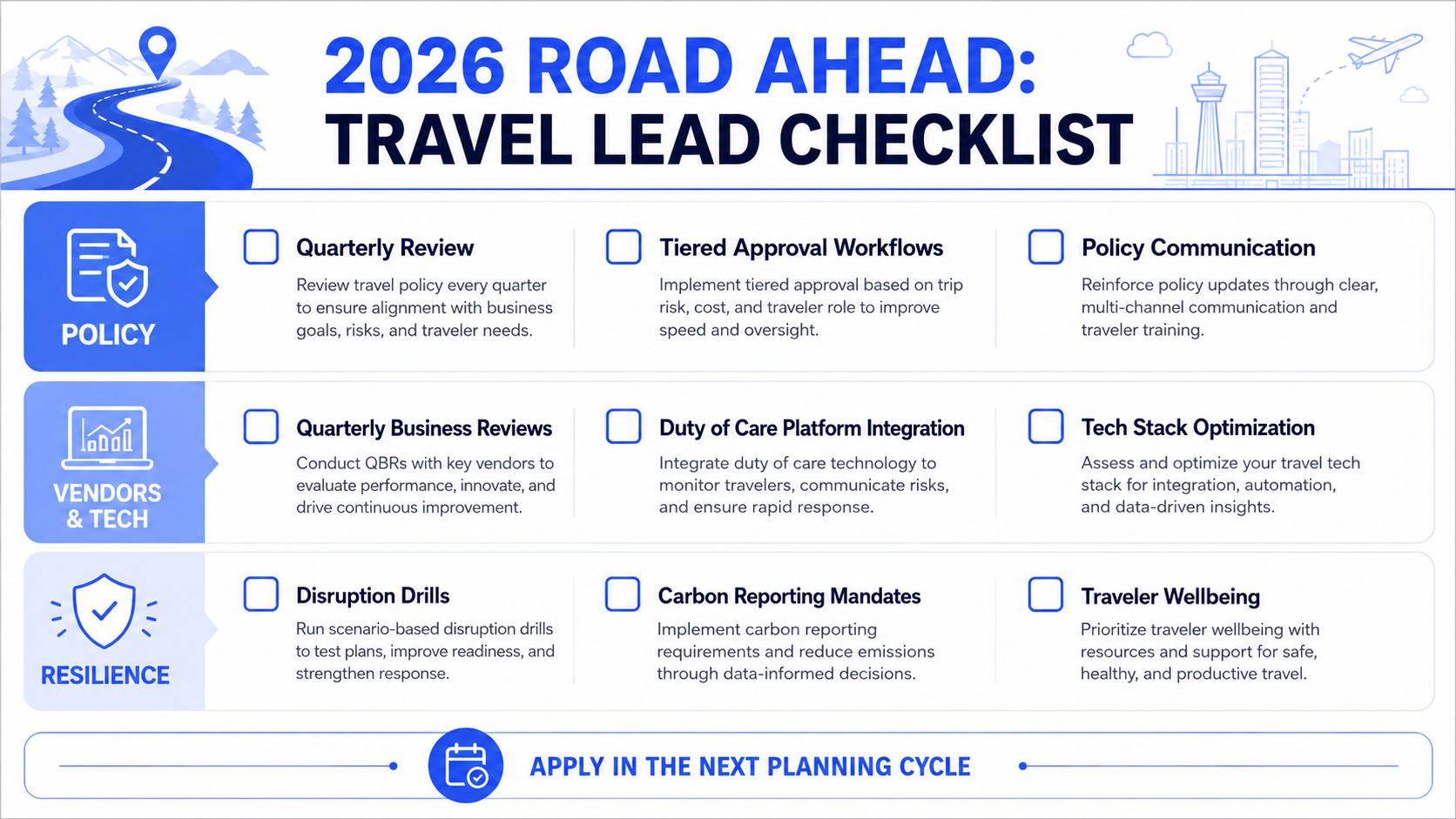
Quarterly policy reviews keep rules aligned with how people travel. Tiered approval workflows help executives move faster without weakening control for everyone else. Negotiated-rate refreshes should happen before suppliers drift out of alignment with the market.
Post-incident debriefs matter too. If the team never documents what broke, the same failure will repeat in the next disruption. A short debrief with travel ops, finance, and the executive assistant usually surfaces more value than a long meeting that produces no action items.
What to watch through 2026
AI-assisted itinerary construction will keep improving the front end of booking and recovery, but it only helps if the underlying policy is clean. Consolidated duty-of-care platforms should reduce the fragmentation that comes from separate risk feeds, tracker tools, and messaging layers. Sustainability reporting will keep pressure on managed programs, so travel leads will need cleaner data and better coordination with finance and operations.
Senior travelers will also push the market toward more experience-based service. That doesn't mean luxury for its own sake. It means the trip has to feel coordinated, discreet, and recoverable when the schedule changes.
If your team needs a travel operation that can handle executive routing, policy discipline, and disruption without turning every change into a scramble, JustKeeps Travel supports corporate and executive travel with end-to-end coordination and 24/7 assistance while travelers are on the road. Visit JustKeeps Travel to see how a managed, high-touch approach can fit into your travel program.