



Destination Wedding Travel Agency: What It Really Does
The first sign is usually not the ceremony. It's the message thread that won't stop. One guest can't find the resort link, another needs a room near an elevator, your aunt is asking about airport transfers, and the best man just noticed his passport name doesn't match the booking form.
That's where a destination wedding travel agency earns its place. Not by choosing linens or debating escort cards, but by keeping the travel program from unraveling when the guest list starts behaving like a moving target. In a market that's now large, structured, and still growing, with estimates placing the destination wedding market at $41.63 billion in 2025 and projecting $82.92 billion by 2030 in one report, and $40.6 billion in 2025 with a forecast of $87.3 billion by 2034 in another, the work is clearly in coordination, not just inspiration (market report).
Table of Contents
- Soft blocks and guaranteed blocks are not the same thing
- Vendor coordination is more fragile than it looks
When the Guest List Outgrows the Spreadsheet
At some point, the wedding folder stops being a folder. It becomes a maze of tabs, screenshots, arrival notes, dietary requests, and half-finished follow-ups. In practice, that usually happens when the guest list gets past the comfortable range where one person can keep everything in their head.
A couple might be sitting on 84 confirmed guests spread across four time zones. Three flight banks are already in motion, eleven dietary needs are still uncollected, a grandparent is flying with a wheelchair, and one key booking is under the wrong passport name. The venue coordinator is focused on the resort, but nobody is clearly owning the travel layer. That's when the wedding stops being one project and becomes two.
The travel problem is separate from the wedding problem
The décor can be perfect and the ceremony timeline can still collapse if arrivals are scattered, transfers are missed, or room assignments don't match the manifest. A destination wedding travels badly when the couple is trying to manage every change themselves. The issue isn't just volume, it's that each guest has a different path, a different booking window, and a different tolerance for being nudged.
Once a guest count crosses roughly 40 people, logistics usually stop being a side task and start needing their own owner. The destination wedding is still a wedding, but the travel program has its own moving parts, its own deadlines, and its own failure points. That's why the smartest couples stop treating the spreadsheet as a planning tool and start treating it as an operational system.
Practical rule: if one person can't answer, at any moment, who is arriving when, where they're staying, and how they're getting to the resort, the travel program already needs management.
That shift matters because destination weddings have become mainstream enough to make the workload unavoidable. One analysis estimates 1.8 million destination weddings were organized globally in 2025, about 12% higher than 2024, and says destination weddings account for 17% of all weddings globally (market data). The planning burden is no longer niche, and the guest travel piece is central, not optional.
What a Destination Wedding Travel Agency Actually Does
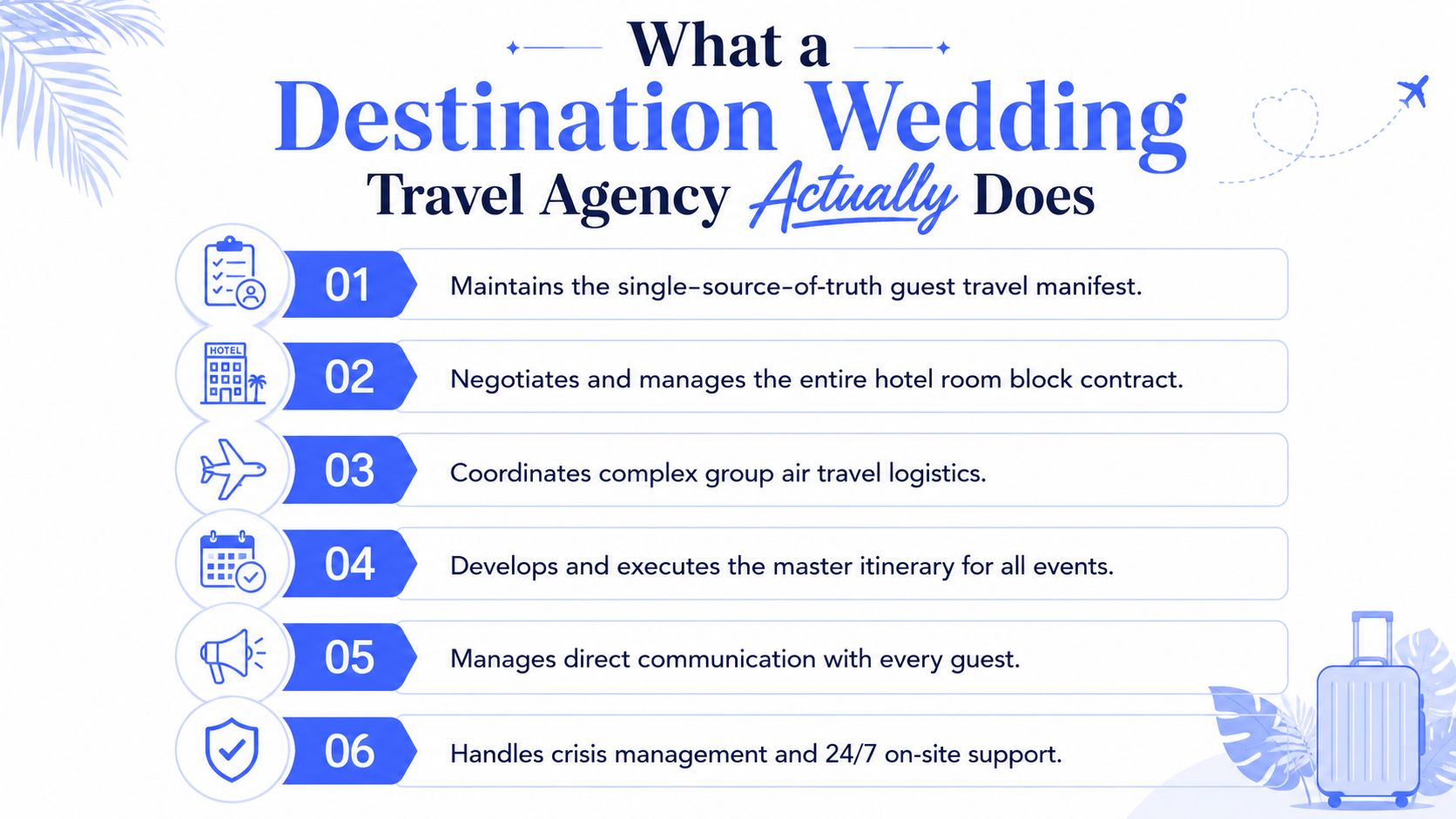
A real destination wedding travel agency owns the travel program from end to end. The couple may still choose the resort, the planner may still design the event, but the agency handles the mechanics that make the guest experience work on the ground.
The core deliverables are operational, not decorative
The first deliverable is a single-source guest travel manifest. That means every arrival city, passport name, special request, and room assignment lives in one place instead of across texts and emails. It also means the couple isn't relaying the same passenger details to five different people.
Next comes the room block. The agency negotiates the contract, tracks the release dates, and watches the attrition terms so unused inventory doesn't become a surprise. It also builds a booking path for guests, often through a private link or category-specific reservation flow, so people aren't trying to book a destination wedding like a weekend vacation.
The travel side usually includes group air strategy, individual booking support, airport transfers, and a live point of contact during wedding week. A stronger agency also provides a shared dashboard for arrival and departure windows, a direct line for travel emergencies, on-site or local representation, and a reconciliation report after the event.
The couple should never be the help desk for flight changes.
The important distinction is this, venue selection, ceremony design, décor, and vendor styling sit with the wedding planner. The agency runs the parallel travel program. When those roles are clear, the guest experience gets easier because no one is guessing who owns what.
For a useful contrast between a specialist's travel role and a general planning role, this destination wedding coordinator overview helps show where the lines usually sit.
Coordinating Guest Travel From Arrival Banks to Name Changes
A destination wedding can look simple on paper and fall apart in transit. Guest travel works better when the agency handles each booking as an operational file with its own tracking system. The intake form should capture passport names, origin city, loyalty numbers, dietary needs, and mobility requirements before anyone starts asking about excursions or brunches. That information separates a clean transfer from a week of preventable corrections.
Why timing matters more than price alone
Air strategy should start as soon as the date and destination are locked. For groups with 30+ guests flying the same route, group booking workflows can materially reduce friction because airline group fares often require 10+ passengers on the same flight and may allow 5% to 15% discounts with flexible name changes (logistics guide). That does not mean group air is always cheaper. It means it can be the right tool when the booking risk is name changes, staggered confirmations, or a lot of first-time international travelers.
Arrival banks matter just as much. A good agency clusters arrivals into two or three windows so transfer vehicles, welcome dinners, and check-in desks do not all peak at once. Ground transport should follow the same logic. Shared shuttles work when timing is loose and arrivals are dense, while pre-chartered coaches make more sense when the manifest is known early and the hotel sits far from the airport.
| Decision | Common Approach | Trade-off |
|---|---|---|
| Collecting guest data | Couple gathers names in a group chat | Fast at first, messy later |
| Air booking | Everyone books independently | Less coordination, more arrival drift |
| Group fares | Used for the main flight bank | Better alignment, less flexibility if the route changes |
| Transfers | Shared shuttles booked late | Cheaper on paper, riskier with mixed arrivals |
| Arrival windows | Guests land over several days | Easier for schedules, harder for welcome events |
The hard part is final-trip change management. Name corrections, date changes, cancellations, and the occasional medical reroute happen late, and the agency has to absorb them without pulling the couple into every fix. That is where group travel coordination services earn their keep, because each booking still needs attention when the room list, flight manifest, and transfer schedule stop matching the original plan.
Room Blocks, Inventory, and Local Vendor Coordination
Hotel inventory is where a lot of couples lose flexibility without realizing it. A room block sounds simple until the contract shows release dates, attrition language, and rate tiers tied to different room categories. If nobody is reading the mechanics carefully, the couple can end up with rooms they can't use or guests who can't book at the agreed rate.
Soft blocks and guaranteed blocks are not the same thing
A soft block returns unused inventory to the hotel if it doesn't sell by the cutoff date. A guaranteed block usually places more risk on the couple, because unused rooms can still be their financial responsibility. Both structures exist, and they work differently depending on the resort, the season, and how confident the group is about attendance.
That's why room block size should track confirmed RSVP behavior, not just the invite list. A specialist agency also watches whether the contract allows category swaps, such as moving some guests from one room type to another closer to departure. Those changes can preserve flexibility when the wedding group has a mix of families, couples, and older travelers with different needs.
Vendor coordination is more fragile than it looks
Local vendors bring another layer. Florists, photographers, musicians, and caterers may be on the resort's preferred list, or they may require separate approval and separate payment handling. The agency usually sequences those deposits against the couple's own schedule, so nobody is scrambling to wire money at the wrong time or chase a contractor who's waiting on confirmation.
A well-run travel agency doesn't control the creative direction, but it does keep the logistics from colliding. If a vendor needs access to the property, the agency coordinates timing. If a guest changes hotels, the agency updates room assignments. If the couple wants to understand what's locked versus what's still flexible, the contract should answer that before signatures go down.
The benefit is control. Not control over every artistic choice, but control over what can still move and what can't.
| Contract Lever | What It Controls | Typical Flexibility |
|---|---|---|
| Room block size | How much inventory is held | Some flexibility before cutoff |
| Release date | When unused rooms return to hotel | Limited once the deadline passes |
| Attrition clause | Who pays for unused rooms | Often the least flexible term |
| Room category tier | Which room types guests can book | Sometimes swappable by request |
| Deposit schedule | When payments are due | Usually fixed once signed |
For a broader look at how a travel advisor thinks about those moving pieces, the travel advisor guide gives useful context on the role itself.
A Real Wedding Week and How the Pieces Line Up
A four-night wedding in Tulum can look relaxed from the outside and feel like air traffic control underneath. The couple may see sunsets, cocktails, and one beautiful ceremony, but the agency is watching arrivals, room assignments, transfers, and excursion counts in the background.
Night by night, the schedule only works if the inputs are clean
Night one starts with arrivals across three flight banks. Guests coming through two properties need different transfer rotations, and the agency has to know who lands when before the vans start moving. If one flight is delayed and the manifest isn't current, the whole check-in plan starts slipping.
Night two usually carries the welcome dinner and a group activity like a cenote excursion. That's the night when the hard headcount matters, because seating, transport, and food all depend on guests confirming on time. Any off-property guests need to be folded in without creating a second logistics track.
Night three is the wedding itself. Vendor setup windows have to line up with shuttle timing between the ceremony, cocktail hour, and reception. Guests staying at another hotel can't be an afterthought, because their transfers are part of the event, not a side note.
Night four is often brunch plus a weather-dependent charter or excursion. By then, the agency has already made the final calls on timing, guest pickups, and any late adjustments.
If the agency doesn't hold arrival data, room assignments, and vendor timelines in one place, the wedding week becomes a chain of phone calls.
The week runs smoothly when the travel program absorbs friction before the couple notices it. That's the part most resorts won't own for you, because they're managing their property, not your guests' entire trip.
How to Choose the Right Agency for Your Wedding
The right agency shows up in the parts that break first, guest names, arrival cities, room lists, and last-minute changes that arrive after contracts are signed.
Ask for proof of operating depth
Start with the operational basics. Ask how many destination weddings they handled in the past 12 months, who manages booking work during wedding week, and how they respond when a guest changes flights late or needs a partial cancellation inside the final payment window.
Then ask how they manage the guest travel manifest, whether they provide reporting, and how often the couple gets updates. Ask about fees too. Planning fees, hotel commission, and blended models all shape incentives, so you need to know where their business pressure sits.
A specialist should also explain how they work with an outside wedding planner when one is already in place. If that handoff is vague, the couple usually ends up filling the gap themselves, and that is where travel mistakes start. For a broader look at the advisory side of the role, this travel advisor resource is a useful complement to the operational questions.
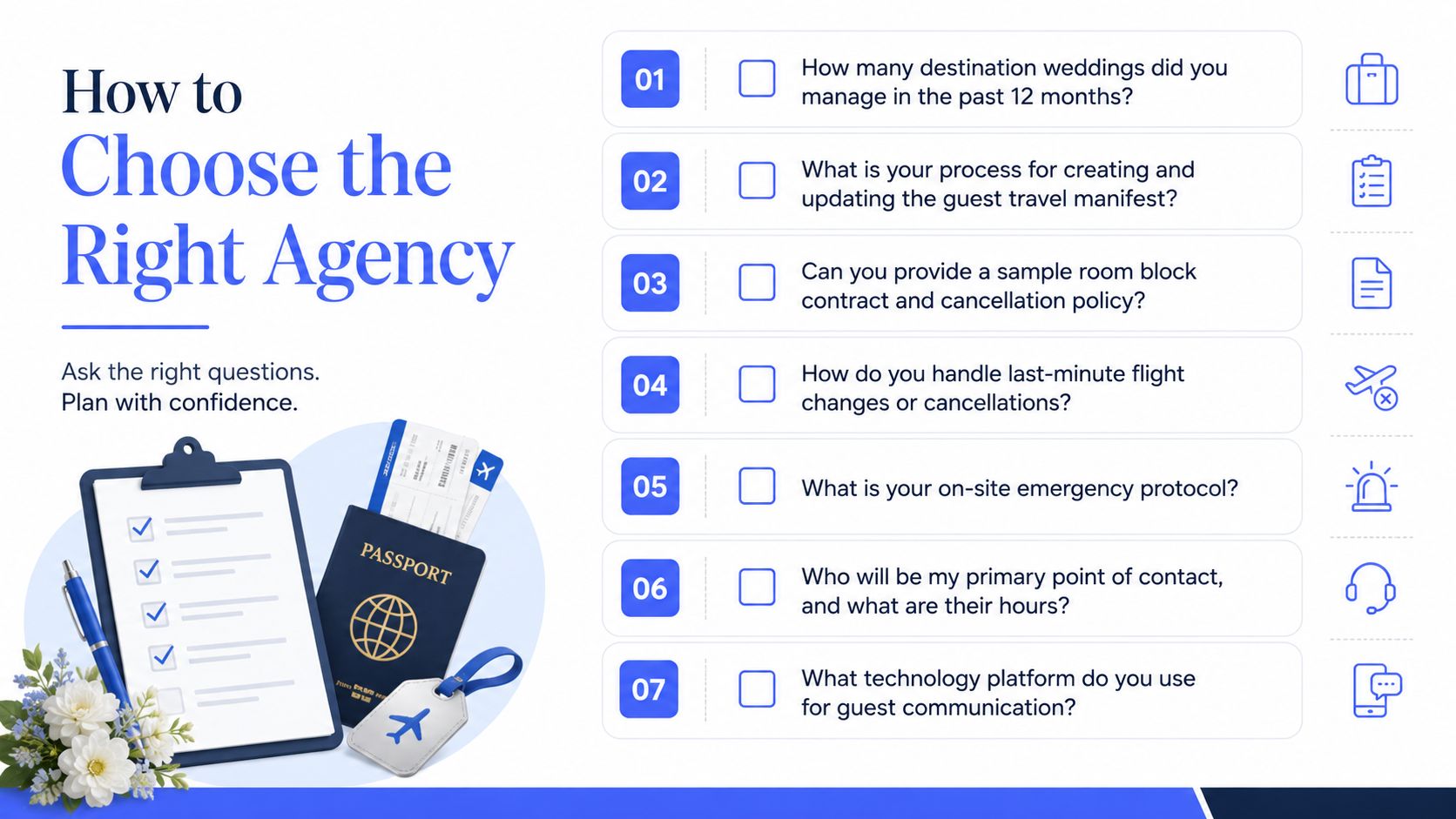
A strong agency should answer these questions directly.
- Recent volume: How many destination weddings did you manage in the past 12 months?
- Manifest process: How do you create and update the guest travel manifest?
- Contract visibility: Can you show a sample room block contract and cancellation policy?
- Change handling: How do you manage last-minute flight changes or cancellations?
- Emergency protocol: What happens if something goes wrong during wedding week?
- Primary contact: Who will be my main point of contact, and what are their hours?
- Communication tools: What platform do you use for guest communication?
The answers should sound operational, not polished for a sales call. If the agency can't describe the workflow clearly, it probably won't hold the week together when guests, flights, and hotel inventory start changing at the same time.
When You Need a Specialist and When You Don't
A destination wedding can be handled three ways, and each one fits a different level of complexity. The mistake is assuming every couple needs the same model, or that a resort coordinator, a planner, and a travel agency are interchangeable.
Three models, three different jobs
A specialist destination wedding travel agency is strongest when guest counts climb, origin cities are scattered, and the couple wants protected room inventory, coordinated flights, and one point of contact for travel changes. That model is built for guests, not just for the couple.
A general wedding planner works well when the event is intimate, creative decisions are central, and most guests can travel without heavy coordination. The planner can own the broader event with less handoff complexity.
A resort coordinator can be helpful, but the role is narrower. The coordinator protects the hotel's process and inventory. They usually don't step into flight disruptions, cross-property transfers, or guest-by-guest booking questions with the same depth a travel specialist does.
| Responsibility | Specialist Agency | General Planner | Resort Coordinator |
|---|---|---|---|
| Guest travel bookings | Owns it | May assist | Usually limited |
| Room block management | Owns it | May coordinate | Focuses on hotel rules |
| Flight changes | Handles it | Sometimes helps | Rarely central |
| Event styling | Not primary | Owns it | Limited |
| Guest communication | Central role | Partial role | Narrow role |
| Travel disruptions | Central role | Limited role | Minimal role |
The rule of thumb is simple. If the guest list is small, the origin cities are concentrated, and the couple wants one creative lead, a planner may be enough. If the event looks more like a travel program than a weekend party, the specialist earns its place.
The First Week of Planning and What Comes Next
Start by sorting the guest list into must-invite, likely, and optional. Then shortlist two or three destinations based on flight access from the cities your guests live in, not just the places that look beautiful on Instagram. Ask at least one specialist agency and the resort coordinator for quotes in the same week.
The next step is a short scoping call. Compare room block terms, group airfare options, and the communication tools each team uses to keep guests updated. Those first decisions shape every logistics move that follows, and they tell you quickly whether you need a travel program manager or just lighter support.
JustKeeps Travel builds destination wedding travel programs around guest-by-guest coordination, room blocks, transfers, and trip communication, which makes it a practical fit when the travel layer needs real oversight. If you're comparing agencies for a wedding with multiple guest origins or changing booking windows, visit JustKeeps Travel to review how their advisory model handles the moving parts.