



The Group Travel Coordinator's Complete Role Guide
At 3:42 p.m. on arrival day, a group travel coordinator may be standing in a hotel lobby while the trip appears perfectly calm to everyone else. Two guests are already at the bar, another has been rerouted through a delayed connection, one room needs to be changed because the sleeper sofa won't work, and the kitchen has no record of a vegan meal. The coordinator confirms the suite, calls the chef, texts the driver, updates the front desk, and moves the welcome-dinner running sheet forward by ninety minutes.
That quiet triage is the essential work. Group travel breaks down at the seam between individual preferences and shared logistics, and someone has to own that seam in real time. The challenge grows across destination weddings, corporate offsites, and multi-family trips, where a single change can affect rooms, transfers, meals, schedules, vendors, and the host's peace of mind.
Table of Contents
What the Moment Actually Looks Like Behind the Scenes
A strong coordinator doesn't start by broadcasting a group message. They start by identifying the decisions that can affect other people, then handle those decisions in the right order.
The room swap comes first because the guest needs a usable room before the rest of the arrival experience matters. The dietary issue follows because the kitchen needs enough time to prepare a safe alternative. The delayed connection requires a driver update, not a vague note to the group. Meanwhile, the two guests at the bar need reassurance that the welcome plan is still moving, even if its timing has changed.
Triage has an order
The sequence matters:
- Protect the guest: Confirm the room, meal, transfer, or accessibility requirement that affects immediate comfort and safety.
- Protect the schedule: Identify which activity must move, shorten, or run in parallel.
- Protect the handoff: Tell the hotel, driver, guide, restaurant, and host exactly what changed.
- Protect the record: Log the new information so nobody acts on the old version later.
The coordinator isn't trying to make every traveler experience the same trip. They're making sure individual needs fit inside a shared plan without forcing the host to become a call center.
That distinction is especially important as group travel takes several forms. A 2016 survey found that the median group travel organizer planned 10 group trips per year, with tours averaging 30 passengers each, while a smaller share managed groups above 55 people or arranged more than 50 trips annually. The same survey showed that organizers handled both domestic and international work, with 67% taking groups abroad and another 19% open to international travel. The survey of modern travel planners also recorded a wide range of per-person trip budgets, from under $1,000 to above $3,000.
Practical rule: If a change affects another guest, a vendor, or the schedule, it belongs in the central trip record before it belongs in a casual text thread.
The rest of the coordinator's job is an extended version of this moment. Every arrival, meal, room, payment, activity, and departure requires the same combination of judgment, documentation, and timely communication.
What a Group Travel Coordinator Really Does
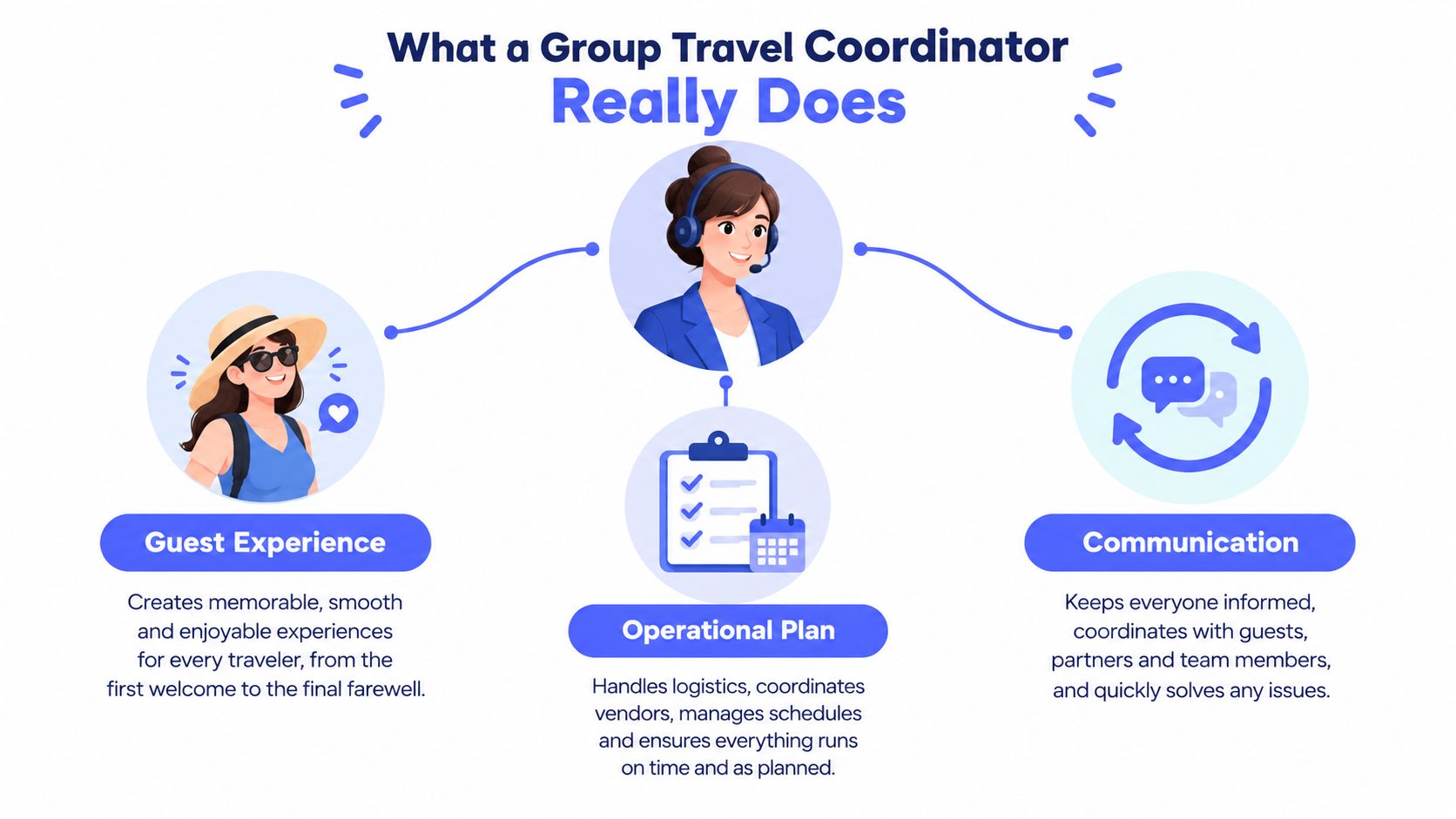
A group travel coordinator is the single accountable person who owns the guest experience, the operational plan, and the communication loop from the first inquiry through post-trip follow-up. They may not design every element, sell every component, or manage every event, but they make sure the parts work together for real travelers with real constraints.
A travel agent typically researches, sources, and books travel components. A tour operator builds and sells a travel product, often combining accommodation, transportation, activities, and guiding into a defined program. A coordinator operates at the point where the booked plan meets the people using it.
The work that sits inside the role
For a 22-person corporate offsite in Lisbon, the coordinator might:
- Run the intake: Collect arrival windows, executive preferences, dietary details, rooming information, and emergency contacts.
- Build the operating file: Maintain the rooming list, transfer manifest, meeting schedule, meal notes, and vendor contacts.
- Brief suppliers: Send the hotel, drivers, restaurants, and guides the same approved information.
- Manage changes: Rework a transfer when a flight changes, adjust a dinner when a meeting runs late, and inform the affected travelers.
- Stay present: Verify arrivals, check the meeting setup, confirm meals, and resolve issues before they reach the company's organizer.
- Close the loop: Reconcile changes, record supplier performance, and collect useful feedback.
Some responsibilities remain outside the coordinator's scope. The client or creative lead defines the trip's vision. A wedding planner handles ceremony design, décor, and wedding-vendor production. A photographer captures the event. The coordinator may align their timelines and handoffs, but shouldn't absorb every adjacent job.
The role works best when ownership is explicit. A coordinator who promises to “handle everything” creates confusion. A coordinator who names the boundaries, then manages every travel-related detail rigorously, gives each stakeholder a reliable point of contact.
How Guest-by-Guest Handling Works in Practice
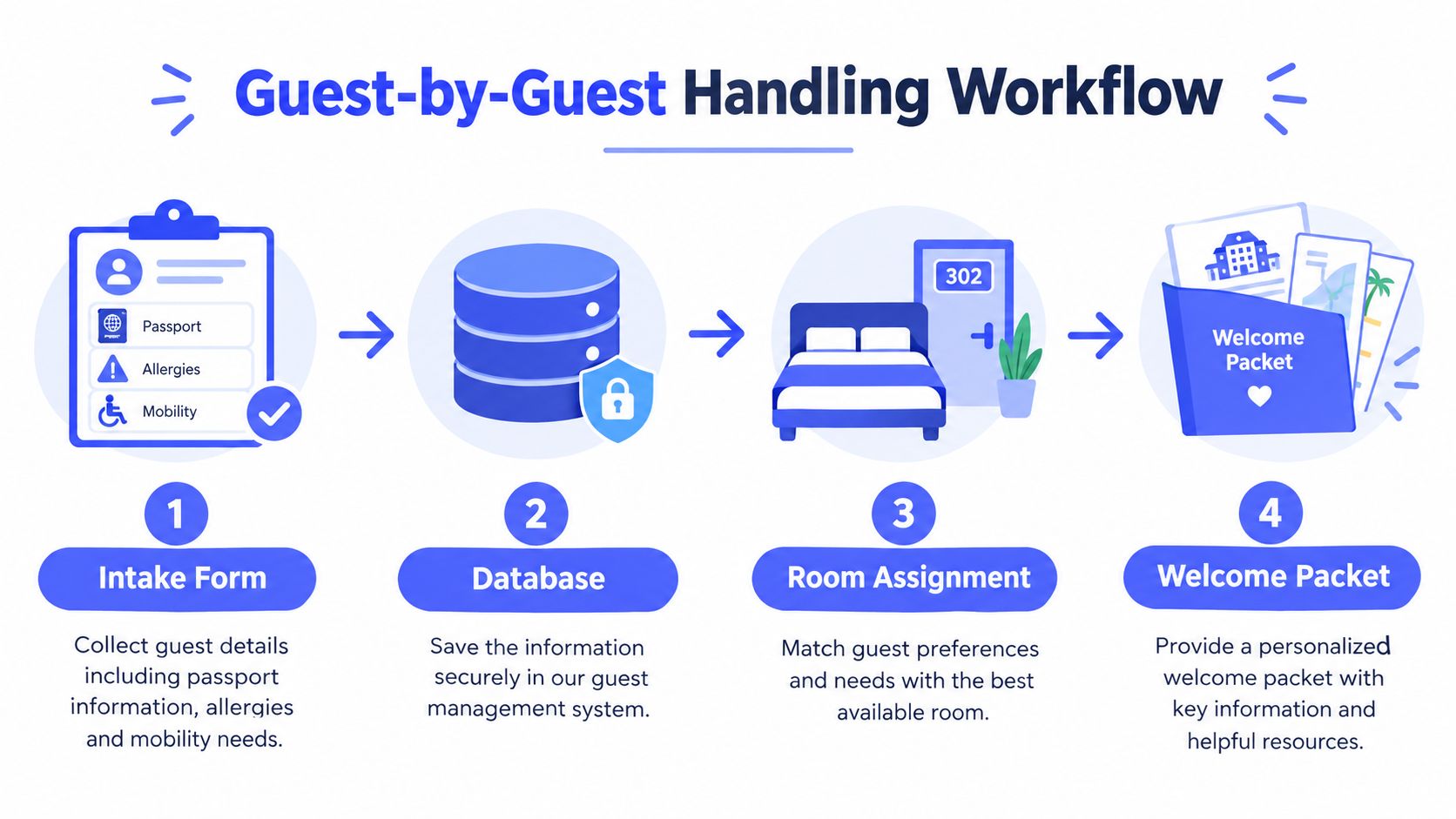
Group coordination starts with an intake form that treats every traveler as an individual record inside a shared itinerary. The form should capture arrival windows, passport details where relevant, mobility needs, allergies, rooming preferences, celebration occasions, emergency contacts, and communication preferences.
That information then becomes a living guest profile. When a traveler emails to say they're now arriving earlier, can't share a room, need a wheelchair-accessible transfer, or have changed a dietary requirement, the coordinator updates the profile and the connected operational documents. A message sitting unread in an inbox isn't a completed task.
Four passes through the trip
Pre-trip confirmation is the first quality gate. The coordinator checks room assignments, payment status, arrival information, transfers, meal restrictions, and special requests. A missing bassinet request discovered three weeks before departure can usually be solved. The same request discovered at check-in becomes a negotiation.
Arrival-day handling requires live visibility. Drivers need current flight details and passenger manifests. The hotel needs the right rooming list. The host needs a concise view of who has arrived, who is delayed, and which issue is being handled privately.
In-trip adjustments are where judgment matters. If a hike runs late, the coordinator doesn't announce that the spa schedule has changed. They identify whose appointment is affected, find an acceptable replacement, confirm availability with the spa, update the guest, and revise the relevant schedule.
Departure logistics deserve the same care as arrivals. The coordinator confirms luggage timing, transfer assignments, flight changes, late checkouts, split departures, and any final billing questions. A guest leaving before the main group should still receive clear instructions, not a last-minute forward of the group itinerary.
A bespoke itinerary can provide the creative structure, but the coordinator's operational file provides accountability. For an example of how individualized trip design can support that structure, see this bespoke travel itinerary approach.
The system can be a carefully designed spreadsheet, a CRM, or a project workspace. The tool matters less than the discipline. Each change needs an owner, a timestamp, an affected supplier, and a clear next action.
A travel disruption illustrates why this matters. A 2025 report found that 89% of global business travelers experienced a trip that didn't go according to plan, while U.S. businesses spent more than $17 billion annually mitigating the fallout. The business travel disruption report supports a practical conclusion for groups: coordinators need two-way communication, itinerary version control, and rebooking logic that can update multiple travelers and vendors at once.
Here's a short visual introduction to the workflow:
Communication Templates and Cadence That Hold a Group Together
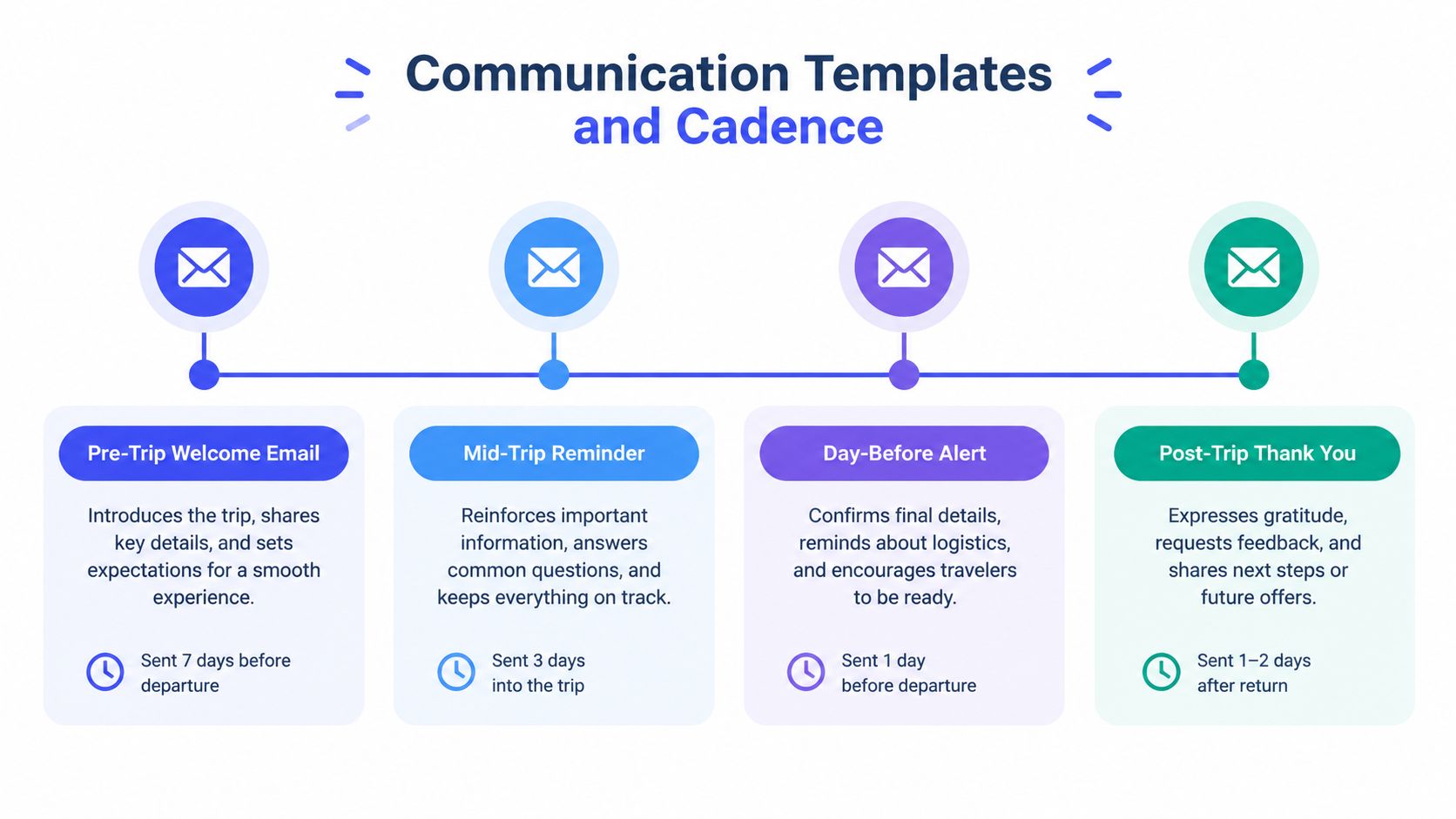
Good group communication is predictable. Travelers shouldn't wonder whether a new message replaces the old itinerary, whether a payment deadline changed, or whether a driver will have their updated arrival information.
The coordinator should maintain one guest-facing email thread for general updates, separate private threads for individual needs, and a vendor thread that never reaches the group. That separation prevents personal information, supplier troubleshooting, and internal decisions from spilling into the wrong audience.
A practical message rhythm
Pre-trip welcome email
Subject: Your group trip details and next steps
Hello everyone,
Your current arrival window is listed in the attached itinerary. Please review your room details, dietary information, transfer plan, and payment deadline. Reply privately if any personal information has changed. General questions can stay on this thread so the group receives one consistent answer.
This message sets expectations without burying travelers in operational language.
Ten-day briefing
Subject: Final group briefing
We're confirming transfers, room assignments, meal flags, and activity timing. Please check your arrival details and tell us about any change that affects transportation or accommodation. After this checkpoint, changes may require supplier reconfirmation.
The wording should be firm without sounding punitive. Travelers need to understand why late changes create work and risk.
Day-of update
Today's transfer: Your driver is scheduled for [time]. Meet at [location]. Driver contact: [name and number]. Please keep your phone available and tell us immediately if your flight, baggage, or arrival plan changes.
Mid-trip change notice
Schedule update: The venue has moved your dinner seating to [time]. Your transfer remains at [time], and the revised meeting point is [location]. We've updated the itinerary, so please use this message as the current version.
Post-trip follow-up
Thank you for traveling with us. Please share feedback on the accommodations, transfers, activities, meals, and communication. Private comments about an individual issue can be sent directly so we can investigate it properly.
A wedding client may need warm, reassuring language. A corporate booker usually wants concise status reporting and confidentiality. A multi-family lead may need extra clarity around shared costs and optional activities. The tone changes, but the cadence stays stable.
How Coordinators Maintain Standards Across Every Guest
Consistency comes from inspection, not optimism. A supplier can receive a perfect brief and still miss a room note, seat a dietary guest incorrectly, or send the wrong vehicle. The coordinator's job is to make the desired standard visible, then verify it at the moments that matter.
A master spreadsheet or group workspace should hold the current operating truth. Useful fields include:
- Arrival data: Flight details, arrival windows, transfer assignments, and contact information.
- Accommodation data: Room category, rooming arrangement, bedding needs, accessibility notes, and check-in status.
- Food and health data: Allergies, dietary restrictions, medication-related considerations shared by the traveler, and meal confirmations.
- Contact data: Emergency contact, preferred communication channel, and the person authorized to make decisions.
- Financial data: Deposits, payment milestones, outstanding balances, and approved changes.
Brief, inspect, escalate
Send each vendor a focused brief before their component. It should include the relevant rooming list, dietary flags, timing windows, passenger details, and the exact contact path for urgent issues. Don't send a restaurant the entire private guest file when it only needs seating and meal information.
At each touchpoint, run a checkpoint:
- Airport pickup: Confirm the vehicle, driver, passenger count, luggage capacity, and meeting point.
- Hotel arrival: Verify room readiness, keys, welcome materials, and special accommodations.
- Welcome meal: Check table placement, dietary execution, pacing, and host preferences.
- Daily activity: Confirm guide arrival, equipment, attendance, and timing.
- Farewell: Reconcile transfers, luggage support, departure instructions, and unresolved issues.
A documented escalation path keeps the coordinator from becoming the only person who knows what to do. The vendor should know whom to call first, what qualifies as urgent, and what evidence to send. A photo of a prepared room, a driver's confirmation of the meeting point, or a restaurant's final seating plan can prevent assumptions from surviving until the guest arrives.
Service standard: Don't ask whether a supplier “should” have handled it. Confirm whether they did, record the result, and correct the gap while the guest still has options.
A private debrief after each component helps identify recurring problems. If one property repeatedly misses bedding notes while another consistently confirms them, the next brief should reflect that difference. Standards become reliable when the coordinator turns observations into revised instructions.
How the Role Shifts Across Weddings, Corporate Trips, and Multi-Family Getaways
The same operating discipline applies across group trips, but the stakeholder map changes. A wedding centers on the couple and their guests. A corporate offsite centers on the business objective and the people responsible for it. A multi-family trip must balance several households, age groups, budgets, and expectations without allowing the loudest traveler to set every decision.
Destination weddings carry a particularly delicate division of labor. The coordinator handles guest travel, room blocks, payments, arrival information, transfers, and travel questions, while the wedding planner leads ceremony production and event design. This distinction is explored further in the destination wedding coordinator guide.
| Trip Type | Primary Stakeholder | Coordinator's Focus | Top Standard to Protect |
|---|---|---|---|
| Destination wedding | Couple and wedding guests | Guest-by-guest travel, room inventory, payments, transfers, and planner handoffs | The couple's attention stays on the celebration |
| Corporate offsite | Company booker and executive stakeholders | Confidentiality, arrival sequencing, attendee tiers, meeting timing, and status reporting | The business schedule remains dependable |
| Multi-family getaway | Lead family and participating households | Shared-cost clarity, age-band needs, rooming fairness, and optional activities | No household feels overlooked or subsidizes an unclear choice |
| Milestone celebration | Honoree, host committee, and guests | Surprise management, discreet communications, arrival timing, and emotional pacing | The surprise survives without compromising guest comfort |
The emphasis changes
For weddings, the coordinator often becomes the buffer between guests and the couple. For corporate programs, the same person may need to separate executive requirements from general attendee logistics and report exceptions without exposing private details. For multi-family travel, the coordinator must make decisions legible, especially when one family prioritizes a private guide while another needs a lower-cost shared option.
Family travel demand makes this work increasingly relevant. A 2025 U.S. family travel survey found that 57% of parents were planning multi-generational trips, 48% were already traveling with extended family, and 61% said they'd consider a travel advisor in the next two years, even though only 19% had used one in the previous three years. The family travel survey highlights point to a practical opportunity for coordinators who can manage accessibility, age differences, and budget fairness within smaller groups.
The coordinator should ask one question before approving a shared plan: who benefits, who carries the inconvenience, and who needs a private alternative?
Why a Dedicated Coordinator Is Worth the Investment
Improvisation looks inexpensive until one failure spreads. A missed airport transfer can trigger a replacement vehicle, a missed meal, a late check-in, and a host who spends the first evening troubleshooting instead of welcoming guests. A misbooked dietary requirement can turn a celebratory dinner into a personal negotiation. A delayed executive arrival can affect the opening meeting and every attendee waiting for it.
The value of a coordinator lies in absorbing those small failures before they become group-wide events. That includes monitoring room assignments, tracking payment and confirmation status, reconciling supplier promises, and maintaining a current emergency plan.
Demand also supports the need for organized handling. The U.S. Travel Association reported that RFP volumes reached 109% of 2019 levels in its 2026 State of Group Travel Report, while market research has estimated the global group travel market at USD 369.8 billion in 2024. The group travel market research presents a large commercial category in which coordination errors can affect significant bookings.
| Factor | Host Manages Solo | Coordinator Hired |
|---|---|---|
| Guest questions | Arrive across personal email, messages, and calls | Route through one accountable travel contact |
| Rooming and dietary data | Host updates multiple documents manually | Coordinator maintains one current operating record |
| Disruption response | Host researches options while managing the group | Coordinator handles rebooking, supplier contact, and updates |
| Vendor handoffs | Host repeats instructions to each supplier | Coordinator issues focused briefs and confirms execution |
| Financial exposure | Problems surface after deadlines or inventory changes | Coordinator monitors changes and flags risk earlier |
| Host experience | The host becomes the default help desk | The host participates as a guest, client, or leader |
The strongest argument isn't that a coordinator prevents every problem. Nobody can control weather, airline operations, supplier capacity, or a guest's decision to change plans. The argument is that one trained person can contain the consequences, preserve accurate information, and give the group a clear next step.
WATG's group travel research found that over half of respondents expected demand to grow, 60% expected per-person spend to rise, 47% expected more participants per trip, and 81% expected trip lengths to stay steady or increase. The future of group travel research makes the risk plain: higher-value trips can involve more guests and more spending while retaining the same operational pressure.
What Separates a Good Coordinator From a Great One
A good coordinator handles the itinerary. A great coordinator notices the guest who never speaks in the group chat, checks whether the allergy is attached to the correct table, and escalates a midnight noise complaint before it damages the next morning.
The difference is less about charm than operating discipline:
- Written handoff procedures: Every supplier receives the right information, in the right format, with a named owner.
- One source of truth: The team knows which document controls rooming, transfers, meals, and changes.
- Response commitments: Travelers know when they'll receive an answer, even when the final solution requires supplier confirmation.
- Escalation contacts: The coordinator has direct paths to the hotel duty manager, transport lead, event contact, and on-site decision-maker.
- Change logging: Every preference update is recorded, not trusted to memory or an informal message.
- Physical presence: The hiring client knows whether the coordinator will be on the ground or supporting remotely.
For luxury group programs, the operating model should match the trip's complexity. Luxury group travel planning often requires close attention to constrained inventory, private guides, transfers, dining, and on-trip changes, so the coordinator's document stack and escalation habits matter as much as destination knowledge.
Ask candidates to describe their last complicated guest request. Ask what they recorded, who they contacted, what they told the guest, and what they changed afterward. Then ask to see the shape of their workflow, including the master file, vendor brief, communication cadence, and emergency process.
The best coordinator doesn't promise a frictionless world. They build a trip where friction has somewhere to go besides the host and the guests.
JustKeeps Travel provides guest-by-guest group coordination for destination weddings, corporate retreats, milestone celebrations, and multi-family travel, including accommodations, transportation, dining, activities, payment schedules, and traveler communications. Visit JustKeeps Travel to discuss a group itinerary that needs precise planning and active support from the first inquiry through the return home.