


Luxury Corporate Travel: What Makes It Different
Most advice about luxury corporate travel starts with the wrong question. It asks whether an executive should fly business class, stay at a five-star hotel, or use a private terminal. Those decisions matter, but they're only the visible layer of a premium trip. A luxury program earns its cost by changing the itinerary itself, protecting productive time, and giving one accountable team control when conditions change.
That distinction matters as corporate travel expands. Global business travel spending reached about $1.48 trillion in 2024 and is projected to reach a record $1.71 trillion in 2026, with 1.84 billion business trips expected worldwide in that year, according to the GBTA 2026 business travel forecast. The United States is projected to represent roughly $369 billion in corporate travel spending in 2026, making it the largest single market in that forecast.
More travel doesn't automatically justify more luxury. It makes better trip design more important. For senior executives, the objective should be fewer, higher-value, better-protected journeys that preserve attention for the meeting that matters.
Table of Contents
- Comfort supports performance
- Privacy protects the work
- Bespoke routing buys control
- Concierge ownership absorbs change
Why Luxury Corporate Travel Is Not Just an Upgrade
A nicer seat on the same poorly designed itinerary is still a poor itinerary.
Many corporate programs apply premium features to a standard booking process. The executive receives a business-class fare, a recognizable hotel brand, and perhaps lounge access, but the underlying plan remains unchanged. The routing may still include an unnecessary connection, the hotel may sit far from the meeting venue, and the support model may still depend on a general service queue when a flight is canceled.
That approach confuses amenity value with operational value. A premium cabin can make a long flight more comfortable, but it can't eliminate a bad connection or recover a lost meeting window. A five-star property can provide excellent service, but it won't help if the executive has to cross a congested city twice a day because the hotel was selected for brand preference rather than location.
The itinerary is the product
A genuine luxury corporate travel program begins with the executive's calendar, risk profile, and recovery needs. The advisor asks what must happen, what cannot move, which arrival times are acceptable, and where a contingency would be most damaging. Only then should the team decide whether the right solution is a commercial premium cabin, a private transfer, a different hotel, or a chartered sector.
That planning logic is the difference between buying an upgrade and buying back time. It may mean avoiding an overnight flight before a board presentation, arranging a car before the aircraft reaches the gate, or holding an alternate room near the meeting site before a hotel issue becomes an executive problem.
Practical rule: If the itinerary would still work only when every flight, transfer, and meeting runs perfectly, it isn't a luxury itinerary. It's a fragile standard itinerary with expensive components.
The scale of current corporate travel makes this distinction more urgent. Premium cabin bookings, including business and first class, rose about 9% year over year in 2026, while economy bookings were flat and premium economy declined about 15%, according to SAP's business travel analysis. The same analysis reported that airfare rose more than 8%, hotel rates nearly 6%, and car rental costs roughly 5% during that period. Paying more is not the same as managing better.
For a deeper look at the human support layer behind this model, corporate concierge services should be understood as itinerary ownership, not restaurant access or airport assistance. The advisor's value appears before departure, during disruption, and after the executive's priorities change.
What Luxury Actually Means for Executive Travel
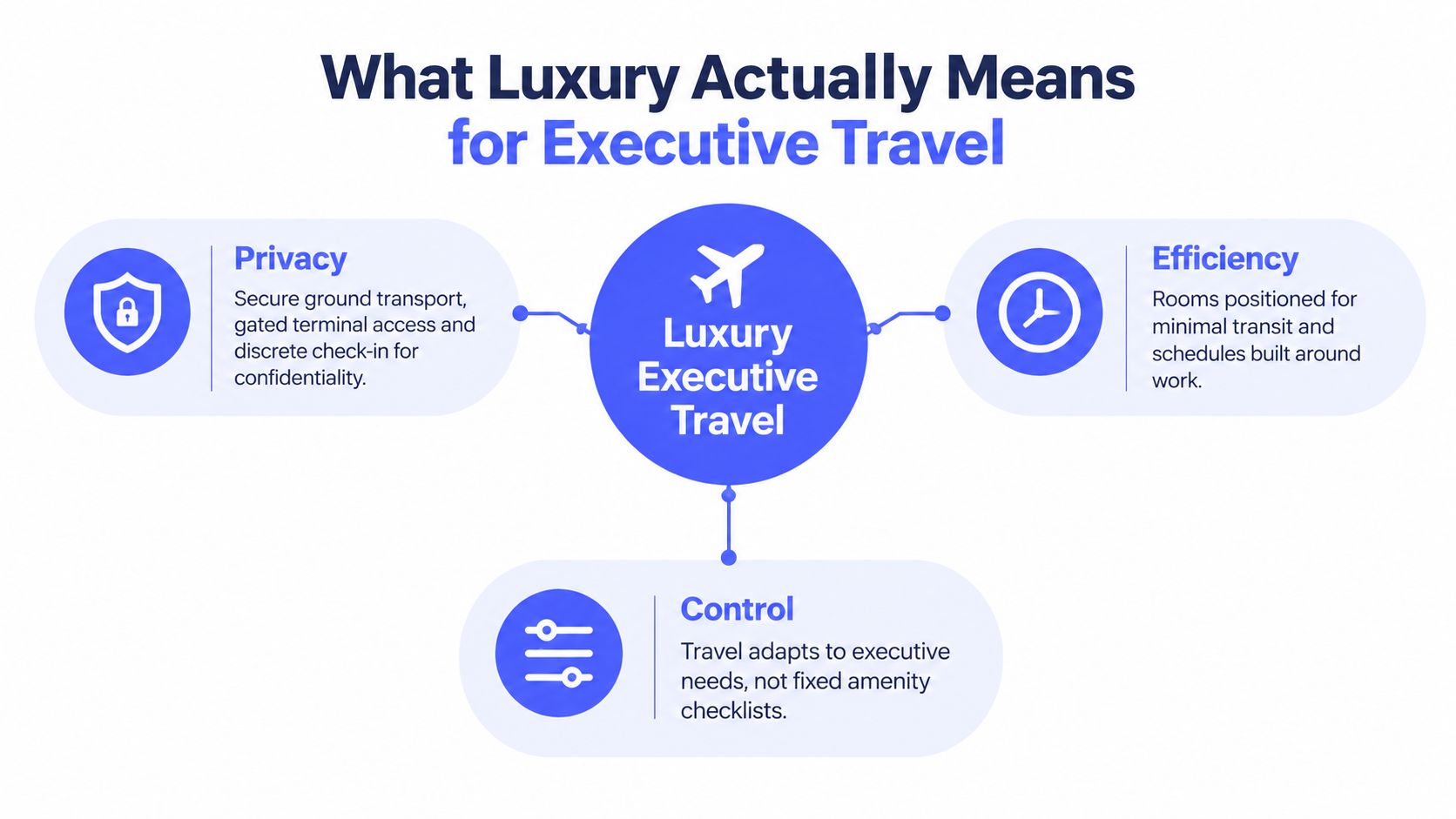
Luxury in executive travel has three working definitions: privacy, time recovery, and bespoke control. Hotel design, dining, and cabin service support those outcomes, but they aren't the outcomes themselves.
Privacy starts with movement that doesn't expose the executive unnecessarily. That can include secure ground transport, gated terminal access where available, discrete check-in, and hotel rooms positioned away from event floors or high-traffic public areas. For sensitive work, the plan may also include private meeting spaces, controlled access, and communication with a small number of named contacts rather than broad distribution of itinerary details.
Time recovery deserves a budget
Time recovery means reducing the hours that produce no business value. The advisor looks beyond flight duration and reviews the complete door-to-door sequence, including airport access, immigration exposure, transfer timing, hotel location, and the quality of the arrival window.
A room near the meeting venue can be more valuable than a larger suite across town. A direct route can be more valuable than a cheaper fare with a connection. A departure timed to protect sleep before a presentation can be more valuable than a late arrival that appears efficient on the booking screen.
Premium cabins can support this objective on long sectors. Guidance on the value of business class for productivity and recovery points to lie-flat seating, larger work surfaces, and onboard Wi-Fi as features that can improve workability and rest, particularly on sectors longer than 8 hours. The fare decision should therefore be tied to meeting readiness, not comfort alone.
Bespoke routing follows purpose
Bespoke routing ignores the assumption that the airline hub or lowest published fare should dictate the trip. It considers the executive's purpose, the value of the meeting, the consequences of delay, and the available recovery options.
That might mean choosing a commercial flight with a longer ground transfer because it protects a critical arrival time. It might mean using a chartered sector when scheduled service turns a short meeting into an exhausting full-day journey. It might mean combining meetings in one region before returning home, even if that creates a higher individual fare, because it prevents another trip later.
The best luxury advisor won't approve an expensive request without scrutiny. They'll challenge it when a different routing produces better control. Luxury travel concierge planning should feel like a senior operator reviewing a business-critical schedule, not a booking agent presenting a menu of upgrades.
The Four Pillars That Set Luxury Apart
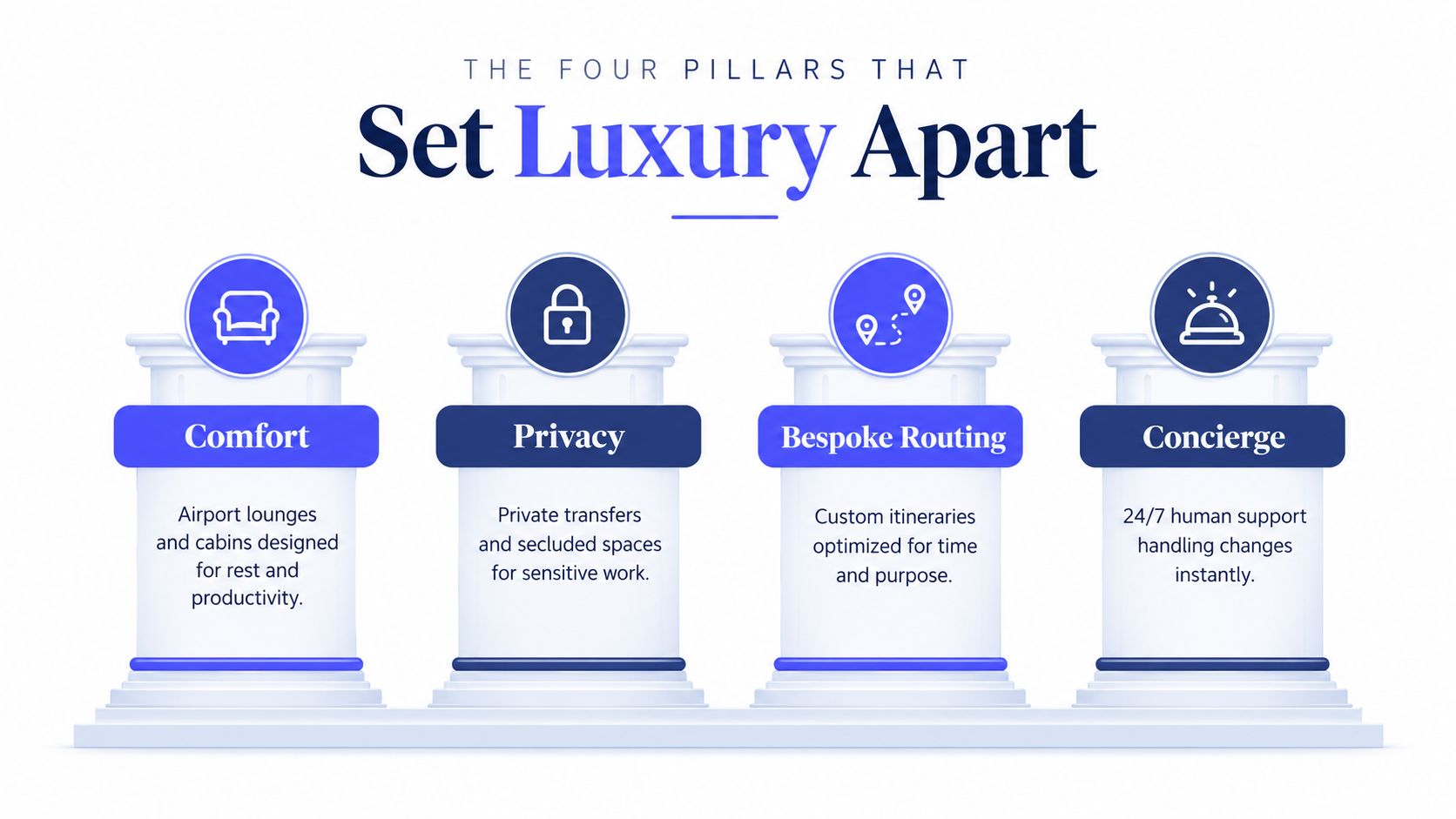
Luxury corporate travel rests on four pillars: comfort, privacy, bespoke routing, and concierge ownership. Remove any one of them and the program starts to resemble premium booking rather than executive advisory.
Comfort supports performance
Comfort is not thread count for its own sake. It's the practical setup that lets an executive leave a board session in the late afternoon and arrive ready for a morning meeting without spending the entire evening recovering.
That can involve lounge access, a cabin suited to sleep, a transfer timed around the actual meeting schedule, and a hotel room that supports rest rather than noise and movement. The advisor should select each element for its effect on the next business obligation.
Privacy protects the work
Privacy must cover the entire chain, not just the hotel room. Secure ground transport, discreet arrivals, controlled elevator access, and private spaces for sensitive calls can matter more than a public-facing luxury feature.
A meeting may need to move from a crowded lobby to an executive lounge. Documents may need to be delivered directly to a room rather than left at a front desk. The travel plan should account for who needs to know the executive's movements and who doesn't.
Bespoke routing buys control
Consider a short London to Brussels deal meeting. A scheduled connection may appear economical, but the total journey can consume most of the working day and expose the meeting to several points of failure. A chartered sector may be justified when the commercial alternative creates unacceptable schedule risk and the meeting carries substantial strategic value.
That isn't a blanket argument for private aviation. It's a decision rule. The advisor compares the value of the meeting, the available commercial schedule, the number of travelers, the required arrival window, and the recovery options before recommending a solution.
Concierge ownership absorbs change
A concierge isn't there only to reserve a restaurant. The right team can coordinate medical contacts, recover a misplaced document, arrange a replacement transfer, secure a backup meeting room, or rebuild the return journey while the executive remains focused on the client.
Support also needs a human owner. A named advisor who understands the trip can make a useful decision quickly. A queue-based contact center tends to make the traveler repeat the problem while time disappears.
Watch the following overview for a visual summary of how the four pillars work together.
The business case is strongest when every pillar connects to either productive time, privacy, recovery, or risk control. If a feature doesn't serve one of those purposes, it may be pleasant, but it isn't central to the luxury program.
A Real Executive Itinerary in Practice
A CFO has four days to attend a board meeting in Zurich, join a leadership offsite in Geneva, and return to New York. The itinerary begins with the board calendar, not the airline schedule.
The advisor avoids placing the CFO on an overnight flight immediately before the Zurich session. A premium cabin may still be selected for the long-haul segment, but the important decision is the arrival window. The hotel block is held under a discreet company name, with rooms positioned for quiet access and a private transfer arranged before departure.
At the airport, the driver is prepared for a tarmac-side private transfer where the operating environment permits it. The driver isn't waiting for a message after landing. The transport plan already includes the aircraft details, the arrival procedure, and the next destination.
The middle of the trip
The CFO attends the Zurich board meeting and then moves to Geneva for the leadership offsite. The original ground plan is ready, but the Zurich to Geneva leg is moved forward by six hours. The executive doesn't need to search for a new ticket or ask an assistant to compare options.
The dedicated travel desk revises the route, updates the driver, confirms the Geneva hotel, and protects the offsite schedule. A backup meeting room has already been booked at the venue in case the primary room is double-booked. That second room is not an indulgence. It prevents a facilities problem from consuming the leadership team's attention.
The hotel and transport partners receive only the details needed to execute their portion of the plan. The CFO's assistant receives the updated schedule through the agreed communication channel, while the travel desk keeps ownership of the moving parts.
The return home
After the offsite, the return to New York is rerouted through the dedicated desk rather than a public portal. The advisor evaluates the best available departure, protects the final meeting window, and coordinates the transfer from Geneva to the airport.
The point isn't that every executive needs a private aircraft or a hidden room. The point is that each decision reflects the business purpose of the trip. The four pillars appear as practical actions: rest is protected, sensitive movement is controlled, the route follows the calendar, and one human team absorbs disruption.
That is what separates an advisor-built itinerary from a premium fare wrapped around standard logistics.
The ROI Case for Premium Corporate Programs
The ROI of luxury corporate travel shouldn't be defended with comfort alone. The stronger argument is recovered executive time, lower disruption exposure, and better duty of care.
Travel disruption already has a measurable enterprise cost. A 2025 U.S. analysis estimated that companies spend more than $17 billion annually mitigating disruption fallout. The same travel disruption analysis estimated that impacted travelers lose an average of 4 hours and 45 minutes per disrupted trip, with 39% needing to work extended hours to catch up. Rebooking averaged 27% higher trip cost in that study.
Those figures change the conversation. A disruption isn't merely an inconvenience assigned to the traveler. It can delay a decision, reduce preparation time, force late-night work, and create additional expense across transport, accommodation, and labor.
Three sources of return
Productive hours preserved come first. A well-built itinerary reduces dead time and protects the hours immediately before a high-stakes session. A premium cabin can contribute when it enables sleep or focused work, but the larger gain often comes from the routing, transfer, and hotel decisions around it.
Decision quality protected is harder to place on an invoice, but it matters. An executive arriving rested and prepared is in a different position from one who has spent the night negotiating a canceled connection and searching for a replacement room.
Duty of care strengthened gives the company more control during disruption. Centralized monitoring, clear escalation paths, and a named advisor help the organization locate the traveler, communicate changes, and make decisions quickly.
| Metric | Standard Booking | Luxury Program |
|---|---|---|
| Routing | Chosen primarily from available published schedules | Built around the executive's purpose, calendar, and risk profile |
| Disruption response | Traveler or assistant searches for alternatives | A named travel desk monitors, reroutes, and coordinates the recovery |
| Hotel selection | Brand, rate, or availability often leads | Location, privacy, recovery time, and meeting access lead |
| Executive time | Lost hours are treated as an individual inconvenience | Time loss is treated as a business cost |
| Duty of care | Information may sit across disconnected suppliers | Travel details and escalation ownership stay centralized |
A premium program won't eliminate every delay. It can, however, reduce the number of avoidable weak points and shorten the time between a problem and a workable decision. That is why premium ROI is different from upgraded-economy ROI. The former redesigns the journey around business value. The latter often adds comfort without changing exposure.
How to Evaluate a Luxury Travel Partner
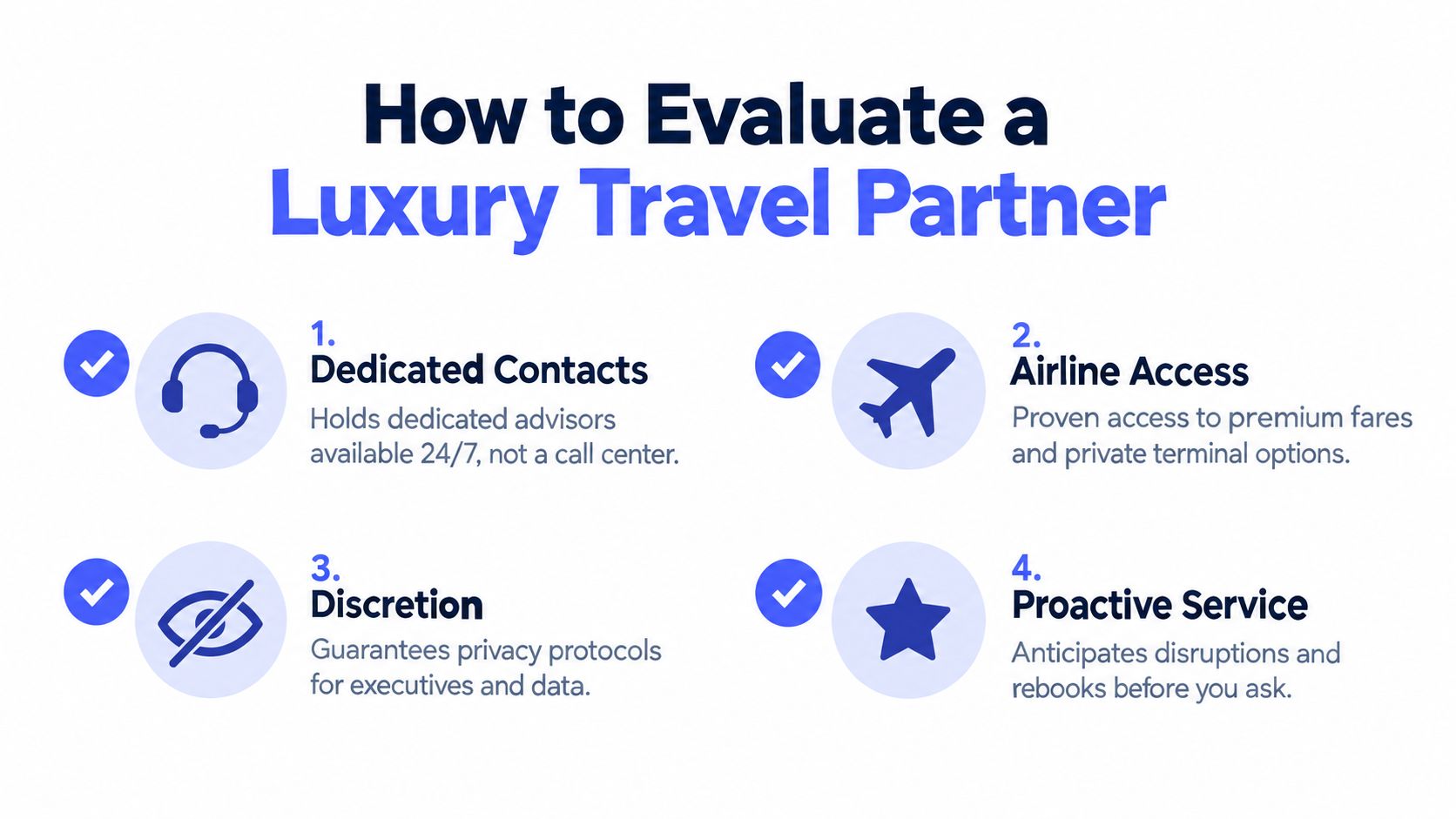
A luxury travel partner should be able to explain how it operates under pressure, not just describe its hotel portfolio. Ask operational questions before discussing preferred brands or cabin preferences.
Start with access and ownership
Use this checklist during a proposal meeting:
- Dedicated contacts: Ask whether the executive and assistant receive a named advisor who understands the itinerary, including outside ordinary office hours.
- Contingency planning: Ask what backup exists for every critical flight, transfer, hotel, and meeting location.
- Executive-grade inventory: Ask whether the partner can secure meaningful options at properties and operators suited to privacy-sensitive travelers, rather than relying only on published rates.
- Active challenge: Ask for an example of when the advisor rejected a requested routing because another option better protected the calendar.
- Disruption ownership: Ask who makes the call when the original plan fails and how the company communicates the change.
- Confidentiality controls: Ask how itinerary data, hotel names, passenger details, and meeting information are shared.
The answers should be specific. An advisor who can describe the property, operator, transfer procedure, and recovery option has probably handled comparable work. An advisor who repeats service language without explaining execution has not given you enough to evaluate.
Look beyond the pitch deck
Red flags include a program built entirely around public rates, a support line that routes every issue through a new agent, no documented disruption playbook, and an inability to identify recent executive-grade properties or transport operators. A partner may have excellent leisure credentials and still lack the discipline required for a board-level itinerary.
Preferred relationships can also matter when inventory is constrained, but ask what those relationships change. The hidden value of preferred partner networks is operational when it produces access, communication, flexibility, or recovery options that a normal booking channel can't provide.
End with one question: How did you handle your last major itinerary failure? The response will reveal more than a presentation about service. Listen for ownership, speed, communication, and what the advisor changed afterward.
Where Luxury Corporate Travel Is Headed Next
The next phase of luxury corporate travel will focus less on adding perks and more on coordinating decisions. AI-assisted itinerary personalization can help align travel with changing executive calendars. Predictive disruption tools can combine operating information and weather patterns to identify weak points before the traveler reaches the airport. Sustainability-linked routing can help companies measure the environmental effect of a trip while still protecting time-critical objectives.
The market is also moving toward fewer, higher-value trips for frequent executives. Deloitte reported that the share of frequent corporate travelers expecting to travel three or more times per month fell from 63% in 2024 to 53% in 2025, while those travelers remained more likely to select premium options when they did travel, according to its travel and hospitality industry outlook. Morgan Stanley's analysis cited in that report also projected a 5% rise in corporate travel budgets in 2026, alongside more liberal premium-class policies and growing interest in private aviation.
That shift rewards planning discipline. Companies need to decide when premium economy is sufficient, when business class protects performance, and when private aviation is justified by schedule value rather than status. Bleisure and wellness choices also need clear policy treatment. ALTOUR reported that premium economy grew 25% year over year, while economy grew 10% and business and first grew 3%, and found that 39% of business travelers frequently or always extend work trips for leisure. Its figures were higher for international travelers and executives, at 59% and 56% respectively, in the 2025 Business Travel Index.
The winning model won't treat luxury as a perk layer. It will use premium service selectively to reduce trip count, protect executive attention, support recovery, and give the company clearer control over spend and duty of care. That's the standard a travel partner should meet.
JustKeeps Travel designs bespoke executive and corporate itineraries with centralized coordination across air, hotels, transfers, and on-trip changes, supported by year-round concierge assistance for clients traveling on arrangements it makes. Visit JustKeeps Travel to discuss a protected, purpose-built itinerary for your next board meeting, leadership retreat, or multi-city executive trip.