



Luxury Travel Concierge Services Worth Knowing
Most advice about a luxury travel concierge starts with the wrong question: can someone get you a sold out table or a suite that isn't visible online? Those tasks matter, but they aren't the core value. A serious concierge earns its place by protecting your time, preserving continuity, managing sensitive details, and keeping a complicated journey workable when the original plan stops fitting reality.
That distinction matters because luxury travel has become a substantial commercial category. One estimate values the broader luxury concierge service market at USD 643.5 million in 2024, with a projection of USD 1.482 billion by 2034, implying an 8.7% CAGR from 2025 to 2034. Travel concierge services account for 36.8% of revenue, while individual clients represent 42.3% of end users, according to Coherent Market Insights' luxury concierge service market analysis. The numbers point to a clear shift. Travelers aren't only paying for access. They're paying for competent orchestration around scarce inventory, tight schedules, family needs, and changing circumstances.
Table of Contents
- Family travel across generations
- Executive travel with moving targets
- Milestones, performances, and private events
What a Luxury Travel Concierge Really Does
A hotel concierge helps once you're inside a property. A luxury travel concierge works across the entire journey, often before the first booking is confirmed and after the last transfer has been completed. The difference is operational, not cosmetic.
The concierge aligns flights, private aviation, ground transport, hotels, villas, dining, events, guides, security preferences, and family logistics. The advisor also checks whether those elements work together. A restaurant reservation that looks perfect on paper may be impossible if the transfer takes longer than expected. A late arrival can make a carefully timed experience worthless. A multi stop itinerary can unravel when one flight changes, unless someone is watching the connections rather than merely collecting confirmations.

The work behind the reservations
The visible outcome might be a hotel room, a yacht, or a table. The less visible work includes comparing supplier reliability, sequencing travel time, confirming dietary and mobility requirements, checking cancellation terms, and preparing alternatives before a problem appears.
A good advisor also builds a usable client profile. That can include preferred room location, sleeping arrangements, preferred pace, dietary requirements, security considerations, and details learned from previous trips. The traveler shouldn't have to repeat those requirements every time.
Practical rule: Judge a concierge by how well it handles constraints, not by how impressive its contact list sounds.
This is why a bespoke travel itinerary should be treated as an operating plan, not a decorative PDF. It needs enough structure to keep the trip coherent and enough flexibility to absorb changes. The concierge's value appears when weather shifts, a family member tires, a meeting moves, luggage is delayed, or a preferred venue suddenly becomes unavailable.
The modern category is moving toward end to end orchestration. Industry intelligence describes affluent clients as expecting specialist destination knowledge, secure digital communication, flexible planning, rapid changes during disruptions, privacy protection, sustainability awareness, and coordination across transport and hospitality, as outlined in 360iResearch's overview of luxury travel concierge services. In practical terms, the concierge is a producer and risk manager for the journey.
How Concierge Service Works
A polished concierge experience can look effortless because the operational work stays out of sight. Behind it, several people and communication paths usually support one client relationship.
The planning sequence
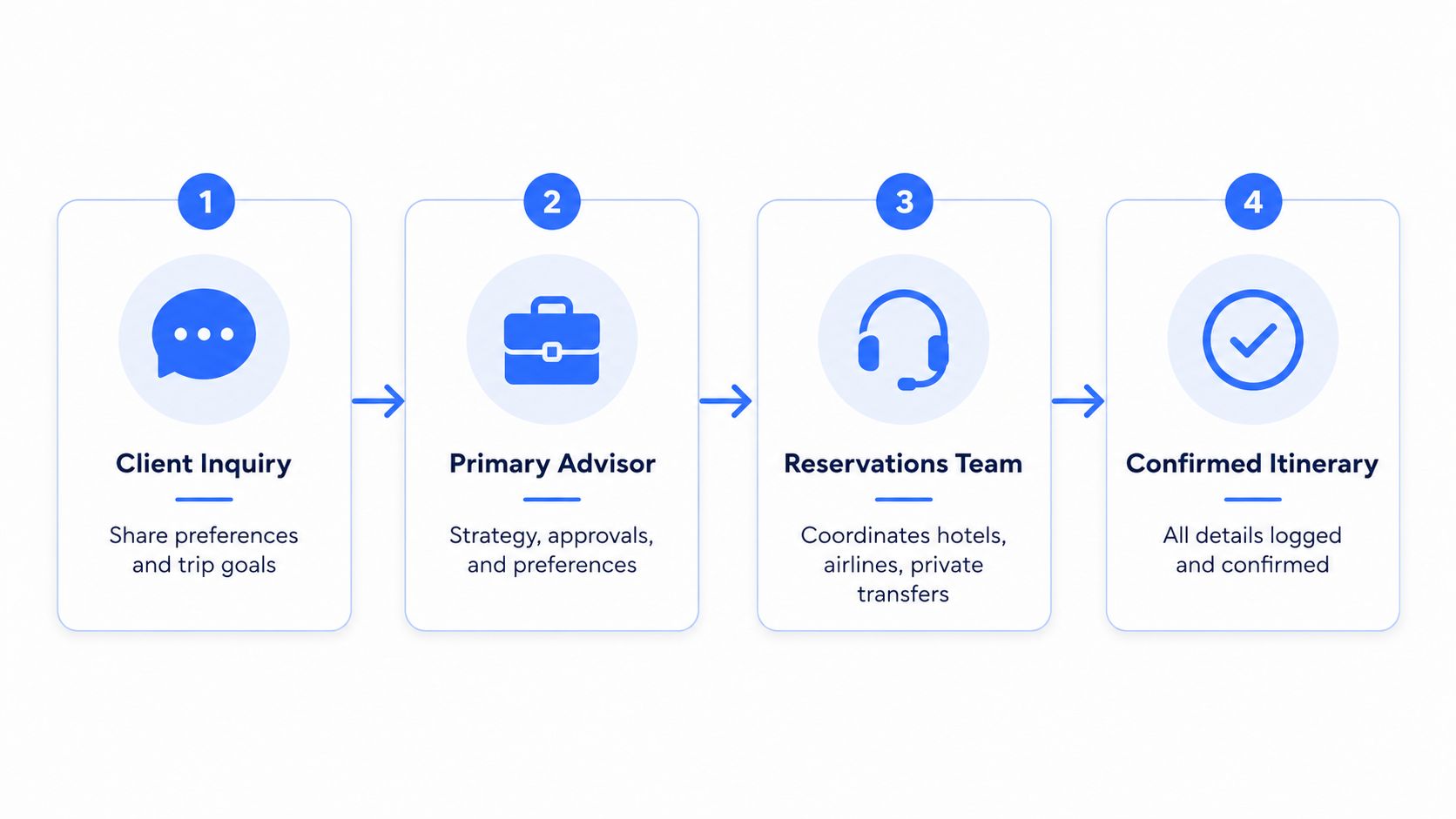
First, discovery establishes the brief. The advisor needs more than destination and dates. They should understand why you're traveling, who is coming, how much activity suits the group, what must remain private, and which details are essential. For a family, that might mean adjoining rooms, a private chef, childcare, and realistic transfer times. For an executive, it may mean quiet arrival logistics, reliable connectivity, and the ability to move meetings without rebuilding the entire itinerary.
Next, the primary advisor turns the brief into a strategy. This person manages preferences, recommendations, approvals, and the overall shape of the trip. A reservations team may then contact hotels, airlines, private aviation providers, yacht operators, ground companies, restaurants, and event venues. The distinction matters because one person should remain accountable for the experience even when many suppliers execute individual components.
Then, the team confirms the details. Every reservation should be logged with dates, times, names, contacts, payment terms, cancellation conditions, and special requirements. The advisor should also identify pressure points, such as short connections, limited transport availability, or activities that depend on weather.
Support during and after the trip
Communication typically runs through a direct advisor by phone, email, or secure messaging. A strong operation also has escalation procedures for evenings, weekends, and urgent situations. Local partners can handle an immediate issue on the ground, while the advisor monitors the larger itinerary and makes sure one change doesn't create a second failure elsewhere.
During travel, support can include rerouting, rebooking, reconfirming transfers, adjusting restaurant times, sourcing replacement activities, coordinating with villa staff, or arranging assistance after a medical incident. None of these outcomes should be promised as guaranteed. Availability, supplier policies, weather, and operational limits still apply.
The process shouldn't end at arrival home. A useful post trip review records what worked, what didn't, preferred guides, disliked room characteristics, dietary changes, and the group's evolving rhythm. That information improves future planning and gives an ongoing relationship practical value.
A concierge service that can't explain who handles a request, who takes over after hours, and how preferences are retained is offering a booking layer, not a dependable operating system.
Key Benefits for High Net Worth Travelers
The strongest reasons to use a luxury travel concierge are practical. Each benefit removes a specific burden that standard booking channels handle poorly.
Access helps when inventory is limited or unavailable through public channels. A concierge may work through hotel relationships, venue contacts, local operators, and preferred supplier networks to pursue waitlisted dining, private clubs, sold out performances, difficult transfers, villas, yachts, or private aviation. Access isn't magic, and no responsible advisor should promise an unavailable reservation. The advantage is having someone who knows which channels to try and who can pursue alternatives quickly.
Discretion matters when the itinerary itself is sensitive. Travel dates, family movements, executive meetings, medical visits, property searches, and event attendance can expose information a client doesn't want widely circulated. A private advisor can centralize communication and limit the number of people handling those details, though clients should still ask how data is stored and shared.
Personalization goes beyond selecting a five star property. A form might record a king bed, but a continuing advisor may know that the traveler wants a quiet room away from lifts, prefers an unhurried first morning, dislikes formal tasting menus, or needs a villa layout that works for grandparents and children. That memory reduces repetition and improves judgment.
Continuity gives one person responsibility across trips. The same advisor can understand how a couple's travel style changes after having children, how an executive's calendar affects routing, or how a family divides activities by age and mobility. Continuity also makes corrections faster because the advisor already understands the client's priorities.
Round the clock support addresses the fact that travel problems don't follow office hours. A diverted flight, lost luggage issue, medical need, or sudden schedule change may require action immediately. The service doesn't remove every risk, but it gives the traveler an advocate who can coordinate the next move instead of leaving them to manage several suppliers independently.
| Benefit | Traveler Problem Addressed |
|---|---|
| Access | Limited inventory, waitlists, and experiences that aren't easily available through public channels |
| Discretion | Exposure of names, movements, family details, or sensitive business arrangements |
| Personalization | Repeating preferences and receiving generic recommendations |
| Continuity | Rebuilding context for every new trip or involving several disconnected providers |
| 24/7 support | Delays, diversions, medical incidents, and urgent changes outside normal business hours |
The trade off is cost and commitment. If your trip is simple, public inventory is available, and you enjoy managing the details, concierge service may add little. If the trip has multiple moving parts or meaningful privacy requirements, the coordination burden becomes the deciding factor.
Concierge Service Compared With Other Booking Options
Online booking tools are excellent at speed, availability checks, and visible pricing. Traditional travel agencies add human planning and reservation support. A luxury travel concierge goes further by assuming responsibility for the relationships, sequencing, and live problem solving around the trip.
That doesn't make one option universally correct. The right choice depends on how complex the journey is, how much discretion you need, and whether you want to remain the project manager.
| Criterion | Online Booking | Travel Agency | Concierge Service |
|---|---|---|---|
| Customization | Strong for selecting individual products, limited for interconnected preferences | Can build structured itineraries and packages | Builds the journey around personal preferences, timing, and constraints |
| Supplier access | Usually limited to displayed inventory and standard channels | Depends on agency relationships and specialization | Often uses broader destination, hotel, villa, event, and local partner relationships |
| Human support | Usually reactive and channel specific | Advisor support during planning and booking | Dedicated oversight before departure and active coordination during travel |
| Privacy handling | Varies by platform and account structure | Depends on agency procedures | Should include explicit confidentiality practices and controlled communication |
| Disruption response | Traveler often manages the issue through separate providers | May assist, depending on hours and scope | Designed to reoptimize quickly, with coordinated escalation |
| Best fit | Straightforward trips and price comparison | Conventional leisure or business travel | Complex, multi stop, private, time sensitive, or high touch journeys |
Where each option falls short
Self service booking gives you control, but it leaves you responsible for checking compatibility. A platform can show a flight and hotel that are individually available without warning you that the transfer is unrealistic or that a missed connection will affect a private event.
A traditional agency can be a strong choice for standard routing, air ticketing, or a defined package. Its limitations appear when you need unusual combinations, sustained on trip oversight, non travel requests, or a single person to coordinate many independent suppliers.
A concierge should be judged more severely because the service promises more. Ask whether the advisor owns the itinerary, whether support continues after booking, and whether the company can make decisions quickly without sending every issue back to you. The distinction between an agent and advisor is explored in this guide to what a travel advisor does.
If your journey involves one hotel, one destination, and no unusual requirements, online booking may be efficient. If your itinerary involves several destinations, multiple generations, sensitive scheduling, or frequent changes, paying for coordination can be more rational than saving a planning fee.
Luxury Concierge Use Cases in Real Travel
The value of concierge support becomes easiest to assess through situations where several priorities compete.
Family travel across generations
A multigenerational family may need different room types, varied activity levels, flexible meal timing, accessible transport, and private time for smaller groups. The challenge isn't finding a luxury hotel. It's creating a schedule that lets grandparents participate without exhausting children, while giving adults enough space to enjoy the trip.
A concierge can coordinate room placement, airport assistance, private vehicles, guides, restaurant timing, childcare, and activities with different levels of intensity. If weather cancels a boat day, the advisor can look for a cultural visit, wellness arrangement, or private culinary activity that works for the same group. None of those alternatives is guaranteed, but the family doesn't have to rebuild the day while standing in a lobby.
Executive travel with moving targets
Executive travel rarely stays fixed. A meeting may move, a board member may join, or a flight may need to change because the business schedule has shifted. The concierge's task is to preserve the objective of the trip while reducing exposure to unnecessary waiting, public confusion, and fragmented communication.
That can mean coordinating airport transfers around a revised arrival, keeping hotel and meeting logistics aligned, arranging quiet ground movement, and maintaining a single message thread for the traveler or executive assistant. The advisor isn't replacing the company's travel policy. They're managing the exceptions and the interdependencies that standard booking tools don't see.
Milestones, performances, and private events
An anniversary, birthday, wedding, or family celebration needs more than an attractive itinerary. Vendors must arrive at the correct time, dietary details must be shared discreetly, transportation must allow for photographs or wardrobe changes, and the group must move without revealing the surprise.
Entertainment travel adds another layer. A performance schedule may require routing for artists, crew, management, security, and equipment, each with different needs. The concierge coordinates the calendar and communication without assuming that a preferred venue, room block, or access request can be secured automatically.
A private request may also emerge during the trip. The traveler may need a gift sourced, a delivery arranged, a last minute dinner found, or a private service organized. Handling that request is useful because the advisor already understands the itinerary, location, standards, and privacy expectations.
The best support is often invisible. The traveler notices that the day still works, not how many calls made it work.
These scenarios share one feature. The concierge isn't merely purchasing luxury products. They're managing timing, dependencies, people, and alternatives while keeping the client focused on the reason for traveling.
Choosing the Right Concierge Service
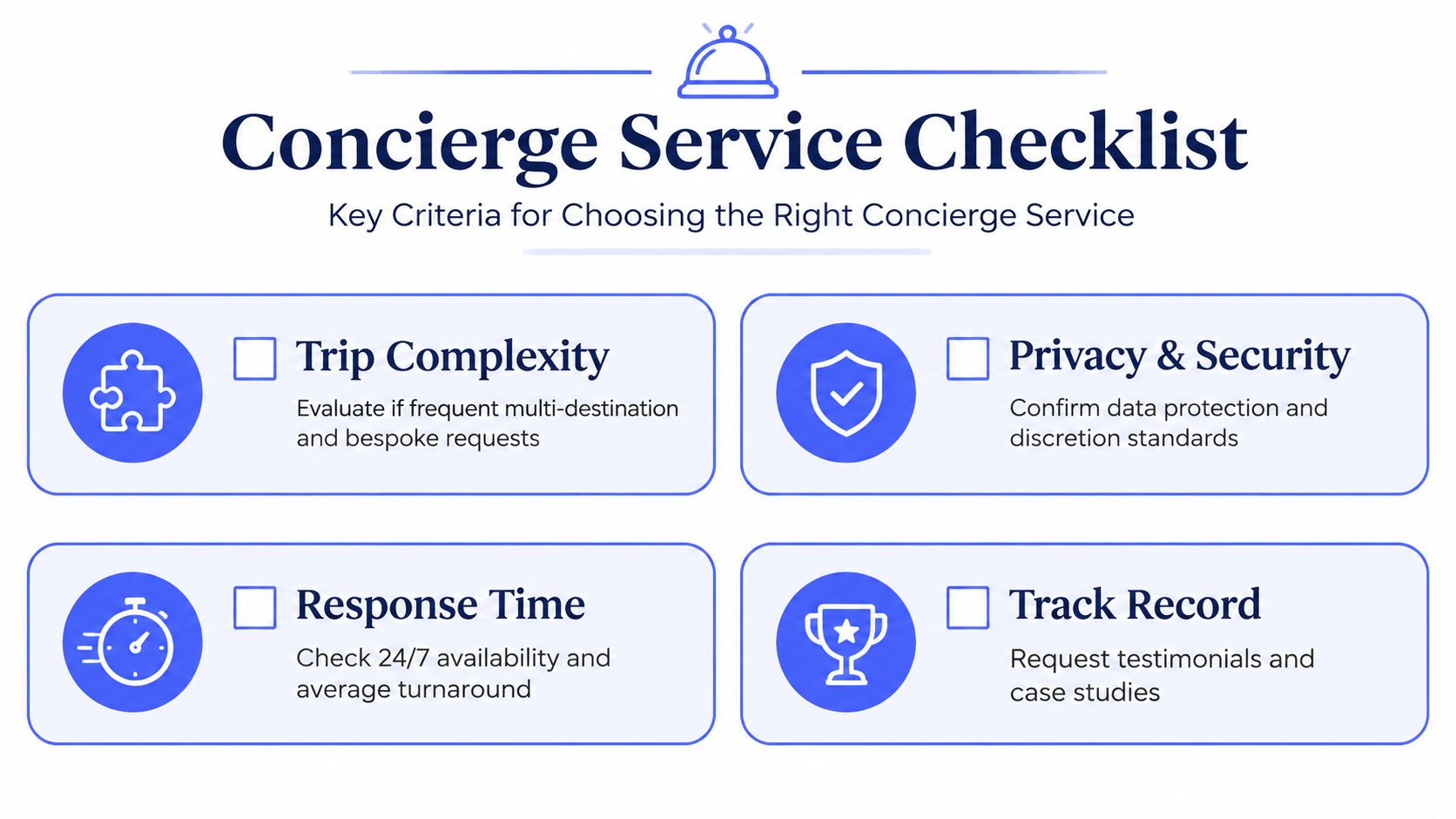
Don't choose a concierge because its website lists private jets, yachts, or sold out restaurants. Choose it because the team can explain how it will manage your particular complexity.
Start with the trip pattern. A provider suited to villa stays may not be the right fit for executive routing, entertainment production, or a destination wedding. Ask whether the team regularly handles multi stop itineraries, family groups, urgent changes, non travel requests, or privacy sensitive clients.
Questions that reveal operating quality
Who will manage the relationship? You should know the primary advisor, the backup structure, and what happens when that person is unavailable. A rotating contact list may be acceptable for a simple booking, but it can create friction when the itinerary is intricate.
How does the team handle disruptions? Ask who monitors the itinerary, who can authorize changes, how after hours escalation works, and whether local partners can act immediately. Don't settle for a vague promise of 24/7 support. Ask what that support includes.
How is privacy protected? Discuss confidentiality, secure communication, supplier access to personal details, and procedures for public figures, executives, family offices, or sensitive events. A provider should answer directly without treating discretion as a marketing adjective.
What is included in the fee? Models can include per trip planning fees, membership arrangements, commissions, retainers, or combinations of these. Request a written explanation of planning, booking, changes, emergency support, cancellations, supplier charges, and requests outside the original scope.
Red flags worth taking seriously
Be cautious if the provider can't describe its supplier relationships, gives unclear answers about response times, changes your point of contact repeatedly, presents templated itineraries as bespoke work, or claims it can guarantee access to anything. Strong providers explain limitations as clearly as they explain capabilities.
Request a sample itinerary for a trip resembling yours. Look for realistic transfer times, sensible pacing, contingency thinking, and details that show the planner understands how the journey will feel on the ground. The quality of that document often tells you more than a long list of brand names.
When Ongoing Concierge Support Makes Sense
Ongoing support makes sense when travel is frequent, complex, private, or closely connected to the rest of your life. It isn't automatically justified by wealth. A traveler with occasional, straightforward trips may be better served by project based planning.
Executives with shifting calendars benefit because the advisor retains context and can respond without starting from zero. Families benefit when school schedules, aging parents, childcare, and recurring destinations shape the calendar. Clients managing property purchases, relocations, medical visits, major celebrations, or entertainment commitments may need travel planning that extends beyond a single vacation.
The broader market reflects this move toward continuity. One trend report describes affluent travelers seeking access over assets, integrated lifestyle management, and planning that spans milestones, family obligations, and major events, as discussed in Perfect.Live's luxury travel trends analysis. Another market estimate projects luxury travel concierge services from USD 2.86 billion in 2025 to USD 5.48 billion by 2034, at a 7% CAGR, while a separate estimate projects growth from USD 801.64 million in 2025 to USD 1,320.09 million by 2032, at a 7.38% CAGR, according to Intel Market Research's category forecast. These are projections, not guarantees, but they support the commercial direction: clients increasingly want an enduring planning relationship rather than isolated transactions.
Before choosing an ongoing arrangement, clarify:
- Scope: Which travel and non travel requests are included?
- Communication: Which channels should you use, and how often will the advisor check in?
- Continuity: Who is your primary contact, and who covers absences?
- Fees: Is the relationship project based, membership based, or retainer based?
- Confidentiality: How are personal and itinerary details protected?
- Boundaries: What happens when a request falls outside travel planning?
For clients whose schedules, privacy, and time carry real weight, corporate concierge services can complement a travel relationship by extending coordination into executive and business needs. Justkeeps Travel offers bespoke leisure, corporate, group, and entertainment travel, with end to end itinerary design, dedicated advisor access, and 24/7 emergency assistance while clients are actively traveling on itineraries arranged by the firm.
The practical test is simple. Count the complexity of your trips, the frequency of changes, and the cost of managing everything yourself. If those demands recur, ongoing concierge support can protect more than a vacation. It can protect attention, continuity, and the ability to stay present when plans change.
Justkeeps Travel designs bespoke leisure, corporate, group, and entertainment journeys, coordinating hotels, villas, transfers, guides, dining, private experiences, and on trip changes through a dedicated advisor. If your travel requires discretion, multi party coordination, or year round support, visit Justkeeps Travel to discuss the kind of planning relationship that fits your needs.