



How to Plan a Group Trip That Actually Happens
You're probably in a group chat with a destination everyone likes, a few enthusiastic reactions, and no actual trip. One person asked about dates, someone else suggested a hotel, three people voted for different budgets, and now the conversation has gone quiet. That isn't a destination problem. It's a coordination problem.
Group travel requires people to align schedules, budgets, travel documents, comfort levels, and expectations before anyone pays a deposit. A 2026 survey summary reported that 69% of trips were planned with other people, compared with 31% solo, and described global group travel as projected to grow at a 6.2% CAGR from 2023 to 2030 (Monkey Travel's 2026 group-travel statistics summary). If you want to know how to plan a group trip that happens, stop treating the group chat as the planning system. Give the trip an owner, a decision process, and deadlines.
Table of Contents
- Appoint one decision owner
- Set a budget band, not a fantasy number
- Lock a usable date window
- Send a short intake survey
Why Most Group Trips Never Happen
Most group trips don't fail because the destination is wrong. They fail because nobody has the authority to turn preferences into decisions.
A 2026 survey of 2,000 U.S. women found that 76% of group trips never made it out of the group chat, while planning took nearly 19 hours over 11 days and required 83 messages on average to reach agreement (the survey summary published by the New York Post). The numbers describe a familiar pattern. People express interest, but nobody owns the next move.

Four breakdowns that quietly kill the trip
- Undefined ownership: Everyone can suggest, but nobody must consolidate the answers or make the final call.
- Vague budgets: “Something reasonable” means different things to different travelers. People who can't afford the emerging plan often disappear instead of objecting.
- Drifting dates: A broad season or month doesn't create urgency. Availability changes while the group keeps discussing.
- Endless polling: Every answer generates another poll, and every poll creates another set of combinations to debate.
The group chat makes all four problems worse because it mixes casual conversation with binding decisions. A message gets buried, a late reply reopens a settled question, and the organizer starts asking for the same information repeatedly. The trip loses momentum before anyone notices.
Practical rule: A group chat is useful for energy and reminders. It shouldn't be the source of truth.
The remedy is deliberately boring. Name one decision owner, agree on a budget band, lock a date window, and keep the current plan in one shared document. The owner doesn't need unlimited power, but the group does need a clear final call. Without that structure, every traveler becomes a veto point, and the easiest outcome is silence.
Group-trip planning also takes longer than non-planners expect. A 2026 survey of 2,725 travelers across 10 markets found that more than 60% of Indian planners spent over 10 hours organizing a single week-long trip, with schedule coordination identified as the biggest stressor at 63.7%, followed by budget management at 59.2% (the Klook study reported by the Economic Times). Build the structure first, then choose the destination.
Locking the Foundation Before You Pick a Destination
Destination research feels productive, but it's usually premature. Start with four inputs that determine what the group can realistically buy: decision ownership, budget, dates, and traveler constraints.
Appoint one decision owner
Choose one person to consolidate responses, maintain the itinerary, communicate deadlines, and make the final call when the group reaches a tie. That person can delegate tasks, such as asking a traveler to compare flights or another to review restaurants, but delegated research doesn't create shared ownership of the final decision.
Tell the group exactly what the owner controls. A useful message is: “I'll collect preferences and narrow the options. We'll vote on the shortlist once, then I'll confirm the plan that fits the agreed budget and dates.” This prevents every decision from returning to the entire group.
Set a budget band, not a fantasy number
Ask for a comfortable range per person and separate essential costs from optional spending. Group organizers often need budget segmentation before destination research begins. One industry survey reported that 43% of group trips cost under $1,000 per person, while 15% exceeded $3,000, and that 67% of organizers ran international trips (Group Travel Leader's modern travel-planner statistics).
Don't ask, “What does everyone want to spend?” with no context. Ask whether the range covers transportation, lodging, transfers, shared activities, and meals, then identify which items travelers can opt out of.
Lock a usable date window
Collect actual availability, not vague preferences. Ask each traveler for dates they can definitely travel, dates they could travel with notice, and dates they can't travel. Then identify the narrowest shared window that works for the essential travelers.
Send a short intake survey
Use Google Forms, Typeform, or a similar tool before opening destination debate. Keep it short:
- Budget: Comfortable per-person range and absolute ceiling
- Dates: Available windows and blackout dates
- Passport: Valid passport, renewal pending, or no passport
- Mobility: Walking tolerance, stairs, transfers, and accessibility needs
- Trip priority: Food, culture, beaches, nightlife, relaxation, shopping, or nature
- Rooming: Private room, shared room, couple, or flexible
- Must-have: One requirement
- Flexible area: One element the traveler can compromise on
Now create a shortlist of two or three destinations, not ten. Score each against the locked inputs, then hold one vote. A 2026 group-travel report stated that 62% of group bookers plan three or more months ahead, while 28% book within one month, reinforcing the need to resolve constraints early (ZipDo's group-travel industry statistics).

Building a Budget That Holds Up Under Scrutiny
A group budget fails when it gives travelers a single attractive headline price and hides everything underneath. Build the estimate in layers so people can see what's required, what varies, and what they can decline.
| Cost Layer | Examples | Who Pays | Visibility |
|---|---|---|---|
| Core trip costs | Flights, lodging, airport transfers, intercity transport | Everyone using the service | High, show before commitment |
| Shared experiences | Tours, group dinners, rentals, guides | Participants who join, or the full group if mandatory | Medium, confirm inclusions |
| Per-person variations | Room category, dietary requests, baggage, private transfers, optional activities | Individual traveler or assigned room | High, itemize separately |
| Contingency reserve | Unexpected transport, replacement bookings, operational changes | Group policy should define this | Medium, explain its purpose |
The first layer determines whether the trip is viable. The third determines whether the group can remain fair. A traveler who needs a private room shouldn't be forced to subsidize another person's upgrade, and a traveler who skips an optional excursion shouldn't automatically pay for it.
Use a simple formula:
Estimated cost per person = shared core costs ÷ participating travelers + individual costs + selected shared experiences + contingency contribution
Keep the calculation in a spreadsheet with one row per traveler and separate columns for mandatory, optional, and individual charges. Google Sheets works well because the owner can restrict editing while still allowing the group to view the current estimate.
Surface the costs people forget
Before asking for a deposit, check every booking page and supplier term for charges that don't appear in the first search result:
- Air travel: Checked baggage, seat selection, airport transfers, and fare restrictions
- Hotels: Resort or destination fees, taxes, breakfast, parking, and room-category differences
- Ground transport: Driver waiting time, luggage handling, tolls, intercity repositioning, and late-arrival surcharges
- Dining: Service charges, gratuities, set menus, cancellation terms, and minimum spends
- Activities: Equipment rental, guide gratuities, transport to the meeting point, and nonrefundable deposits
Don't disguise uncertainty by presenting a falsely precise total. Label each figure as confirmed, estimated, or pending. Travelers can accept a range when they understand what controls it. They resent a low initial figure that changes after they've already committed.
Budget discipline: Every line item needs an owner, a payer, and a cancellation rule.
For different comfort levels, create packages rather than arguing over one universal standard. One traveler might choose a shared transfer and a standard room, while another pays the supplement for a private transfer and a higher room category. The shared document should show both the group baseline and each traveler's additions.
The decision owner should issue a payment schedule with due dates, payment method, refund terms, and the consequence of missing a deadline. A trip becomes financially real when the group understands not only what it costs, but also what happens if someone changes their mind.
Managing Guests Without Becoming the Unpaid Project Manager
The organizer shouldn't have to remember every dietary restriction, passport detail, room preference, and unanswered question. Move those details out of conversation and into a controlled intake system.
Start with one preference form. Capture the traveler's legal name as it appears on travel documents, preferred name, contact number, emergency contact, passport expiration status, dietary requirements, allergies, mobility needs, rooming preference, bed preference, flight details once booked, and willingness to join optional activities. Collect sensitive information only through a private form or direct message, not in a public group thread.
Keep the operating system simple
Use three files:
- Private traveler sheet: The owner keeps legal names, passport status, emergency contacts, medical notes, and payment records. Limit access to people who need it.
- Rooming matrix: The group sees room assignments, room types, roommates, and practical notes, but not sensitive personal information.
- View-only itinerary: The owner controls edits. Guests can check dates, addresses, confirmation numbers, meeting points, and contacts without changing the plan.
A practical role structure is described in this guide to coordinating group travel, where guest-by-guest details must be managed alongside the shared itinerary. The principle matters more than the software. One source of truth prevents conflicting versions from circulating.
Set a 72-hour response window for decisions. Send the request, state the deadline with a time zone, and define the default if someone doesn't reply. “If I don't hear from you by Thursday, I'll assume you're not joining the optional dinner” is clearer than three follow-up messages asking whether the person has seen the poll.
Route questions to the right channel
- Shared document: Confirmed itinerary, room assignments, booking details, deadlines, and meeting points
- Private message: Medical information, payment concerns, passport issues, and personal upgrades
- Group thread: Decisions that affect everyone, such as dates, shared activities, or a change to the hotel
Don't solve every request in the group chat. The group needs visibility on decisions, not a transcript of private negotiations.
| Guest | Room Type | Roommate | Notes |
|---|---|---|---|
| Guest A | King | Guest B | Couple, late arrival |
| Guest B | King | Guest A | Couple, late arrival |
| Guest C | Twin | Guest D | Early riser |
| Guest D | Twin | Guest C | No feather pillows |
| Guest E | Twin | Guest F | Shared room approved |
| Guest F | Twin | Guest E | Vegetarian meal |
| Guest G | Single | None | Quiet room requested |
| Guest H | Single | None | Mobility assistance at check-in |
For larger blocks, add a room number only after the hotel confirms it. Never promise adjoining rooms before the property does.
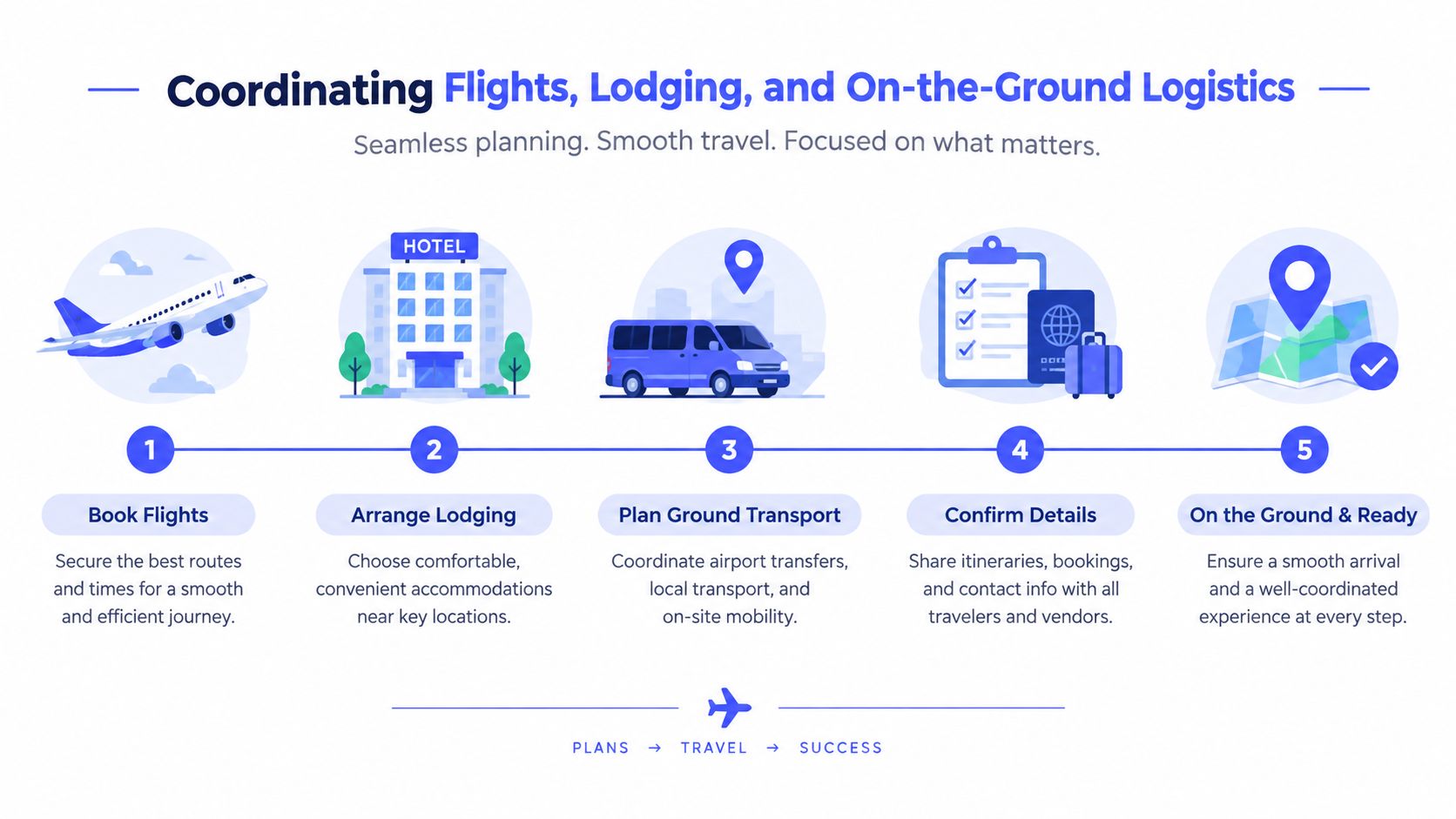
Coordinating Flights, Lodging, and On-the-Ground Logistics
A destination wedding makes the sequencing problem obvious. Suppose the group arrives in a major city for the ceremony events, then moves to a beach property for several nights. The trip works only if flight arrivals, hotel check-in, transfers, and the second accommodation are treated as one connected system.
Start with the airport arrival window, not the transfer booking. Ask travelers to share arrival airports, flight numbers, arrival times, baggage needs, and whether they're comfortable waiting for the rest of the group. Once the arrival pattern is clear, the transport provider can recommend private vehicles, a coordinated shared transfer, or separate pickups.
Booking a driver before collecting flight details is a classic failure. A delayed flight can leave a driver waiting, while a traveler who lands earlier may be left without transport. Put the flight window into the shared document, then issue a transfer plan with the provider's emergency number and a meeting-point description.
Choose the right lodging structure
A hotel block reserves a defined number of rooms under agreed terms, sometimes with a release date or pickup requirement. It's useful when the group needs coordinated room types, a shared arrival experience, or event proximity.
A group rate is a negotiated price or set of terms, but it may still require each traveler to book individually. That can reduce the organizer's payment burden, though it introduces a risk that travelers miss the booking deadline.
Individual bookings offer flexibility, but they make rooming, arrival tracking, and changes harder. Use them when travelers have sharply different budgets or when the property doesn't offer a workable block.
Before sharing a deposit link, confirm the room inventory, cancellation terms, payment schedule, taxes and fees, breakfast or meal inclusions, and whether the hotel will hold rooms until a specific date. For a high-touch itinerary, luxury group travel coordination can also involve private guides, dining reservations, and local partners that need to be sequenced around the core bookings.
Book shared experiences only after the headcount stabilizes. A private boat, restaurant buyout, or guided excursion can have strict cancellation terms, so don't commit the group's money while several travelers are still undecided.
Before the deposit request goes out, verify:
- Flights: Arrival airports, timing, flight numbers, and baggage assumptions
- Hotels: Room block, rooming plan, terms, and release date
- Transfers: Pickup method, vehicle capacity, waiting policy, and emergency contact
- Activities: Minimum headcount, inclusions, exclusions, and cancellation rules
- Payments: Amount due, individual balance, deadline, and consequence for nonpayment
Communication Templates That Keep the Group Moving
Good communication isn't constant communication. Send a message when the group must understand something, decide something, or prepare for something. Every decision message should include the deadline and the default outcome if someone stays silent.
Kickoff message
Channel: Group chat
Tone: Warm, confident, concise
Trip idea: [destination]
I'm happy to coordinate this trip. I'll collect preferences, manage the shared itinerary, and make the final call when we reach a tie. Please complete this form by [date and time]: [link].
I need your budget range, available dates, passport status, room preference, mobility or dietary needs, and top trip priority. I'll return with two or three workable options by [date]. If you don't complete the form, I'll treat you as undecided and won't include you in the first booking count.
This message creates a role without making the organizer sound authoritarian. It also stops “I'm interested” from being mistaken for a commitment.
Deposit request
Channel: Group chat, with payment details in the shared document
Tone: Direct and specific
Deposit deadline for [trip name]
The current plan is [hotel and dates], based on the budget range we agreed. Your deposit is [amount] and is due by [date and time]. Payment terms and cancellation rules are in the itinerary.
If payment isn't received by the deadline, I'll release your room and remove you from the shared bookings. Please reply “paid” after submitting, or message me privately if you need to discuss an issue.
Don't write a vague reminder. The deadline and consequence protect the group from carrying an unconfirmed traveler.
Weekly update
Channel: Group chat, with the full record in the itinerary
Tone: Brief, operational
Weekly trip update
Open decisions:
- Confirm your flight details by [date].
- Choose [shared dinner option A or B] by [date].
- Confirm rooming details in the matrix.
- Tell me privately about any mobility or dietary change.
If nobody objects by [deadline], I'll proceed with option A and the current rooming plan.
Limit each update to the decisions that need attention. A long stream of minor details trains people to ignore the important ones.
Final-week briefing
Channel: Group chat and view-only itinerary
Tone: Calm, practical, reassuring
One week to go
Your itinerary now includes flight details, hotel addresses, transfer instructions, meeting points, and emergency contacts. Please check your passport, travel insurance, medication, luggage plan, and phone access before [date].
Airport transfer instructions are listed beside each arrival. If your flight changes, contact [transfer contact] and me immediately. We'll meet at [anchor point] at [time] before the first shared activity.
Keep routine updates to a predictable cadence, such as a kickoff, weekly decision message, deposit reminder, and final briefing. Too many messages create fatigue. Too few leave travelers anxious and encourage private side conversations.
Contingency Planning and Knowing When to Hand It Off
A smooth itinerary isn't one with no problems. It's one where the group knows who acts when a problem appears.
Build a one-page contingency brief before departure. It should match the actual bookings and include vendor contacts, booking references, cancellation terms, traveler emergency contacts, medical and dietary notes, the secondary decision owner, and instructions for flight disruption, illness, weather, and vendor failure.
Pre-build the response
For a flight cancellation, the decision owner checks the airline's rebooking options, then contacts the transfer provider and hotel with the revised arrival plan. For illness, the traveler gets private help while the group continues on a modified schedule. For weather disruption, the owner uses the documented cancellation terms rather than negotiating from memory.
Give each supplier a primary and backup contact. Re-state refund timelines next to every booking in the private planning sheet. Travelers should carry a compact medical and dietary sheet, while the organizer keeps the full version securely.
Name a secondary decision owner before departure. That person needs access to the itinerary, supplier contacts, payment records, and traveler list. If the lead planner is unreachable, the group shouldn't have to vote on who can call the driver.
Distribute the contingency brief 72 hours before departure and ask travelers to acknowledge that they've read it. Keep the current version in the shared itinerary, but don't expose sensitive details to everyone.
Recognize the handoff point
DIY planning stops making sense when the organizer must manage too many variables at once. Clear triggers include:
- More than 12 travelers: Rooming, payments, arrivals, and special requests become difficult to reconcile manually.
- Multi-country routing: Each border, transfer, currency, and supplier adds another dependency.
- Visa requirements: Document errors can affect the entire schedule.
- Accessibility needs: Lodging, transportation, and activities require precise verification.
- Budget above $50,000: The financial exposure warrants stronger contracts, tracking, and escalation.
The cost of professional planning isn't only a fee. It's also the value of the organizer's time, the risk of a missed cancellation window, and the consequences of a failed transfer or unsuitable room block. A group travel advisor can centralize accommodations, flights, transportation, activities, dining, room assignments, payment schedules, and traveler communication. JustKeeps Travel's group travel service is one option for groups that need that level of coordination.
Use the handoff conversation to ask what the advisor owns, what remains with travelers, how payments are collected, what happens during disruptions, and whether support continues while the group is traveling. If the trip has outgrown a spreadsheet, continuing to DIY it isn't discipline. It's unmanaged exposure.
JustKeeps Travel coordinates bespoke group trips, including destination weddings, celebrations, reunions, multi-family getaways, and company offsites, with guest-by-guest handling and support across flights, hotels, transfers, dining, activities, and changes. If your group needs a single planner to turn competing preferences into a workable itinerary, visit JustKeeps Travel to start the conversation.