



10 Names for Travel Companies: Naming Models That Work
Popular advice says a travel brand name just needs to sound elegant. That's too shallow for a category where clients judge trust, clarity, and fit before they ever speak to an advisor. A strong name has to signal who you serve, whether you're advisory or transactional, how far your services can scale, and whether the brand will still make sense when you add corporate travel, group coordination, concierge support, or destination expertise. It also has to survive the practical checks that sink weak names, exact domain use, trademark friction, easy pronunciation, and whether it sounds credible in an email signature or a sales call.
That matters even more in travel because the market is crowded and trust sensitive. In a concentrated market, big labels dominate attention, and category leading firms usually pair clear parent brands with distinct subsidiary brands rather than relying on one generic name alone, as seen in the scale of Booking Holdings and Expedia Group and their multi brand architecture in online travel Statista's travel agency revenue summary. For Justkeeps Travel, the naming conversation is also about founder led service, discretion, and bespoke execution, not just style. The right model has to support that promise from day one.
Table of Contents
- 1. Descriptor + Sophistication Model
- 2. Founder Name Heritage Model
- 3. Destination Mastery Model
- 4. Service Definition Model
- 5. Experience + Outcome Model
- 6. Proximity + Partnership Model
- 7. Discretion + Confidentiality Model
- 8. Relationship Depth Model
- 9. Problem and Solution Model
- 10. Membership + Exclusivity Model
- 10 Point Comparison of Travel Company Name Models
- Turn the Shortlist Into a Defensible Brand
1. Descriptor + Sophistication Model
A descriptor plus sophistication name tells the buyer exactly what kind of travel brand they're dealing with. Curated Journeys, Refined Escapes, and Bespoke Experiences all signal hand selected service, not a generic booking engine. That matters in luxury leisure because the name should sound selective, polished, and capable of handling more than one trip type.

The strongest versions of this model use a sharp descriptor with a real operational promise. Curated works if your team hand builds itineraries, vets properties, and edits every proposal. Refined works if the service standard is high but not fussy. Orchestrated Escapes sounds more dynamic, while Seamless Journeys fits a brand that handles logistics from air to arrival.
Practical rule: Don't use a luxury adjective unless your delivery matches it. Clients notice the gap fast when the name promises taste but the process feels templated.
This model is especially useful for firms that want to cover honeymoons, family vacations, wellness retreats, and premium leisure without sounding too narrow. It's less effective if you need to lead with corporate rigor or entertainment discretion. For a founder led brand like Justkeeps Travel, the best use of this model is as a descriptor layer beneath the master brand, not necessarily as the legal name itself. The brand can still borrow the tone while keeping room for concierge, corporate, and group services, which is consistent with the rise of ultra curated travel positioning in Justkeeps Travel's curated travel perspective.
2. Founder Name Heritage Model
Founder names work because they make the business feel accountable. A name like JustKeeps, The [Surname] Collection, or [Surname] Advisory tells clients there's a person behind the service, not just a platform. In high touch travel, that personal stake is often the difference between a polite inquiry and a signed client relationship.
This model fits luxury advisory work, family office style service, and any firm that wants to lean on generational judgment or long term relationships. It performs well when the founder is the face of planning, the one who knows the hotel partners, and the person clients expect to call when plans change. It also works when the company serves public figures or privacy conscious travelers, because the name itself feels more bespoke than generic.
The trade off is real. If the founder leaves without a succession plan, the brand can lose part of its meaning. That's why this model should be tied to a clear narrative, a visible philosophy, and a communication plan for future transitions.
A strong founder led name often benefits from one of these structures:
- Founder's Name + Advisory: Signals professional service and executive handling.
- Founder's Name + Collection: Suggests curation and premium taste.
- Founder's Name + Travel: Simple, direct, and easy to understand.
- Founder's Name + Concierge: Works when service breadth extends beyond booking.
Use this model if the selling point is judgment, access, and continuity. It's especially strong when your clients stay with the same advisor year after year. For Justkeeps Travel, the founder led frame fits the business reality, limited roster, one to one planning, and year round support.
3. Destination Mastery Model
Destination led names say, “We know this place better than a generalist does.” Japan Journeys, Safari Masters, and Italian Escapes immediately tell the client what expertise sits behind the brand. That's powerful when your business is built on deep route knowledge, preferred partners, and destination specific planning.
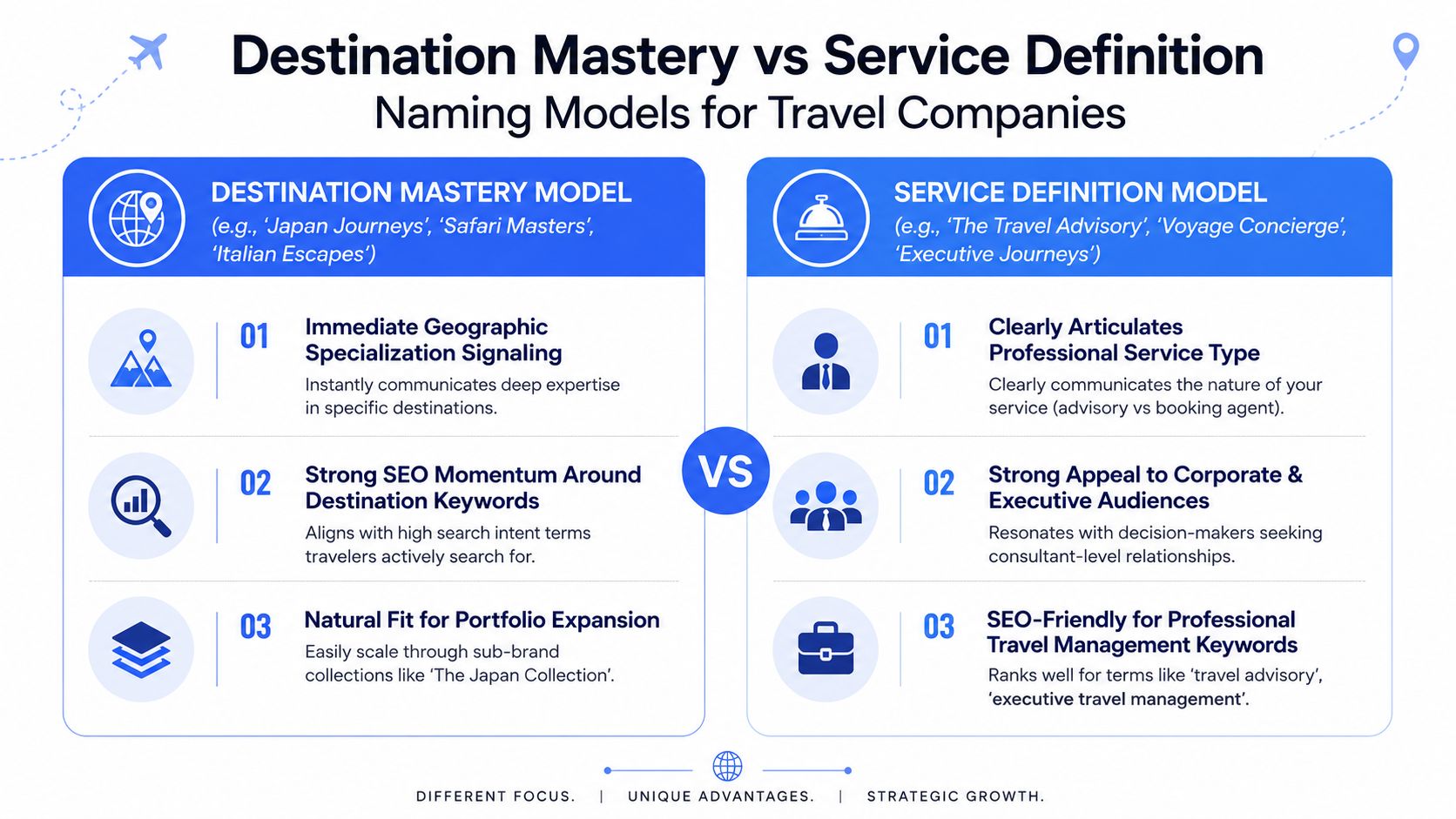
This model is ideal for firms that want to own a geography or a small set of regions. It works well for Japan, East Africa, the Maldives, or the Amalfi Coast because the name can reinforce local knowledge, seasonal intelligence, and meaningful supplier relationships. A client booking a specialist wants confidence that the advisor understands the destination beyond surface level inspiration.
The problem appears when the business expands. A hyper specific name can become restrictive if you later add more countries, broader concierge services, or non destination based travel like corporate offsites. If the business has plans to serve multiple verticals, the geography should sit in the content architecture, not always in the master name.
For that reason, destination mastery is strongest as a brand system, not just a label. A master brand can stay broad while journey pages, guides, and curated collections carry destination signals. That structure is especially useful for a firm like Justkeeps Travel, which already shows destination depth across Japan and other signature markets, including a dedicated Japan journey page.
Use geography when the destination is the reason clients choose you. Avoid it when the real selling point is broader than one place.
4. Service Definition Model
Some of the best names don't try to sound poetic. They lead with the service. The Travel Advisory, Voyage Concierge, and Executive Journeys tell buyers what level of help they're getting before they read a single line of copy. That makes this model ideal for corporate travel, high touch concierge work, and clients who value professionalism over romance.
The advantage is clarity. A corporate buyer, executive assistant, or production manager needs to know whether the firm handles complex itineraries, changes, and approvals. Service definition names reduce ambiguity and create a better fit for channels where speed matters, such as RFPs, assistant networks, and relationship driven referrals.
This model also aligns with the broader shift toward advisory language in travel. The industry's best operators increasingly frame themselves as advisors, specialists, or concierge services, because those words imply judgment and coordination rather than simple booking. That distinction matters when the client is comparing a premium firm against a commodity channel.
A useful naming pattern here is service term + distinctive modifier. Precision Travel Advisory sounds more credible than Travel Advisory alone. Discreet Journeys Concierge suggests privacy and polish. Executive Journeys fits a firm that handles business travel and leadership retreats.
The downside is that purely functional names can feel generic if the visual brand is weak. They need a strong website, tight copy, and proof of service depth. A name like this works best when the business handles complex routing, VIP requests, and time sensitive problem solving. For brands serving corporate and high net worth clients, that's often the point.
5. Experience + Outcome Model
This naming model ties the feeling of the trip to the result the client expects. Flawless Expeditions, Precision Retreats, and The Discovery Collective signal polish and intent at the same time. The name promises an experience, and it also hints at how the business delivers it.
It fits brands that sit between inspiration and logistics. Leisure clients want the trip to feel memorable. Corporate clients want control. Group clients want coordination. A name in this model can speak to all three if the positioning is disciplined.
The promise has to stay believable. Flawless should mean fewer handoffs, tighter coordination, and faster adjustments. Precision should mean detail management, not rigid service. Discovery should fit a brand built around immersion, not casual sightseeing.
Use the name to match the problem you solve. A firm that cleans up messy planning can credibly use Precision Retreats or Flawless Expeditions. A brand that builds discovery led itineraries for discerning travelers can use The Discovery Collective without sounding transactional.
The strongest version pairs a clean name with a direct service explanation. That is where editorial discipline matters. A luxury travel brand can sound aspirational and still stay operationally clear. For Justkeeps Travel, this model fits because the promise is end to end design, not a stack of disconnected bookings, which is the logic behind its bespoke itinerary approach.
6. Proximity + Partnership Model
Names built around local presence work because clients want insider access, not just internet research. The Local Collective, On Ground Partners, and The Ground Advantage all suggest a network of vetted people in the destination, not a faceless intermediary. That is a strong fit for brands that rely on guides, concierges, hoteliers, and destination specialists.
The business logic is simple. If your edge is preferred relationships, the name should hint at it. Clients booking a villa, a safari, or a complex multi stop trip want to know someone is in the market, solving problems with local context. That's especially valuable when the itinerary depends on timing, access, or nuanced logistics.
This model is strongest when the brand can prove the network exists. That means partner profiles, local guides, destination stories, and concrete examples of coordination. A name alone won't carry the claim. It has to be backed by content and operations.
The trade off is that proximity language can feel vague if it isn't grounded. Ground Advantage sounds credible when the company has on the ground contacts. It sounds empty if the service is still mostly remote and generic. Keep the promise practical.
A local partnership name should point to real access, not decorative neighborhood language.
For firms that specialize in luxury leisure, destination travel, or entertainment logistics, this model supports trust without sounding cold. It also pairs well with destination content because the brand can talk about guides, hotels, and suppliers in a way that feels earned rather than borrowed.
7. Discretion + Confidentiality Model
Privacy first names speak directly to clients who need calm, control, and minimal exposure. Private Compass, Confidential Journeys, and The Discreet Advisory all signal that the business knows how to handle sensitive travel with care. That makes this model a strong fit for celebrities, executives, entertainment clients, and anyone whose movements need protection.
The value here is not glamour. It's restraint. A privacy oriented name says the brand won't overshare, won't publicize client details, and won't treat logistics like content. That message matters in a category where discretion is often a selling point but rarely named directly.
This model should be backed by operational discipline. NDAs, limited information sharing, staff training, and tight communication controls are not optional if the name makes a confidentiality promise. If the firm markets privacy, it has to behave that way in every client touchpoint.
Use this style when the business serves clients with security concerns or reputational sensitivity. It's also useful for entertainment travel and production logistics, where schedules change fast and visibility needs to stay low. A direct name here is better than a clever one.
The risk is overclaiming. A word like private raises expectations, so the brand has to protect that promise from the first inquiry onward. This model works when confidentiality is a real operating principle, not a cosmetic adjective.

8. Relationship Depth Model
Some names are built to signal continuity rather than one off bookings. Your Travel Companion, The Long Game Collective, and Lifetime Journeys all suggest an ongoing relationship, not a transaction. That's a strong fit for firms that manage repeat leisure trips, annual family travel, and year round concierge needs.
The best version of this model sounds personal without becoming casual. Companion works because it implies closeness, but it still feels service oriented. Lifetime works if the business expects long client retention and multi trip planning. Long Game is better for a modern, strategic brand that wants to emphasize tenure and stewardship.
This model is useful when the advisor relationship is the product. Clients want the same person to remember their preferences, family milestones, and travel history. The name should reinforce that ongoing memory and care. It also supports membership or retainer structures if the business chooses to formalize recurring access.
The problem is that relationship language can be vague unless the service architecture is strong. If you choose this model, the onboarding process, client records, and communication rhythm need to be excellent. A warm name without operational continuity feels thin.
That's why this model works best for firms with direct access planning and consistent advisor continuity. It fits a brand that wants to become part of a client's annual rhythm, not just their next trip. It also supports a concierge forward model where the relationship continues between journeys.
9. Problem and Solution Model
Some clients don't want inspiration first. They want the headache removed. The Coordination Specialists, Complex Journeys Made Simple, and Stress Free Travel attack the problem head on and make the value proposition obvious. That can be very effective for corporate buyers, group coordinators, and executive assistants.
This model is especially strong when the brand solves recurring operational pain. Multi city routing, conflicting preferences, sold out inventory, last minute changes, and event travel all benefit from a name that sounds competent and unflustered. If the business is built around recovery and coordination, clarity beats poetry.
The best names in this category are direct but not dull. Complex Journeys Made Simple has a clear promise. The Coordination Specialists sounds professional and capable. Stress Free Travel is easy to remember, but it can feel generic unless the supporting brand is sharp.
Use this model when the buyer is under pressure and needs certainty. That makes it ideal for conference planners, family reunion organizers, entertainment teams, and busy executives. It also fits firms that can prove they reduce friction through process, not just through style.
If the client's main emotion is relief, the name should sound like relief.
Keep the language grounded in operations. This model should lead into systems, response speed, and problem resolution, not vague reassurance. It works when the brand can simplify complexity and coordinate a lot of moving parts without making the client manage the mess.
10. Membership + Exclusivity Model
Membership style names make the brand feel selective and recurring. The Passport Collective, The Travel Society, and The Journeys Club all imply belonging, access, and ongoing benefits. That's a strong fit for affluent clients, executives, and frequent travelers who want curated treatment rather than open market service.
The appeal is straightforward. A club style name creates a sense of privilege and continuity. It also gives the business room to offer priority access, member events, and tiered service levels without constantly explaining the model again. If the company wants predictable revenue or deeper engagement, this is a smart direction.
The model only works if the experience is selective. That means clear entry standards, strong onboarding, and benefits that feel useful, not decorative. A membership name with no real exclusivity can look inflated fast.
A useful structure here is to connect the club concept to a tangible service promise. The Travel Society can support curated access. The Journeys Club can support member only planning perks. The Passport Collective can work for a broader, community driven luxury travel brand.
This model is also effective when the business wants to build community around travel rather than sell itineraries. It suits repeat travelers who enjoy having a known advisor and a defined relationship with the brand. For a premium advisory firm, that relationship layer can be a real differentiator.
10 Point Comparison of Travel Company Name Models
| Model | 🔄 Implementation complexity | ⚡ Resource requirements | ⭐📊 Expected outcomes | Ideal use cases | 💡 Key advantages |
|---|---|---|---|---|---|
| Descriptor + Sophistication Model ("Curated Journeys") | 🔄 Medium, simple two word formula; needs consistent visual & editorial execution | ⚡ Moderate, branding, premium content, SEO | ⭐ High quality perception; 📊 Strong luxury SEO & brandability | Luxury leisure, cultural markets (Italy, Japan), editorial channels | 💡 Differentiates from mass market; memorable and premium feel |
| Founder/Family Name Heritage Model ("JustKeeps") | 🔄 Low to Moderate, straightforward name; requires succession/legal planning | ⚡ Low to Moderate, PR, founder visibility, reputation management | ⭐ High trust & credibility; 📊 Strong referral performance, limited scalability | Founder led concierge, HNW relationship driven services | 💡 Builds personal trust and accountability; great for referral growth |
| Destination Mastery Model ("Japan Journeys") | 🔄 Low, clear naming; operational work to prove expertise | ⚡ Moderate, destination partnerships, deep content, local teams | ⭐ High authority in target regions; 📊 Strong search visibility for destination intent | Destination specialists (Japan, Amalfi, safaris, Maldives) | 💡 Excellent SEO and perceived expertise; supports subsidiary brands |
| Service Definition Model ("The Travel Advisory") | 🔄 Low, direct & functional; needs clear positioning to avoid generic feel | ⚡ Low to Moderate, credentials, B2B sales, professional messaging | ⭐ Moderate to High clarity; 📊 Strong B2B conversion and premium margin potential | Corporate, executive, and professional travel management | 💡 Immediate clarity on offering; appeals to corporate buyers |
| Experience + Outcome Model ("Seamless Expeditions") | 🔄 Medium, must balance service promise with aspirational outcome | ⚡ Moderate, creative marketing, testing, layered messaging | ⭐ High versatility; 📊 Broad appeal across leisure and corporate segments | Multi segment brands serving both precision focused and experiential clients | 💡 Flexible positioning; marketing friendly and memorable |
| Proximity + Partnership Model ("The Local Collective") | 🔄 Medium to High, ongoing partner vetting and quality control | ⚡ High, local partner network management and QA processes | ⭐ High authenticity; 📊 Differentiated access and premium pricing potential | Safaris, cultural immersion, adventure and off the beaten path travel | 💡 Exclusive local access and storytelling; hard to replicate by platforms |
| Discretion + Confidentiality Model ("Private Compass") | 🔄 High, legal, security, NDA and ops frameworks required | ⚡ High, cybersecurity, legal counsel, vetted staffing, insurance | ⭐ Very high trust among privacy sensitive clients; 📊 Narrow, high value market | Celebrities, executives, entertainment production travel | 💡 Commands premium fees; builds deep, trust based relationships |
| Relationship Depth Model ("Your Travel Companion") | 🔄 High, CRM, continuity planning, advisor protocols | ⚡ High, dedicated advisors, CRM tech, retention programs | ⭐ Very high lifetime value; 📊 Strong retention and recurring revenue | Year round concierge, retainer/subscription clients, family travel | 💡 Justifies retainers/memberships; maximizes client LTV |
| Problem and Solution Model ("The Coordination Specialists") | 🔄 Low, direct messaging; must substantiate claims with proof | ⚡ Moderate, case studies, measurable outcomes, B2B outreach | ⭐ Moderate to High conversion when proven; 📊 Measurable operational benefits (time/cost saved) | Corporate travel, large groups, events, executive assistants | 💡 Clear ROI messaging for decision makers; effective in RFPs |
| Membership + Exclusivity Model ("The Journeys Club") | 🔄 High, membership tiering, exclusivity rules, ongoing engagement | ⚡ High, onboarding, member benefits, events, community management | ⭐ High perceived value & retention; 📊 Recurring revenue, community effects | HNW repeat travelers, club/membership audiences | 💡 Creates predictable revenue and client lock in; strengthens community |
Turn the Shortlist Into a Defensible Brand
Start with the audience, not the adjective. Decide whether the business is luxury leisure, corporate, group, entertainment, concierge, destination mastery, or founder led advisory. Then shortlist names that match that promise at the operational level, because a name that suggests the wrong service class will create confusion before the first call.
Test the shortlist out loud. Say each name on the phone, spell it to someone once, and see whether they can repeat it back correctly. If the name sounds elegant but people can't spell it, remember it, or type it without friction, it's weak.
Then check the exact domain and social handle situation before you fall in love with anything. That step is not optional. Naming guidance consistently stresses that domain availability and handle alignment matter, and for a travel brand they affect discoverability, trust, and day to day consistency across email, web, and social channels Wix's travel business naming guidance.
After that, run a trademark search with professional legal support. Don't guess. Search in the markets where you'll operate, and look closely at similar names in adjacent travel and hospitality categories. A name that feels available in conversation can still be legally blocked.
Finally, test how the name works beside a descriptor and your service architecture. A strong master brand should sit cleanly with pages for bespoke leisure, corporate travel, group planning, and concierge support. If the name can't flex across those service lines, it's not ready.
The best names for travel companies aren't just beautiful. They prepare the client for the level of precision, discretion, access, and relationship the company can deliver. That's why founder led, bespoke positioning like Justkeeps Travel deserves a name system, not a random phrase generator.
Justkeeps Travel designs bespoke leisure, corporate, group, and entertainment travel with the kind of precision this topic demands. If you want a brand partner that understands how naming, positioning, and service promise work together in real travel business, visit Justkeeps Travel and see how founder led advisory can be built around discretion, access, and execution.