



Personal Concierge Service: What It Includes and Who It Helps

The worst advice about a personal concierge service is that it's just a nicer way to book dinner. That reduction misses the job, which is to absorb friction before it reaches the client, keep moving parts aligned, and make sure one request doesn't turn into six separate problems. In luxury travel, concierge work has shifted from a trip by trip perk into a continuous layer of support. A true personal concierge service sits closer to an operating system than a booking desk.
A true personal concierge service sits closer to an operating system than a booking desk. It knows when to step in, when to keep quiet, and how to handle private preferences without forcing the client to repeat them. For affluent travelers, families, and executives, that difference is the whole product.
Table of Contents
Why Most People Misunderstand Personal Concierge Services
Buyers often compare a hotel concierge desk, an app, and a dedicated personal concierge service as if they deliver the same outcome. They do not. A hotel desk handles the stay in front of it. An app completes a booking flow. A dedicated concierge works across a client's routines, preferences, and timing so the request fits the person, not just the transaction.
Transactional help is not the same as lifestyle management
A transactional service completes a task. A strategic concierge relationship understands the context behind it and acts on it without needing the same instructions twice. If a client prefers a specific hotel wing, avoids late night arrivals, wants vegan options only when traveling with family, and does not want repeated follow up questions, the concierge can move faster and with less back and forth.
Affluent clients often get caught between app based platforms and add on tiers that look higher touch than they are. Digital tools work well for routine reservations and standard bookings. They do not keep memory in the way a dedicated human does. They miss calendar changes, family schedule shifts, and privacy boundaries that matter on a last minute reroute.
Practical rule: if the service cannot anticipate a preference without being reminded, it is not acting like a true concierge relationship.
The category is also changing as technology enabled platforms handle more structured intake and status work. That shift does not make human support less relevant. It raises the value of discretion, judgment, and exception handling when a request cannot be solved by a standard workflow.
The strongest personal concierge service feels less like a one off booking aid and more like a trusted layer in the background. It cuts decision fatigue, protects privacy, and keeps the client from managing the mechanics of daily life one request at a time.
What a Personal Concierge Service Includes
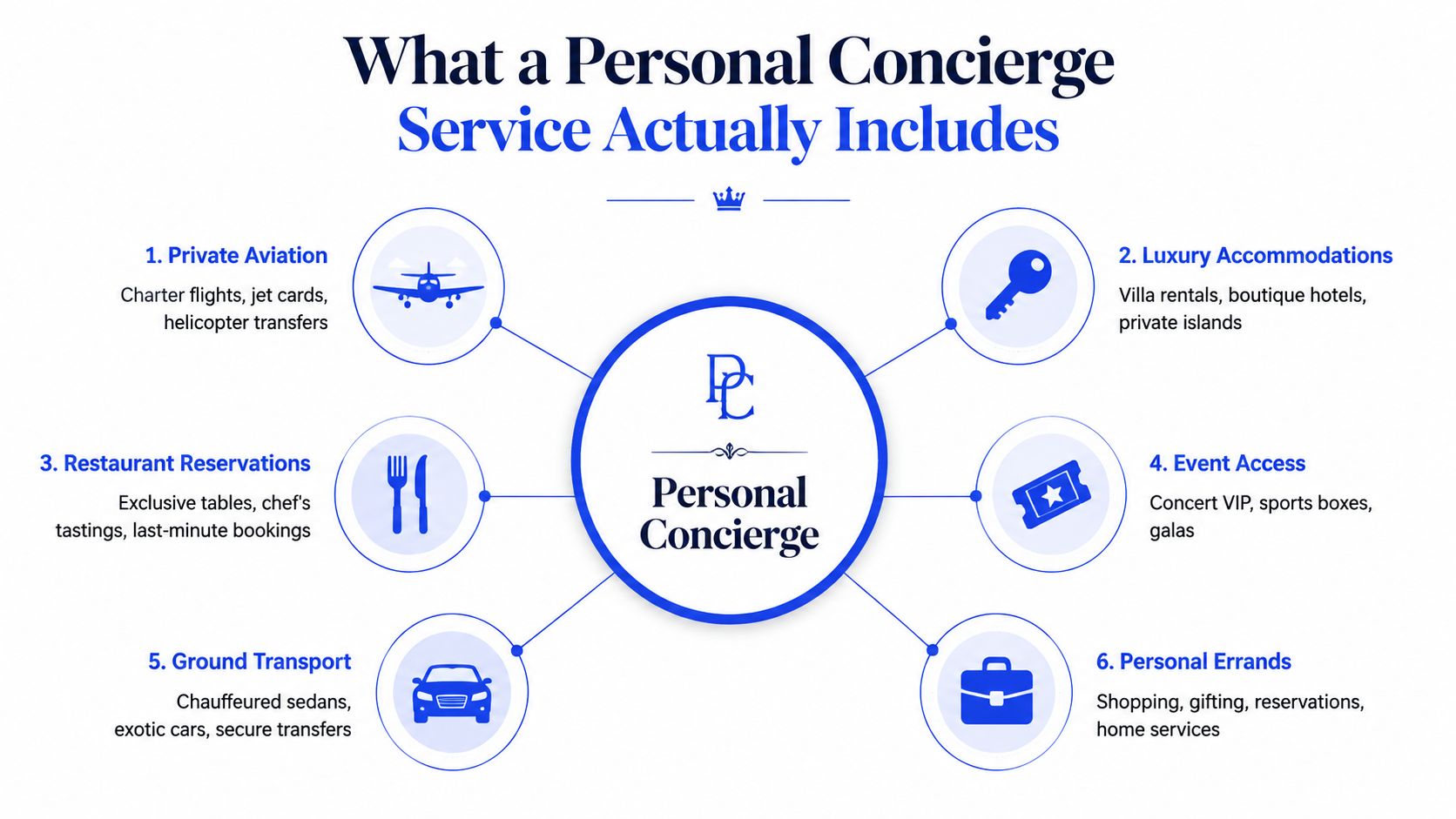
A serious personal concierge service is defined by how many moving parts it can coordinate without losing context. Travel, dining, property logistics, gifting, and last minute problem solving sit in one workflow because the client experiences them as one life, not separate tasks.
The strongest providers handle the messy middle between planning and execution. That means confirming arrival timing, adjusting ground transport when flights change, or finding a backup plan when a preferred venue falls through. These are the details that often consume time and attention.
The core work spans more than travel
In travel, the concierge may coordinate multi leg routing, private aviation, hotel or villa confirmations, and ground transport staging. In lifestyle support, the same team may manage household vendors, source gifts, arrange event access, or find a personal shopping solution that matches an established taste profile. For administrative support, they may help with calendar triage, reservation handling across multiple properties, and coordination with a family office or executive assistant.
A good concierge filters options that fit the client's standards, timing, and privacy needs.
The value shows up fast when the request has dependencies. A same weekend villa in the Amalfi Coast with a private chef, a tutor, and airport transfers is not one booking. It is a chain of arrangements that all have to fit together. If one piece fails, the whole experience wobbles.
On demand requests are where the service proves itself
The on demand side is often what clients remember most. That can mean hard to access event tickets, a last minute restaurant table, emergency itinerary pivots, or a same day delivery that would otherwise consume an assistant's afternoon. The point is not that each task is rare. The point is that the client can hand off the entire chain of work to one trusted contact.
Operationally, clients are buying convenience, exclusivity, and time compression, not isolated bookings. Travel is often intertwined with dining, events, transportation, gifting, and other concierge needs. That is why the service works best when it behaves like an always on queue, not a one off errand desk.
Who Benefits Most from a Dedicated Concierge
The strongest fit for a dedicated concierge isn't always the person with the flashiest travel style. It's the person with the most coordination friction. The more layered the life, the more a personal concierge service earns its keep.
Different clients buy different kinds of relief
A senior executive may need one point of contact who can manage international business travel and still handle family plans without adding cognitive load. A high net worth family with multiple residences may need someone who can track seasonal moves, property readiness, staff scheduling, and children's calendars across locations. An entrepreneur or public figure often needs more discretion than speed, with secure communication and low visibility arrangements built into every step.
Retired couples use concierge services differently. They may care less about urgency and more about access, calm pacing, medical coordination, and culturally rich itineraries that don't require them to spend hours researching every detail. The service still has to be precise, just with a different rhythm.
| Client Profile | Primary Pain Points | Key Concierge Deliverables | Value Delivered |
|---|---|---|---|
| Senior executive | Constant calendar pressure, cross border routing, family planning spillover | Business travel coordination, backup options, family trip support | Less context switching, fewer missed details |
| Multi residence family | Seasonal transitions, staff coordination, children's schedules | Property readiness, transport, reservations, activity planning | Smoother moves between homes |
| Entrepreneur or public figure | Privacy risk, unpredictable schedules, low tolerance for noise | Secure communication, discreet bookings, rapid pivots | More control and fewer exposure points |
| Retired couple | Planning fatigue, complex interests, health or accessibility needs | Cultural access, medical or wellness coordination, multi generational trip support | Easier travel with less stress |
Some buyers need support from the moment they leave home. Others use concierge help to make home life easier between trips. The category keeps expanding because the pain points aren't limited to vacation planning. They're tied to how much time a client has, how visible their life is, and how much they want to delegate.
For organizations that want a corporate oriented version of this model, Justkeeps Travel's corporate concierge services show how the same operational logic applies to executive travel and coordination heavy itineraries.
Human Led Concierge Versus Digital Platforms
Digital platforms work well for clean, repeatable tasks. A human led personal concierge service earns its place when the request has edge cases, shifting preferences, or reputational risk. That difference matters because the lowest cost option on paper can become the most expensive one once something goes wrong.
Where software is enough
Apps and hotel branded tools can handle ordinary reservations, standard activity bookings, simple itinerary assembly, and routine status updates. They do fine when the request is straightforward, the destination is familiar, and the stakes stay low. A standard dinner booking or transfer does not usually need a live operator watching every detail.
Where people outperform platforms
The gap opens when the work turns messy. A last minute multi leg disruption, a privacy sensitive arrival, or a vendor change across time zones is a coordination problem, not a database problem. Software can surface options. A skilled concierge can call the right partner, press for the exception, and keep the client from having to repeat the issue over and over.
Digital tools streamline clicks. Human operators manage the consequences when things go wrong.
The hidden cost of a cheap platform is rework. If a reservation is wrong, a preference gets missed, or a chain of requests has to be repeated, the client pays in time and frustration. A dedicated concierge builds institutional memory instead, so the next request moves faster because the first one was handled well.
| Service Dimension | Human Led Concierge | Digital Platform |
|---|---|---|
| Complex problem solving | Handles exceptions, relationships, and follow through | Suggests options, but often stops at the interface |
| Privacy sensitive work | Can adapt communication and booking style | Usually follows standardized flows |
| Preference memory | Learns taste, habits, and boundaries over time | Stores data, but rarely interprets context well |
| Last minute pivots | Uses vendor relationships and judgment | Often limited by inventory and automation rules |
| Cost reality | Higher upfront, fewer failures and less rework | Lower visible cost, more hidden friction |
How On Demand Support Complements Travel Planning
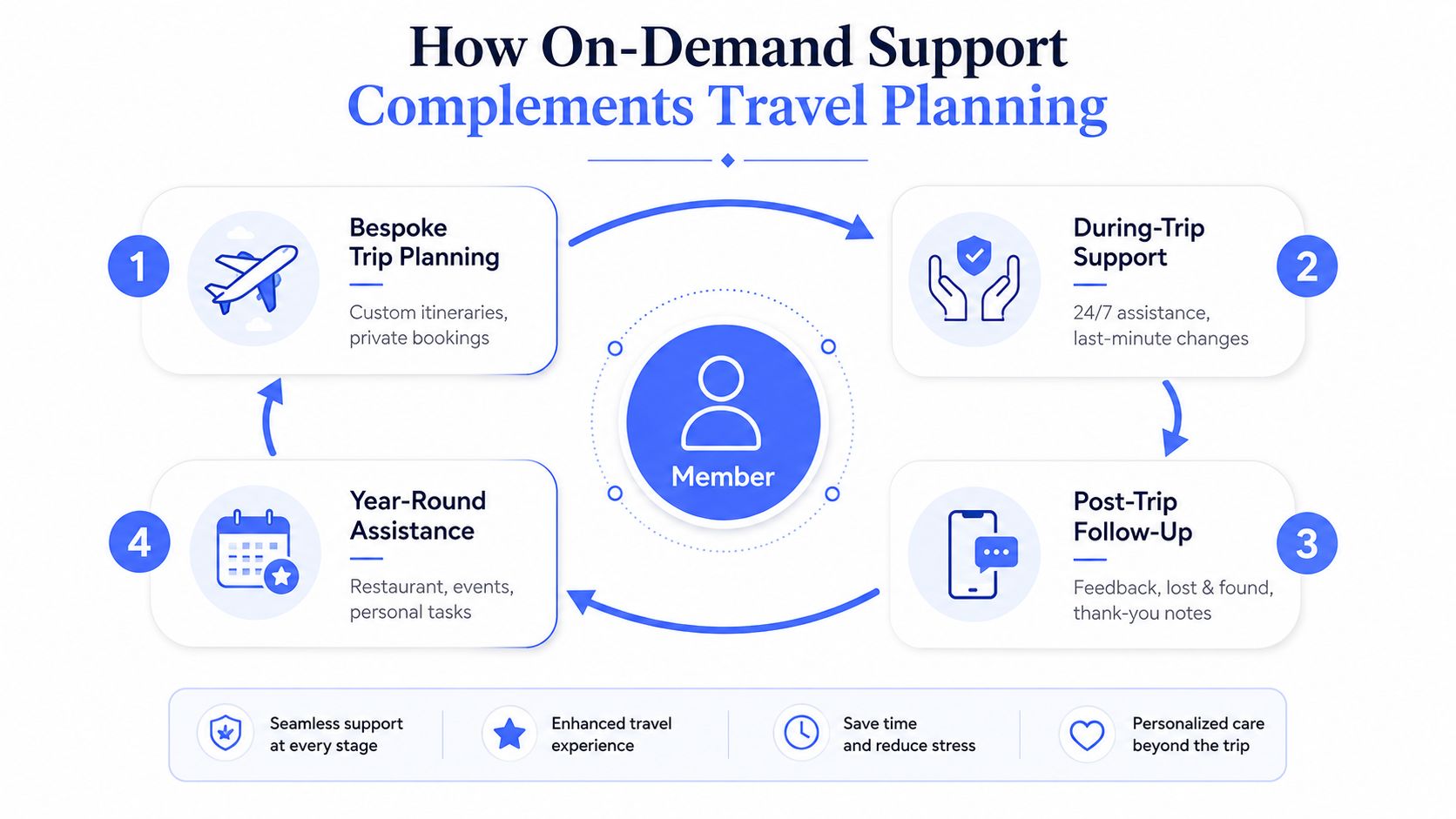
The biggest misconception about travel support is that it begins at departure and ends at checkout. In practice, the best concierge relationships live on both sides of the trip. They start before the client packs a bag and continue after they're back home, because travel exposes every other weak point in a busy life.
Pre trip and post trip work matter just as much
Before departure, a concierge can handle wardrobe sourcing, pet care arrangements, home security coordination, and timing changes that keep the trip from starting in a rush. During travel, the same person can reroute ground transport, secure a last minute reservation, or resolve a supplier issue before it derails the day. After the trip, there's still follow up, including feedback, lost and found issues, and the small administrative details that clients don't want hanging open.
The value gets clearer when travel reveals a different type of need. A client may realize during a trip to Basel that they need an art shipper they can trust. Another may notice that their calendar needs better buffer management between international flights and board meetings. Those are not one off annoyances, they're design flaws in the client's broader support system.
Travel support becomes a standing lifestyle layer
That's why the strongest providers treat each itinerary as part of an always on workflow. One request turns into a preference record, and that preference record shapes the next trip. This is the operating model behind a durable concierge relationship, not a one off travel transaction.
For deeper itinerary design principles, Justkeeps Travel's bespoke travel itinerary guide reflects the same idea, travel works best when the logistics, pacing, and on the ground support are designed together.
A useful way to think about on demand support is this, travel exposes the gaps, concierge fills them, and the next trip runs more cleanly because the last one was handled properly.
How to Choose the Right Personal Concierge Service
Picking a personal concierge service is less about the branding on the website and more about the mechanics behind the promise. The right provider should feel calm, responsive, and clear about what it can deliver. If the sales pitch is all access and no structure, keep looking.
Evaluate the operating model first
Start with staffing. Ask whether you get a named advisor or a rotating queue. A service with a limited roster usually has a better shot at remembering your preferences, while a call center model tends to flatten the relationship into tickets and handoffs.
Then look at the network. The provider should be able to explain where its relationships are strongest, which destinations it handles routinely, and how it secures hard to find inventory. If you travel often to specific cities, that local strength matters more than broad marketing language.
Practical rule: ask how the service handles a request that can't be solved through a standard vendor portal.
Discretion deserves equal attention. Ask about staff vetting, data handling, and whether the team uses NDAs or other confidentiality practices. If the client base includes public figures, executives, or family offices, secure communication isn't a nice extra. It's basic hygiene.
Pricing should match the service style
Retainer based models usually support more proactive work because the team isn't trying to invoice every small action. Per task billing can work for occasional users, but it sometimes discourages the very engagement that makes concierge valuable. Trial periods, reference checks, and direct conversations with existing clients can help reveal whether the service behaves like a partner or a vendor.
When evaluating a provider, ask how it handles wellness requests, sustainability claims, health contingencies, and supplier transparency. The strongest providers can explain how they verify claims and manage contingencies, not just how they book reservations.

Making the Most of a Concierge Relationship
A good concierge relationship gets better with use. The more the team learns about your travel style, family dynamics, supplier preferences, and timing quirks, the less effort you need to spend explaining yourself. That's why the biggest mistake is treating concierge as an emergency only resource.
Keep the communication channel active, even for smaller requests. The team learns faster when it sees your actual habits, not just your high stakes emergencies. Share upcoming milestones early, mention when your priorities change, and give direct feedback after each engagement so future execution gets sharper.
If you want a useful test, treat the relationship like an operating partnership, not a guest pass. Ask for help before the need becomes urgent, then watch how the service handles context, follow through, and discretion. Strong concierge teams get more valuable as the relationship matures because they stop starting from zero.
For clients who want a provider built around that model, the hidden value of preferred partner networks is exactly where the long term advantage shows up.
Justkeeps Travel offers bespoke travel advisory and year round concierge support for leisure, corporate, group, and entertainment travel, with direct coordination across air, hotels, transfers, dining, and on trip changes. If you want a service model built around discretion, preferred access, and real human follow through, visit Justkeeps Travel and schedule a consultation.