

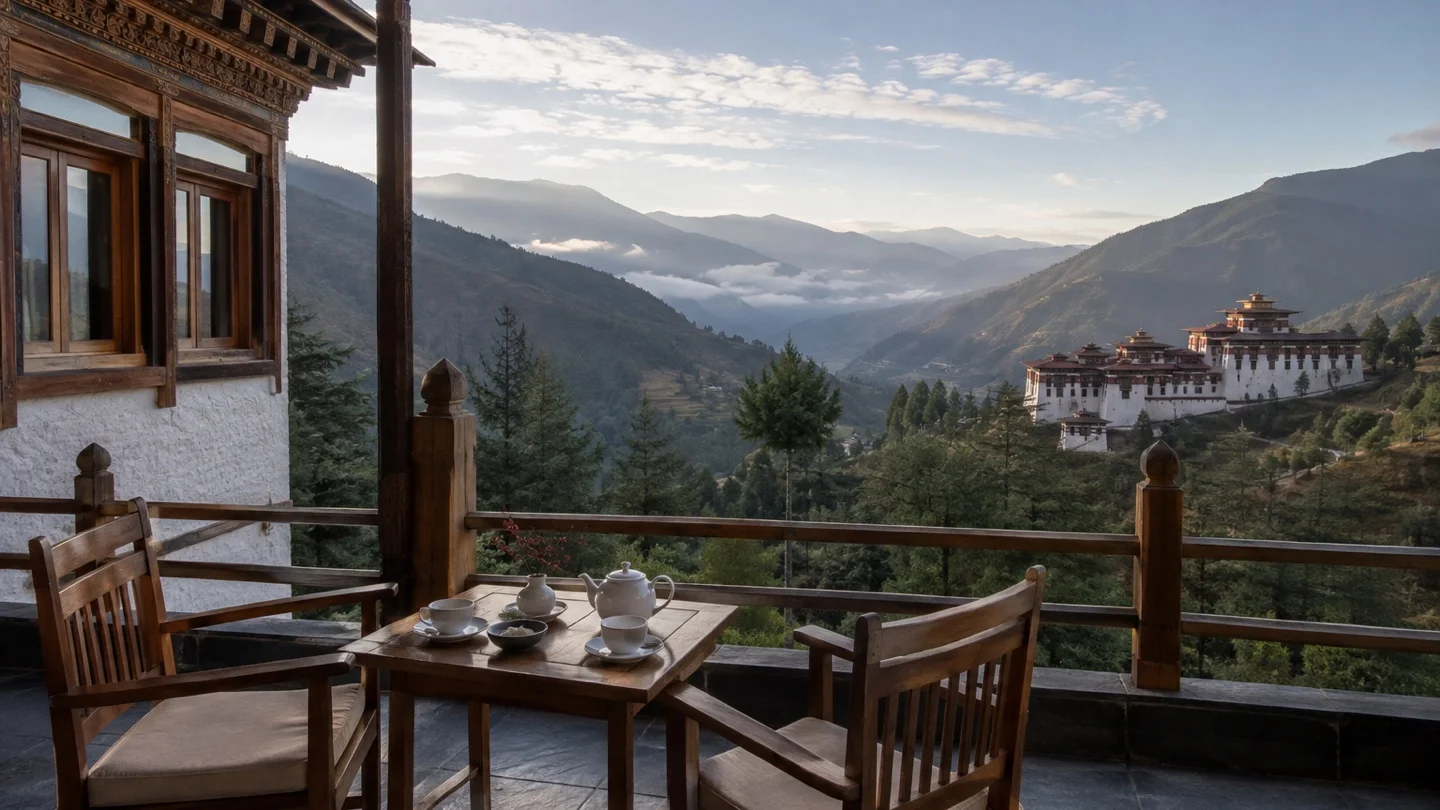

Bhutan
In Bhutan the Gate Is the Point
Bhutan charges you to be there. The Sustainable Development Fee is one hundred US dollars per adult per night, sitting on top of flights, lodging, guides and everything else, and it is the single fact that decides the shape of a trip here. Most countries would treat that as a deterrent. Bhutan treats it as the policy, and what it buys is the thing money cannot buy elsewhere in the Himalaya: dzongs without coach parties, passes without convoys, valleys where the loudest sound is prayer flags. The rules changed in 2022 and the shorthand has not caught up. You can book every part of the journey independently now. What you cannot do is travel without a guide.
Know before you go
- Fly into Paro, the country's main international airport, served only by the two national carriers, Drukair and Bhutan Airlines, on direct routes from Bangkok, Singapore, Kathmandu, Dhaka, Delhi, Kolkata, Bagdogra and Guwahati. There is no long haul service into Bhutan, so the connection is the flight you actually have to plan.
- Trip length seven to ten nights across two or three valleys. Bhutan punishes a compressed itinerary more than almost anywhere travelers go, because the distance between valleys is measured in mountain passes rather than kilometers.
- The nightly fee the Sustainable Development Fee is USD 100 per night for adults. Children aged six to eleven pay USD 50 per night and children under six pay nothing. It is charged for every night of the stay and stands entirely outside your hotel and guiding costs.
- Visa a one off, non refundable application fee of USD 40, and applications are reviewed within five working days. A tour operator or hotel can file on your behalf, which is how it usually happens.
- A guide is not optional it is mandatory to be accompanied by a guide at all times in Bhutan, and a guide is required to enter monuments and dzongs. The same holds for treks and for anyone bringing their own vehicle in.
- What changed in 2022 since the reopening on 23 September 2022 visitors can book every aspect of the journey independently. The old fixed daily package is gone. The fee and the guide are what remain.
- Best months autumn, from late September or early October to late November, gives bright sunny days and is the season of feasts and festivals. Spring, March to mid April, is the botanical window, with the valleys in bloom.
- Getting around a vehicle and driver, arranged through your operator. Self drive hire does not exist in Bhutan, so the driver is part of the trip rather than an upgrade you are being sold.
- Money the ngultrum, pegged one to one with the Indian rupee. The Sustainable Development Fee itself is quoted and paid in US dollars, so the local currency matters mostly for markets and tips.
- Dress for the dzongs long sleeves and covered legs at sacred sites, shoes off on entering, caps and hats off, and no photographs inside. Your guide will tell you before you get it wrong, which is one of the quieter arguments for having one.
- Coming in by road four official land entry points from India, at Samtse, Phuentsholing, Gelephu and Samdrup Jongkhar. A guide is mandatory for anyone continuing beyond the border towns.
What a hundred dollars a night actually buys
It buys scarcity, and scarcity is the whole product. Walk into a working dzong on a weekday morning and you will share it with monks and a handful of other travelers, which is not a sentence anyone can write about the equivalent building in Nepal or northern India. It is also worth understanding what the fee is not. It is not a package. It does not cover your room, your guide, your driver or your meals, and it does not fall away if you stay somewhere modest. Budget it as a fixed line per person per night, set your number of nights against it, then spend what remains on where you sleep. Travelers who reverse that order cut nights, which is the wrong economy in a country that rewards slowness.
Tiger's Nest is a whole day, and it belongs at the end
Paro Taktsang clings to a cliff face high above the valley, and the photographs flatten what is a steady climb of several hours up and back on a dusty switchback trail, much of it in the sun. There is a rest point roughly halfway with a view straight across at the monastery, then a descent and reclimb of stone stairs across the gorge before you reach the door. Most reasonably fit people manage it comfortably. What catches them out is doing it on day two, at altitude, with legs still stiff from the flight. Put it near the end, start at first light, wear proper shoes, and treat the horses as transport for the lower section only. Cameras go away at the entrance.
Autumn is festival season, and the festivals are what fill the rooms
The tshechus are masked dance festivals held in dzong courtyards over several days, and they are religious observance rather than performance, which is precisely why they are worth planning around. Autumn carries the greatest concentration of them alongside the clearest mountain air of the year, and spring holds the other major cluster. The consequence is unglamorous: each valley has only a handful of genuinely good rooms, and festival weeks are held roughly a year out. If a festival is the reason for the trip, that date is the fixed point. If it is not, the quiet weeks either side are often the better traveling. Winter is cold, sharp and nearly empty, which some experienced travelers now prefer.
Two lodge circuits, and the choice is mostly about driving
The luxury question resolves into a choice between two circuits. Amankora runs a chain of lodges from Paro east to Bumthang, built to be traveled as one continuous journey. Six Senses also spans several valleys and centers its circuit on wellness. COMO Uma covers Paro and Punakha for travelers who want excellent without flagship pricing, and there are good independent houses in Punakha and the Phobjikha valley. The real variable is time on mountain roads, because the further east you go the more of the trip is driving. Two valleys in seven nights is relaxed. Four in the same week is a road trip with monasteries attached.
Planning brief
The nightly fee, the guide and a very small supply of good rooms all interact, which is why early decisions pay more here than almost anywhere.
- Best suited to: cultural travelers; walkers and trekkers; festival travelers; wellness stays; anyone who wants the Himalaya without the crowds.
- Decisions to settle early: festival dates against quiet weeks; how many valleys and therefore how much driving; the lodge circuit; where Tiger's Nest falls in the sequence; total nights, since the nightly fee applies to all of them.
- Arrival and routing: Paro on Drukair or Bhutan Airlines through Bangkok, Singapore, Kathmandu or an Indian gateway; the USD 40 visa filed by your operator and reviewed within five working days; a guide from arrival to departure.
The Festival Date Is the Fixed Point
Everything else in a Bhutan itinerary arranges itself around it: which valleys, how much driving, how much walking, how many nights the fee rides on. Say which tshechu tempts you, how far you actually want to walk and what the trip is marking, and the valleys come back in the right order with a Paro connection that does not have you sprinting through Bangkok.
Bhutan is almost always reached through a gateway city worth a night or two of its own, so read our Bangkok and Singapore guides alongside this one. The flights, the fee, the guide and the lodge circuit are held as one plan by our luxury leisure travel planning team.
Which lodge circuit should we take?
Amankora if the journey itself is the point, because the lodges were built to be traveled in sequence from Paro eastwards and the driving between them is part of the design rather than an interruption. Six Senses if wellness is the reason for the trip and you want the valleys with treatment rooms attached. COMO Uma if you want Paro and Punakha done well without flagship pricing, which for a first visit of seven nights is often the sensible answer. The independent houses in Punakha and Phobjikha are the ones repeat visitors move to. Whichever you choose, count the driving hours before the room categories.
Do I really need a guide for the whole trip?
Yes. It is mandatory to be accompanied by a guide at all times in Bhutan, and a guide is specifically required to enter monuments and dzongs, so this is not a rule you can quietly work around. The better news is that it stops being a constraint within a day. A good Bhutanese guide reads your energy, reorders the schedule when the weather turns, explains what is happening inside a dzong rather than pointing at it, and gets you into places and conversations that would otherwise pass you by. Choose the guide with as much care as the hotel.
Is Tiger's Nest as hard as people say?
It is a solid half to three quarter day of walking, not a technical climb, and most reasonably fit people do it without drama. The honest difficulties are altitude, sun and the final flight of stone stairs down into the gorge and back up to the entrance. Do it late in the trip rather than early, start at first light before the heat and the crowd, wear real shoes, and take it slowly on the first section. Horses can carry you part way up but not down, and not the last stretch. Skipping it is legitimate if walking is genuinely difficult, and the valley has plenty else.
Is Bhutan worth it if we are not walkers?
Yes, with one honest exception. The dzongs, the valleys, the markets, the textile work and the festivals are all reached from a vehicle, and the drives themselves over the passes are among the finest sitting down you will do anywhere. A trip built on Paro, Thimphu and Punakha asks very little of the legs. The exception is Tiger's Nest, which is several hours of steady climbing and cannot be shortened, so plan either to give it up without regret or to walk only as far as the halfway rest point, which has the view straight across at the monastery and is a genuine reward in itself.
How much is the daily fee to visit Bhutan?
The Sustainable Development Fee is USD 100 per adult per night. Children aged six to eleven pay USD 50, and children under six pay nothing. It sits on top of flights, lodging and guides, and the visa adds a one off USD 40 fee. Fly in through Bangkok or Kathmandu, both with direct routes to Paro.
CONTINUE EXPLORING