
Botswana
Botswana Floods in the Dry Season, and That Is the Whole Calendar
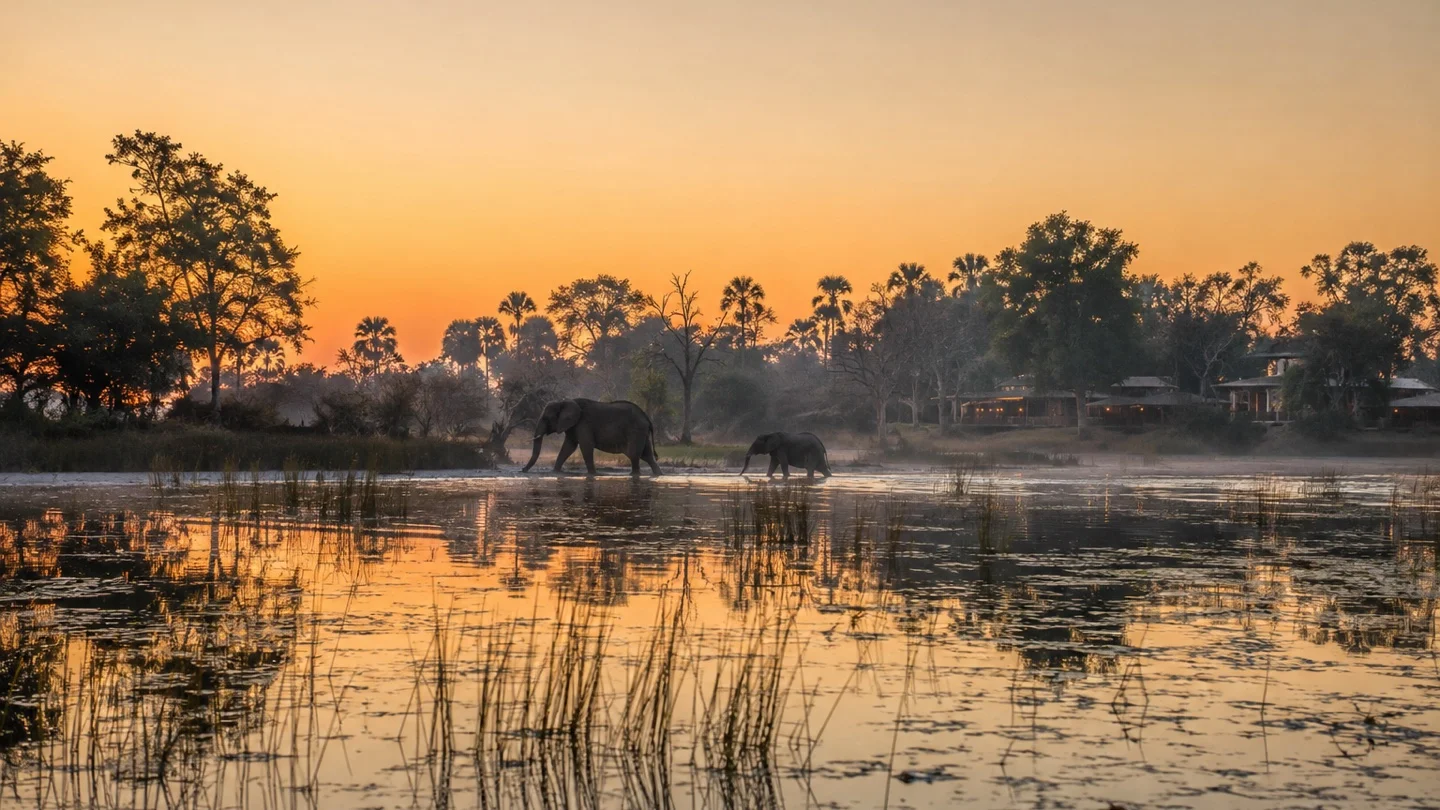
Rain that falls on the Angolan highlands early in the year does not reach the Okavango for months. It seeps south through a thousand kilometers of sand and arrives around the middle of the year, spreading through channels and floodplains at exactly the moment Botswana itself has stopped raining. The wettest the Delta ever looks is the driest the country ever is, and every animal has organized its life around that inversion. Every planning decision follows: whether you are poled through papyrus or driving hard floodplain, which camps earn their peak rate in which month, and why the green season is a different holiday rather than a cheaper one.
Know before you go
- Fly into Maun, code MUB, for the Okavango, and Kasane, code BBK, for Chobe and the Zambezi corner. Johannesburg is the usual connecting point. Past those two airports everything is light aircraft onto sand strips.
- Soft bags, weighed charter operators run a firm soft bag allowance including hand luggage, no wheels and no frame, because the holds are small and irregularly shaped. Confirm the figure on your ticket and pack to it. Camps launder daily, which is why experienced travelers bring four days of clothes for two weeks.
- The Okavango flood inscribed as a World Heritage site in 2014, the thousandth on the list, covering 2,023,590 hectares. UNESCO describes the annual flood as arriving during the dry season and peaking around June and July. Water level, not rainfall, is what you book.
- The months of lag rain that falls on the Angolan highlands early in the year seeps south through a thousand kilometers of sand and arrives months later. That lag is why a rain forecast tells you almost nothing about what your camp will look like.
- Best months June through September is the classic window: full channels, cold dawns, warm days, game pushed onto islands and floodplain edges. October produces superb sightings and serious heat. December through March is the green season, with newborn antelope, migrant birds and the lowest rates of the year.
- Water or land a camp on a permanent channel gives mokoro and boating; drier ground gives game drives and walking. Some concessions do both from one address, and if you have only one Delta stay, those are worth paying for.
- Trip length seven to ten nights, built as three camps of three nights. Two nights is one full day, after you spent a flight getting there. Three is where a camp and a guide start to work for you.
- The booking window camps run eight to twelve tents by design and the country caps beds deliberately. Peak season at a well known camp is committed a year ahead. Green season can usually be built inside six months.
- Entry rules no visa for United States passport holders for stays of up to ninety days. Your passport needs six months of validity beyond arrival and six months beyond departure, with three blank pages at entry, stricter than most of the region.
- Yellow fever trap Botswana requires a certificate from anyone arriving from a country where yellow fever is endemic. Via Johannesburg that is not a question; as the second half of a trip that began in East Africa it very much is.
- Money and cards the pula is the local currency and camps invoice in dollars. Cards work in Maun and Kasane, and inside a concession there is nothing to buy, so cash matters for tips. Amounts over 10,000 pula, roughly 1,000 dollars, are declared on entry and exit.
Low volume and high value is a policy, not a slogan
Botswana decided decades ago what kind of safari country it wanted to be and has not wavered: fewer visitors, paying more, across enormous private concessions rather than public parks. You feel the arithmetic within a day. A leopard in the Delta might be shared with one other vehicle rather than fourteen, and your guide can leave the track to follow it, because the concession is leased and the rules are set by whoever holds the lease.
The same arithmetic explains the price. Camps run eight to twelve tents, concessions are measured in hundreds of square kilometers, and everything arrives by light aircraft, including the fuel and the wine. What you buy is not thread count, it is the absence of other people, and Botswana is the most consistent place in Africa to buy it.
Mokoro or game drive is decided by the water, not by you
The mokoro, a shallow canoe poled from the stern, is the emblematic Delta activity and genuinely lovely: reed walls, frogs at eye level, no engine. It also depends entirely on there being water where your camp is, which is a function of the flood and of where in the Delta you sit.
Deep water camps in the permanent Delta run boats and mokoro most of the year and few drives. Dry ground camps on the fringes and in Moremi run drives and walking, and may have no water activity in a low flood year. The concessions that do both are worth the money and hardest to book.
The practical answer is to stop solving this from a brochure. Give the month first, and let the water level pick the camps rather than picking camps and hoping the water agrees.
Three camps, and the case for the green season
The shape that works is three camps of three nights, each doing what the others cannot. One deep water Delta camp for mokoro and boating. One drier Delta or Moremi camp for predators, walking and long drives, where most big cat viewing happens. Then a third of different character: Chobe and the Linyanti for elephant in numbers hard to comprehend until you see them drink at once, or the Central Kalahari for black maned lion. Or skip it for Victoria Falls, an easy transfer from Kasane.
On timing, December into March brings much lower rates, dramatic light, migrant birds and plains full of newborn antelope with the predators that follow them. The trade is heat, humidity, afternoon rain, grass long enough to hide things, and limited water activity because the old flood has drained and the new one has not arrived. April and May are quietly the best value of the year: water rising, shoulder rates, very few other vehicles.
Planning brief
Planned from the water outwards. The flood sets the activities, the activities set the camps, availability sets how early the conversation starts.
- Best suited to: travelers who want few vehicles and will pay for it; second and third safaris; photographers, in both the flood and the green season; anyone pairing a safari with Victoria Falls or Cape Town.
- Decisions to settle early: the month, which sets the flood level; water camp, land camp or both; nights and moves; peak inventory, which commits a year ahead; whether Chobe, the Kalahari or the falls takes the third leg.
- Arrival and routing: Maun, code MUB, for the Okavango and Kasane, code BBK, for Chobe, both usually via Johannesburg; light aircraft between camps with a firm soft bag limit; Victoria Falls an easy transfer from Kasane.
Let the Water Choose the Camps
Dates, a tolerance for heat and a view on whether the flood matters more than the rate are enough to produce three camps in the right order rather than a list of names. In peak season that conversation happens a year out, because the beds simply do not exist in the quantity people assume they do.
Etosha, across the border in Namibia, adds a very different dry season landscape to a Botswana safari.
The concessions, the charter sequence and any Cape Town or falls extension are held as one trip by our luxury leisure travel planning team, and our Southern Africa guide shows how it all fits together.
From the journal
More on Botswana: Cape Town and Safari: The Right Route and Planning a Multi-Generational Family Safari: A Luxury Guide for Every Generation.
Is Botswana the right country for a first safari?
It is the best first safari money can buy and it is not the cheapest way to start. What you get for the price is the thing most people did not know to want: a leopard shared with one other vehicle instead of fourteen, a guide who can leave the track, and no queue at a sighting. What you give up is variety of price and the large open parks where a first timer can move by road. If the budget is stretched, a first safari in South Africa or Kenya will still deliver the animals. If it is not, start here and everything afterwards is measured against it.
How much of a problem are the light aircraft?
Less than nervous flyers fear and more than they are told. The hops between camps are short, low and flown by experienced pilots who do this several times a day, and the view over the Delta from a thousand feet is one of the memorable parts of the trip rather than an ordeal to endure. What is genuinely restrictive is the packing: a firm soft bag allowance with no wheels and no frame, because the holds are small and oddly shaped. Camps launder every day, so four days of clothes covers two weeks. Anyone who truly will not fly small should be looking at a road based safari elsewhere.
Is the Botswana green season a false economy?
No, but it is a different trip rather than a cheaper version of the same one. From December into March rates fall substantially, the light is dramatic, migrant birds arrive, and the plains fill with newborn antelope and the predators working them. The Kalahari in particular transforms. Against that, it is hot and humid, afternoon rain is normal, the grass is long enough to hide things, and water activities can be limited because the old flood has drained and the new one has not arrived. If you have been on safari before and you photograph, the green season is often the better buy.
Can I do both mokoro trips and game drives on one Botswana trip?
Yes, but not necessarily from one camp, and this is the detail that trips people up. Whether a camp can put you in a mokoro depends on the flood level at that specific spot in that specific month, not on what the website shows. Deep water camps in the permanent Delta run boats and mokoro most of the year with fewer drives. Dry ground camps in and around Moremi run drives and walking and may have no water at all in a low year. A few concessions genuinely do both, and they are the ones worth booking early. Otherwise, split the nights between one of each.
Is there a wet and dry season in Botswana?
Yes. The dry season runs roughly May to October, and the Okavango flood peaks around June to August, the best time for water safaris and game viewing. The green or wet season runs about November to March or April, with fewer guests and lower rates. Pair it with Cape Town or plan it as a honeymoon.
CONTINUE EXPLORING