

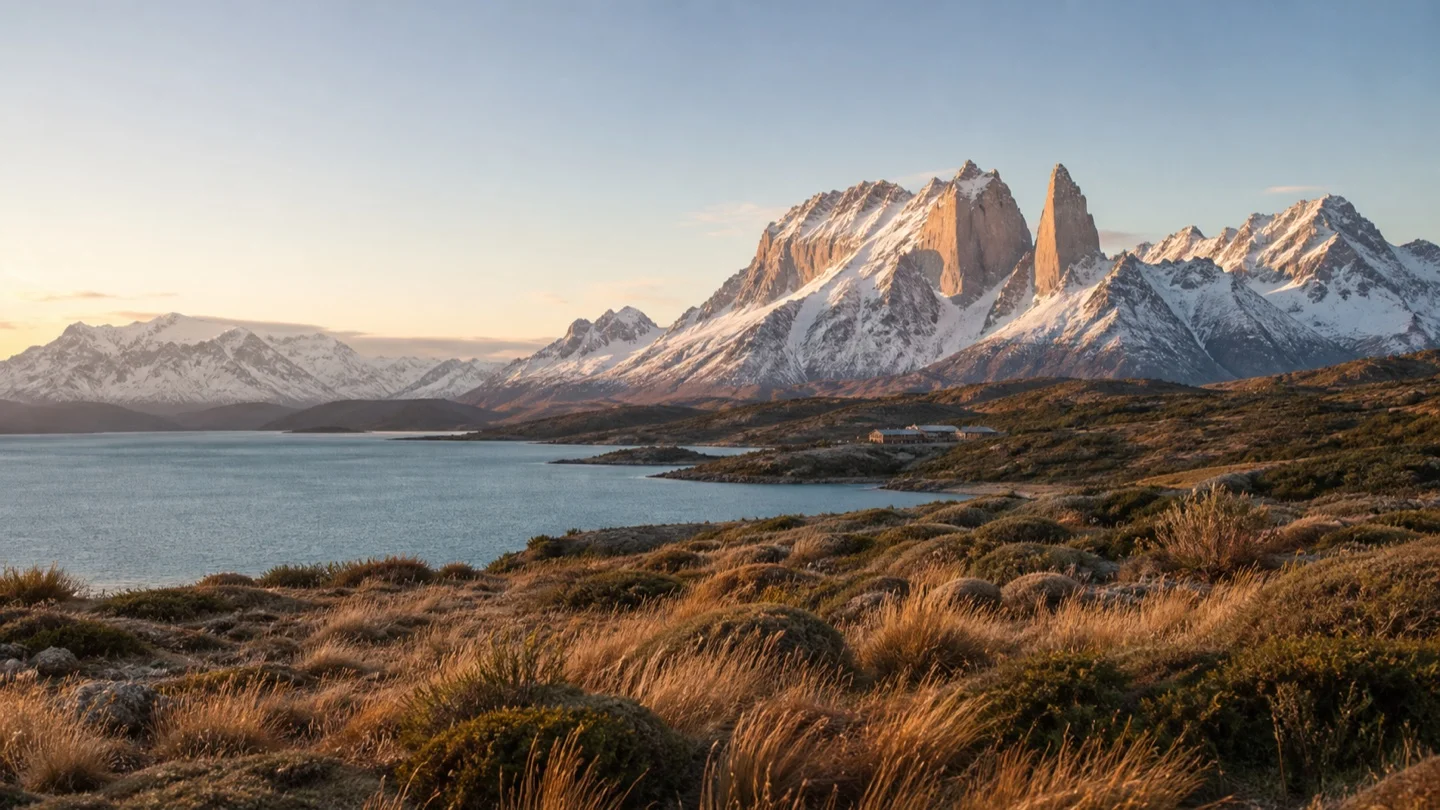

Patagonia
In Patagonia the Best Weather and the Worst Wind Are the Same Months
Two countries sharing one mountain range at the bottom of the Americas, and almost everything about planning it runs backwards from what a northern hemisphere traveler expects. December is high summer. June and July are the dead of winter, when much of the region closes. The months with up to eighteen hours of daylight are also the months the wind is hardest. The other structural fact is the border. Torres del Paine is in Chile, the Perito Moreno glacier and El Chaltén are in Argentina, and a trip that wants both carries two sets of logistics and a day surrendered in each direction. Neither is a reason not to come. Both are reasons to build the trip properly.
Know before you go
- Fly into PUQ at Punta Arenas or PNT at Puerto Natales for Chile, FTE at El Calafate for Argentina. PNT is closer but normally has one LATAM flight a day from Santiago in high season. PUQ has the schedule.
- The road from PUQ is most of a day. Punta Arenas to Puerto Natales is 250 km and three hours, then Puerto Natales to Torres del Paine is 112 km and two. Five hours from the aircraft door to the park.
- Trip length eight to ten nights to combine Torres del Paine with El Calafate and El Chaltén. Take one out and the border day absorbs it, so you lose a full park day rather than an afternoon.
- Best months December through February, with up to eighteen hours of daylight against nine in June. El Calafate average highs are 18°C or 64°F in January and 17°C or 63°F in February, and Torres del Paine sits near 18°C through summer.
- The wind is the headline here rather than a footnote. Torres del Paine runs from about 20 km/h to gusts of up to 110 km/h and is strongest in summer. El Calafate averages 16 mph in November and December against 10 mph in June.
- The closed season runs May through August, when many refugios and lodges shut and transport thins right out, with services reopening from mid September. El Calafate highs in June and July are 4°C or 39°F.
- The border day is the trap. El Calafate to Puerto Natales is 268 km and five to seven hours depending on the crossing, plus two more to the park. Itineraries drawn off a map give away two days to it.
- Park tickets for Torres del Paine must be bought ahead on the CONAF platform at pasesparques.cl. Foreign adults pay CL$34,000 for a single day and CL$48,500 for multiple days, and under 12 enter free.
- Entry, twice over because it is two countries. Chile wants a passport valid for the stay, no visa up to 90 days, one blank page, a tourist card issued on arrival and handed back on departure, and proof of $46 a day in funds. Argentina wants a passport valid at entry and no visa for 90 days or fewer.
- Two currencies if you cross. Both run to hundreds and thousands against the dollar rather than to units, so the arithmetic at a roadside till takes a moment. Carry cash for the stops between towns.
The season is inverted, and the good weather and the wind arrive together
December through February is high summer, with average highs around 17°C to 18°C on both sides of the border. It is also the windiest part of the year. Torres del Paine sees anything from about 20 km/h to gusts reaching 110 km/h, and El Calafate averages 16 mph in November and December against 10 mph in June. That is a design constraint rather than a deterrent. It is why the good lodges reorder your days instead of publishing a fixed program, why a windproof layer beats a warm one, and why exposed lookouts get done on the calm morning. The shoulder months are a real alternative, not a consolation, with services running from mid September. Avoid May through August, when lodges close and El Calafate sits at 4°C with nine hours of light.
Two countries, one range, and a day given up in each direction
Torres del Paine sits in Chile. The Perito Moreno glacier and El Chaltén sit in Argentina. On a map they are neighbors and on the ground they are not. El Calafate to Puerto Natales is 268 km and five to seven hours depending on how the crossing goes, and the park is two hours beyond that, which costs a day at each end. That arithmetic turns a supposed eight night trip into six nights of actual Patagonia. Doing both sides is still right for most people, because these are genuinely different landscapes rather than two versions of one, but it needs eight to ten nights and the transfer days have to be planned as days. With less time, take one country.
Torres del Paine and El Chaltén are not the same experience
Torres del Paine is a park you stay inside or beside, with a handful of lodges running guided days, vehicles and long walks from a fixed base. The scale is the point: granite towers, glacial lakes and open steppe, mostly reached by driving to a trailhead. El Chaltén is the opposite arrangement, a small town at the foot of Fitz Roy where the trails start at the end of the street, so you walk out of the door with no vehicle. El Calafate, three hours away, is the base for the Perito Moreno glacier and the airport for both. The road between them is about 220 km and three hours, up Route 40 then Provincial Route 23, partly gravel.
The constraint is beds, not budget
December to February is peak, and the honest description is crowded trails with accommodation and campsites booked up far in advance. Inside the park that matters more than almost anywhere else, because the refugios and lodges have finite capacity and there is no overflow: no nearby town to fall back on, no way to add rooms. Explora sits inside the park with the largest guiding operation and suits anyone intending to walk seriously. Awasi runs a few villas, each with its own guide and vehicle, so every day is private and built around the weather. Tierra Patagonia is the design answer, on the shore of Lake Sarmiento. All three run on guides, vehicles and minimum stays. Book the beds first and the flights second.
Planning brief
Patagonia is a routing and calendar problem across two countries, and the wind, the daylight and the bed count decide the rest.
- Best suited to: active travelers and walkers; landscape photographers; couples wanting remote lodges with private guiding; anyone happy to give real days to transfers.
- Decisions to settle early: Chile, Argentina or both; how many nights the border day leaves you; peak months against the shoulder; lodge sequence and minimum stays; park entry bought in advance.
- Arrival and routing: PUQ or PNT for Torres del Paine and FTE for El Calafate and El Chaltén; five hours from PUQ to the park; seven to nine hours across the border to the park; El Calafate to El Chaltén about three hours.
The wind is not a problem to solve. It is a schedule to write around.
So is the border day, and an itinerary drawn off a map without them becomes a trip about vehicles. How many nights, how far you want to walk, and whether glaciers or granite pull harder: those three produce a season, a sequence and a crossing that costs an afternoon.
Lodges, internal flights, guides and weather margin are all covered by our luxury leisure travel planning. Most Argentine routes want a night in Buenos Aires at one end or the other.
From the journal
More on Patagonia: Patagonia: How to Route Chile and Argentina.
Is it worth doing both Chile and Argentina in one Patagonia trip?
Yes, if you have eight to ten nights, and no if you have less. They are genuinely different landscapes rather than two versions of the same one, so the case for doing both is strong. The cost is arithmetic: El Calafate to Puerto Natales is 268 km and five to seven hours depending on the crossing, plus two more hours to Torres del Paine, which is seven to nine hours in total and a day gone in each direction. With six or seven nights you would spend a third of the trip moving. Pick one country, do it well, and come back.
How windy is Patagonia really, and does it ruin the walking?
It is genuinely windy and it does not ruin anything, provided you plan for it. In Torres del Paine the wind runs from around 20 km/h up to gusts of 110 km/h and is strongest in summer, which is the same period as the best weather and the longest days. At El Calafate the average is 16 mph in November and December against 10 mph in June. What that means in practice is a windproof outer layer above everything else in the bag, and a flexible order of days so that the exposed viewpoints get done on the calm morning rather than the scheduled afternoon.
Is a guided lodge worth the money in Torres del Paine?
Here, more than almost anywhere. The wind and the light change what is worth doing on any given morning, and a lodge with its own guides and vehicles simply reorders your day, taking the exposed lookout on the calm morning and the sheltered valley when the gusts arrive. A self driven trip cannot do that, because you booked the trail two weeks ago. The private guide and vehicle model costs more and buys the whole day rather than a seat in someone else's. If the budget will only stretch to one thing, spend it inside the park rather than on a longer trip based outside it.
Torres del Paine or El Chaltén if I can only choose one?
El Chaltén if you want to walk out of your door and onto a trail, Torres del Paine if you want the scale and are happy to be driven to it. El Chaltén is a small town at the foot of Fitz Roy where the routes start at the end of the street, which makes it the better value and the easier logistics, and El Calafate with the Perito Moreno glacier is three hours away. Torres del Paine is the bigger landscape, with granite towers and glacial lakes, lodges running guided days and vehicles, and a park entry system you must buy into ahead. Most first trips take Torres del Paine.
When is the best time to visit Patagonia?
December through February is high summer, with up to eighteen hours of daylight and highs around 17°C to 18°C. It is also the windiest part of the year. The shoulder months are a real alternative, with services running from mid September. Avoid May through August, when many lodges close. Read our Patagonia routing guide or start in Santiago.
CONTINUE EXPLORING