

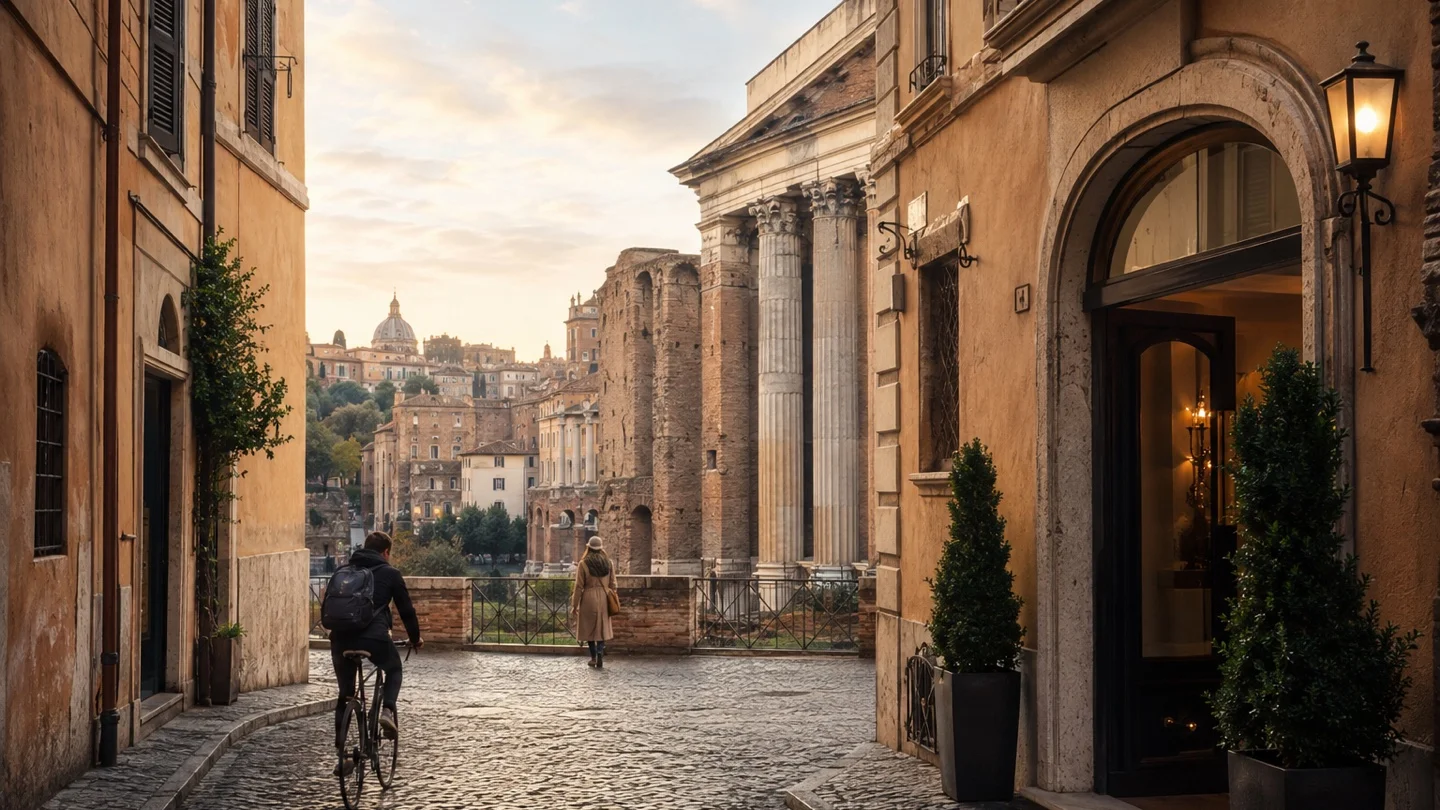

Rome
Rome Rewards the People Who Book It Backwards
Rome does not have a sightseeing problem. It has a calendar problem. Three of the four things most visitors come for run on hard capacity systems with fixed release windows, and two of them are shut on a day of the week nobody checks before booking flights. The Colosseum sells exactly thirty days ahead, in the traveler's own name. The Borghese runs ten timed shifts and clears the building between each one. The Vatican closes on Sundays. None of this is difficult once you know it, and almost nobody knows it at the point where it still costs nothing to fix. Get the calendar right and Rome is generous. Get it wrong and you have paid a great deal to stand outside buildings.
Know before you go
- Fly into Fiumicino, code FCO. The Leonardo Express reaches Roma Termini in 32 fixed minutes for 14 euro, every 15 minutes from 05:38 until 23:27. Ciampino, code CIA, takes low cost traffic. A car through Roman traffic is fixed at nothing.
- Trip length Four nights. Three is possible and feels like an errand, because the two ticketing systems that matter cannot both be satisfied on one morning. The fourth night turns a list of monuments into a city.
- Best months Late April to mid June, then late September through October. May gives 72°F days with about five and a half rainy days. July and August run 88 to 89°F with nights barely below 67°F, in a stone city that holds its heat after dark. November is the best value month if you accept rain.
- Entry No visa for a United States passport on stays up to 90 days. What catches people is that the allowance belongs to the Schengen area as a whole and runs on a rolling 180 day window, so a January week in Amsterdam is already spent by the time you land at Fiumicino in June. Three months of validity beyond the day you leave the zone, plus two blank pages.
- The new border check The EU Entry Exit System became fully operational on 10 April 2026 and replaces the passport stamp with a facial image and fingerprints taken at your first crossing, so first arrivals run slower. ETIAS is a different thing and it is not in operation. No applications are being collected and no start date has been announced.
- Money The euro, worth a little more than the dollar. Cards work everywhere. Keep cash for the tourist tax, which every comune sets for itself and charges per person per night on top of the room rate, collected by the property when you settle.
- Tipping Round up, or leave a few euro in coins. A bill carries a coperto, a fixed charge per person for table and bread that is not a tip, or a servizio, which means service is paid for already. There is no fifteen to twenty percent convention, and twenty marks the table as foreign.
- Colosseum tickets Sales open exactly thirty days before the visit date, through ticketing.colosseo.it and nowhere else. Tickets carry the holder's name and matching identification is checked at the gate. One name change is allowed, by midnight seven days before, in documented cases. Book with everyone's passport open.
- The Vatican shuts Sundays Every Sunday except the last of the month, which opens 09:00 to 14:00 free and is therefore the most crowded morning of the month. Otherwise Monday to Saturday, 08:00 to 20:00, last entry 18:00. It also closes on 14 and 15 August.
- Borghese and Mondays Closed Mondays. Ten entry shifts run from 09:00 to 17:45, each about two hours, with the rooms cleared at the end of every one. Reservation is required for all ticket categories, including the free tickets for under eighteens.
- Leave the car alone The historic core sits inside limited traffic zones watched by camera. No barrier, no warning, and the fine arrives months later through the hire company with an administration charge added. A hotel inside one has to register your exact plate in advance, usually only for the day you arrive and the day you leave.
Sunday and Monday quietly wreck Roman itineraries
Check the day of the week you land before you check anything else. The Vatican is closed every Sunday but the last of the month. The Borghese is closed every Monday. A long weekend arriving on Friday evening therefore has one possible Vatican morning and one possible Borghese slot, both fixed, and neither of them movable once everything else is booked around them. Then there are the free days. The first Sunday of the month is free at the state museums including the Colosseum park, and the last Sunday is the free Vatican morning. Free means the largest crowd of the month with priority admission set aside, so those two dates are ones to schedule around rather than into.
Go at opening or in the last two hours, never in between
The Colosseum opens at 08:30, the Roman Forum and Palatine at 09:00, the Vatican Museums at 08:00, and those first ninety minutes are the whole trip. Closing moves with the season, which is where winter plans fall apart: the archaeological park closes at 19:15 with last admission 18:15 until the end of September, at 18:30 through the first 24 days of October, then at 16:30 from 25 October with last admission at 15:30. A late afternoon at the Colosseum in December does not exist. The park is open every day of the year apart from 25 December and 1 January, so the constraint is the hour, not the date. In summer the Palatine at midday is open ground with no shade at 88°F.
Where you sleep buys more time than another guide does
Roman traffic makes hotel position destiny, and over four days the gap between a good address and a merely convenient one is measured in hours. Hotel de Russie, between Piazza del Popolo and the Spanish Steps, has the terraced garden the rest of the city envies and puts the Vatican and the centro storico on either side of you. Bulgari Roma faces the Ara Pacis and is the design stay, Roman scale handled with a jeweler's discipline. The St. Regis Rome brings butler service and walks to almost everything. What the three share is that you can leave at half past seven in the morning and be standing at a monument before the coaches arrive, without a car or a negotiation.
Planning brief
Rome is a booking exercise dressed as a holiday. Settle the fixed slots first, place the hotel around them, then let the rest of the days stay loose.
- Best suited to: art and archaeology; food led city stays; a first family trip to Italy; the opening leg of a longer Italian route.
- Decisions to settle early: the arrival day of the week; Colosseum names on release day; the Borghese slot and the guide together; hotel position against the sites you care about.
- Arrival and routing: Fiumicino for anything transatlantic; the Leonardo Express at 32 minutes to Termini; onward by fast train rather than by car.
A fifth Rome is not a first Rome
Which of the two this is changes how the days should be built, and so does the honest answer about how much walking the group wants before lunch. Send the month, the names on the passports and some idea of how you like your evenings. The fixed slots go in first and everything else is arranged behind them.
Sardinia is a short flight from Rome if you want beaches that feel far from the city. Two new hotels are worth knowing: Corinthia Rome and the upcoming Rosewood Rome.
Rome is usually the anchor rather than the whole trip, and the fast train north makes Florence the natural second leg. Our luxury leisure travel planning holds the timed entries and builds the route around them.
From the journal
More on Rome: Corinthia Rome: A New Palazzo Hotel in the Historic Center and Rosewood Rome: A 2027 Opening Worth Watching.
Rome or Florence for a first trip to Italy?
Rome first, and then Florence on the same trip if the days allow, because the fast train makes that easy. Rome is the harder city to book and the more rewarding one to have booked well, and nothing in Florence carries the weight of the Forum or the Sistine Chapel. Florence is the gentler week: walkable end to end, one great museum you can do in a morning, and a countryside on its doorstep. Reverse the order and Florence feels small afterwards. If there is genuinely only room for one city and the party wants ease over scale, take Florence.
Is early access to the Vatican Museums worth paying for?
Yes, and it is the single best upgrade in Rome. The museums open at 08:00 Monday to Saturday and take the bulk of the day's arrivals from mid morning, so an hour at the front of the day is a different building from the same rooms at noon. The Sistine Chapel in particular is either a room you can stand still in or a room you are moved through. What makes the difference is the hour rather than the ticket type, so if you book nothing else in advance, book the earliest entry you can get on a Saturday and treat it as fixed.
Is Rome in August a mistake?
Not if you plan for it and accept the shape of the day. August highs average 89°F with nights that barely drop below 67°F and almost no rain to break the heat, and the stone holds it after dark. What that means practically is that you get a morning and an evening, not a day. Start at opening, be indoors or horizontal from noon until five, and go out again when the light goes long. Book a hotel with a garden or a pool, because the afternoon has to happen somewhere. The compensation is that Romans have left and their restaurants are easier to get into.
Should you rent a car in Rome?
No, and this is one of the few travel questions with a flat answer. The historic center sits inside limited traffic zones enforced by camera, with no barrier and no warning at the line, and the fines arrive months later through the hire company with an administration charge added. A hotel inside a zone can register your plate with the comune, but usually only for the day you arrive and the day you leave. Rome is a walking and taxi city with a 32 minute train from the airport. If the itinerary needs a car later, collect it on the day you leave Rome, not on the day you arrive.
When is the best time to visit Rome?
Late April to mid June, then late September through October. May gives 72°F days with about five and a half rainy days. July and August run 88 to 89°F in a stone city that holds its heat after dark. November is the best value month if you accept rain. Plan four nights, add Florence, and read about a luxury Italy trip.
CONTINUE EXPLORING