


Seychelles
In the Seychelles the Wind Decides Which Beach Is Yours
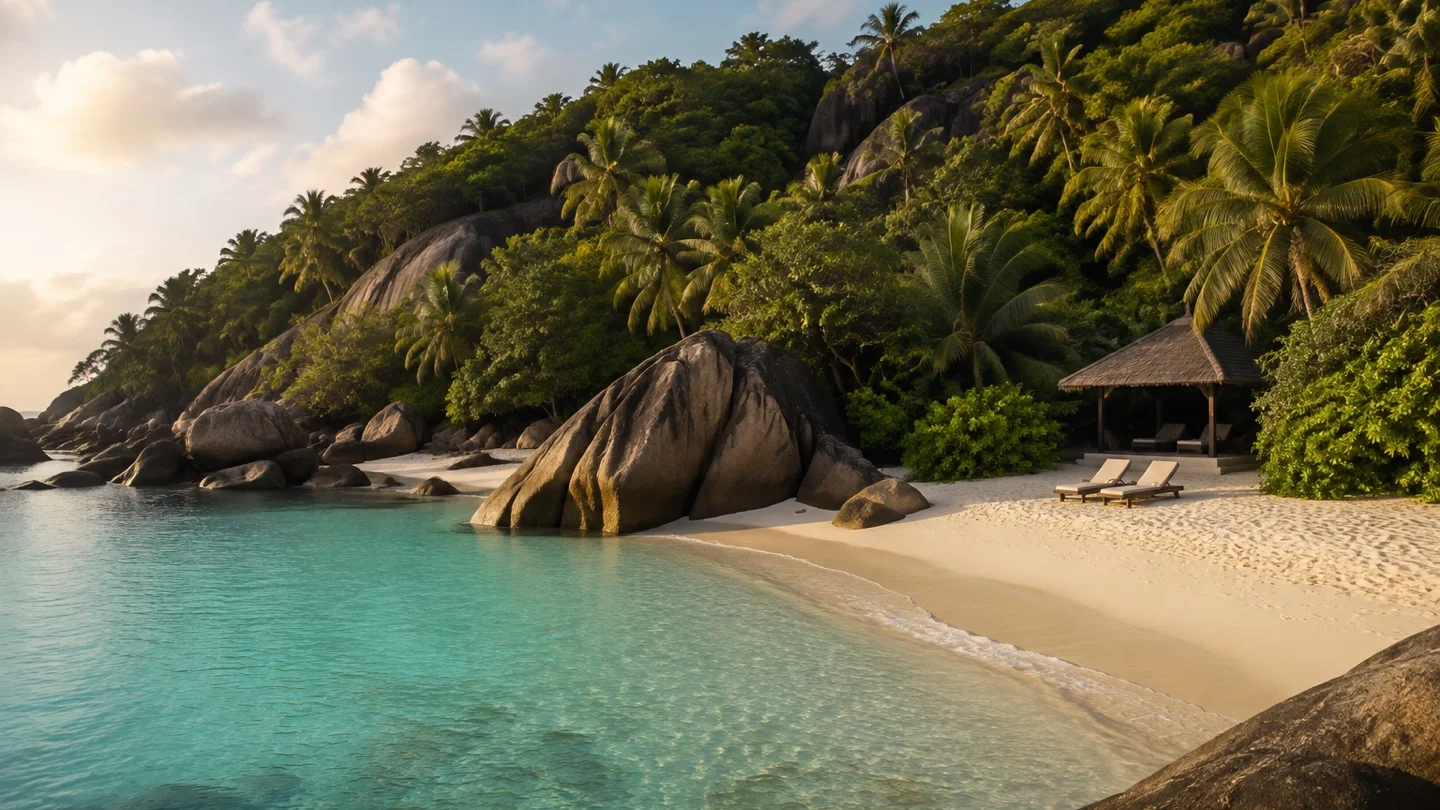
These are not coral islands. The inner Seychelles are granite, the exposed peaks of a sunken continent, and the difference runs through everything: forested mountains rising straight off the sand, boulders the size of houses framing the water, and a plant and animal list that exists nowhere else. The hotels are exceptional and they are guests here. Practically, that means you do not choose a resort and stop, the way you would in the Maldives. You choose a sequence of islands and coasts, and because two trade winds take turns across the year, the coast that is glassy in January can be the one you avoid in July.
Know before you go
- Fly into Seychelles International on Mahe, code SEZ. There is no non stop from North America, so this is a one connection trip through a Gulf hub or Istanbul, and you land on the main island whatever your final destination.
- Trip length eight to ten nights, and two islands rather than three. A week split three ways is mostly boats and airport waits.
- Entry every traveler must complete the Seychelles Travel Authorisation before departure. Border formalities here are fully digitized and handled through the official Seychelles Electronic Border System, the authorization carries a fee, and arriving without it draws a penalty. Apply on the government site rather than the lookalike agencies that outrank it in search results.
- Two trade winds the northwest monsoon runs roughly November to March, still and humid with the heaviest rain around December and January. The southeast trades run roughly May to September, cooler and choppier, with seaweed on some exposed beaches while sheltered ones turn perfect.
- Best months April to May and October to November, the two turnarounds between the winds. Glassy water, the year's best diving visibility, and the smallest gap between the photographs and what you get.
- Outside the cyclone belt the inner granite islands sit clear of the south west Indian Ocean cyclone track, which is a real planning advantage here and one reason the year has no dead season, only different ones.
- Getting between islands a real part of the trip and a real part of the cost. Praslin is a short hop by fixed wing from Mahe or a longer crossing by fast catamaran. La Digue is a ferry from Praslin and then moves at bicycle pace. The outer private islands each need their own light aircraft.
- The baggage trap the domestic aircraft carry a much tighter allowance than the international flight that brought you. Confirm the exact figure when the internal legs are ticketed rather than at the check in desk on Mahe.
- The arrival night a long haul arrival and an island transfer rarely fit comfortably into the same day. Budget a first night on Mahe and move in the morning.
- Money the Seychelles rupee, written SCR. Cards work at hotels, restaurants and airlines, and cash is worth carrying on La Digue and for markets, taxi boats and tips.
- Vallee de Mai the palm forest on Praslin is one of the world's smallest natural UNESCO World Heritage Sites and the stronghold of the coco de mer, which grows naturally only on Praslin and Curieuse. Give it a morning rather than an hour.
Two trade winds, and why your beach moves
There is no bad season here, only two different ones and a pair of hinges between them. From November to March the northwest monsoon brings warm still air, higher humidity and short heavy downpours around December and January, and the northwestern coasts take the weather while the southeastern ones lie calm. From May to September the pattern reverses: the southeast trades cool the air, roughen the exposed coasts and can push seaweed onto beaches that are flawless six months later, while the sheltered side gives the best swimming of the year. April to May and October to November are the turnarounds, with the least wind and the clearest diving visibility. None of this is a reason to avoid a month. It is the reason to match the island and the coast to the month.
Two islands, not three, and the transfers are part of the trip
Mahe is the largest island and the only one with a real town, mountain roads and a proper spread of restaurants, with beaches like Anse Intendance and Petite Anse on the southwest. Praslin is quieter and greener, with Anse Lazio, Anse Georgette and the Vallee de Mai behind them. La Digue is the postcard, reached by ferry and ridden by bicycle, and the granite at Anse Source d'Argent is the most photographed rock in the Indian Ocean. The outer private islands are a different proposition again: a light aircraft each way and total seclusion once you land. The workable shapes are Mahe plus one private island, or Praslin with La Digue attached and one private island to finish. Three granite islands in seven nights does not work, because each move costs half a day at either end.
What to do that is not a beach
More than people expect, and it is what separates a Seychelles trip from a generic beach week. The Vallee de Mai on Praslin is a near primeval palm forest and a morning well spent, with black parrots overhead and coco de mer palms that grow nowhere else in the wild. Curieuse, a short boat ride away, holds free roaming giant tortoises that walk over to inspect you. La Digue on a bicycle is the best half day in the country. On Mahe, the Morne Seychellois trails and the market in Victoria give the islands a shape beyond the lagoon. Under the water, the granite drop offs carry the best diving, and the turnaround months give the visibility.
Where to stay, and what each address is for
Cheval Blanc on Mahe's Anse Intendance is the most polished thing in the country, pool villas on one of the finest beaches on the main island. Four Seasons Seychelles above Petite Anse remains the treehouse villa classic and the easiest first visit recommendation. Four Seasons Desroches is the outer island for families who want space without ceremony. North Island is eleven villas and a conservation story that predates the fame. Raffles on Praslin puts families within reach of Anse Lazio. On La Digue the standard is lower, and that is fine, because the island is the point.
Planning brief
Here the wind sets the sequence, and the sequence sets everything else.
- Best suited to: honeymooners wanting the most dramatic coastline in the Indian Ocean; nature travelers; divers and sailors; families willing to stay put on one or two islands; anyone finishing an East African safari.
- Decisions to settle early: the month and therefore which coasts will be calm; how many islands, usually two; fixed wing or ferry for each internal leg; the domestic baggage allowance; whether the trip ends on a private island.
- Arrival and routing: Seychelles International on Mahe, code SEZ, on one connection; the Seychelles Travel Authorisation filed with the official Electronic Border System before departure; a first night on Mahe before any internal transfer.
The wind will have decided before we do
Which coasts are calm in your month is not a matter of opinion, and it settles which two islands are worth your nights and which transfers are worth making private. That is the part of a Seychelles trip that goes wrong quietly and expensively, so it is the part we start with.
For a wilder Indian Ocean island, look at Madagascar and its beach escape, Nosy Be.
Still weighing island groups? Our Mauritius guide draws the comparison honestly, our Maldives guide covers the third option, and anyone arriving off a safari should read it beside East Africa. Our luxury leisure travel planning matches season, islands, hotels and internal flights as one piece of work.
Seychelles or the Maldives?
The Maldives if you want one resort, one lagoon and nothing to decide after you arrive. The Seychelles if you want scenery, movement and something to do. These are granite islands with mountains, forest, villages, a local population and roads, so a week here has texture that an atoll resort deliberately does not. The trade off is effort and cost: you will change islands, take small aircraft and ferries, and pay for the privilege. Honeymooners who want total ease usually prefer the Maldives. Travelers who get restless on day four almost always prefer the Seychelles.
Seychelles or Mauritius?
Mauritius is the larger, more developed island and the better value, with a capital city, a mountainous interior, golf, rum and sugar history and a genuinely multicultural culture and kitchen. It suits families and anyone who wants a country as well as a beach. The Seychelles is a scattered granite archipelago with a far smaller population, more dramatic beaches and inter island travel by ferry and light aircraft built into both the experience and the budget. Come here for the coastline and the nature, go to Mauritius for the range. If the trip is a honeymoon and the photographs matter most, this is the one.
Is a private island worth the extra flight?
Once, at the end, and only if you understand what it costs you. A private island buys total quiet, a single beach that belongs to the guests and staff who learn your name inside a day, and the light aircraft in and out is part of the appeal rather than a chore. What it removes is choice: one kitchen, one bar, no village to walk into and no changing your mind at six in the evening. The shape that works for most travelers is a granite island first, where there is a country to look at, and the private island last, when doing nothing is finally the point.
Is La Digue worth staying on, or is a day trip enough?
Stay if you can, even for one night. The day boats arrive mid morning and leave mid afternoon, which is exactly the window when Anse Source d'Argent is busiest and the light is at its hardest. An overnight gives you the granite at first light and again at sunset with almost nobody there, and it gives you the island itself, which moves on bicycles and ox carts and has no real traffic. The accommodation standard is well below Mahe and Praslin and that is the honest trade. You are paying for the island, not the room.
When is the best time to visit the Seychelles?
April to May and October to November are the best months. These are the turnarounds between the two trade winds, with glassy water and the year's best diving visibility. The inner granite islands sit clear of the cyclone track, so no month is dead. Plan eight to ten nights across two islands. Compare it with Mauritius.
CONTINUE EXPLORING