



Executive Assistant Travel Planning Toolkit That Works
The cancellation alert arrives while the executive is boarding a connecting flight. A client meeting starts soon, the replacement options are disappearing, and the itinerary in the calendar doesn't show the ground transfer, hotel confirmation, or local contact details. You can either begin rebuilding the trip from scattered emails or work from a system designed for exactly this moment.
That distinction defines modern executive assistant travel planning. Booking the original itinerary is only one part of the assignment. The responsibility is protecting executive time, preserving meeting outcomes, controlling exposure to disruption, and making sure someone has the authority to act when the plan breaks.
Table of Contents
- Start with the outcome
- Build backward from the first obligation
- Book the primary plan and the escape routes
- Put everything in one living itinerary
- Build one source of operational truth
- Treat the traveler profile as infrastructure
- Set lead-time triggers without making them rigid
- Assign decision rights before the alert
- Use a short communication loop
- Monitor actively and rehearse the handoff
Why Executive Travel Planning Is Now Risk Management
A flight, hotel, and meeting may look like a complete itinerary. For a senior executive, those pieces form a chain. A delayed arrival can remove the only workable route to a client meeting, while a late hotel change can create privacy or security concerns. The booking is only the visible part of the risk.
Disruption is common enough to plan for directly. In 2025, 89% of global business travelers and 87% of U.S. business travelers said at least one trip did not go according to plan. U.S. businesses were estimated to spend more than $17 billion annually addressing the fallout, roughly 4% of the U.S. business travel budget, according to Business Travel Executive's reporting on business travel disruption.
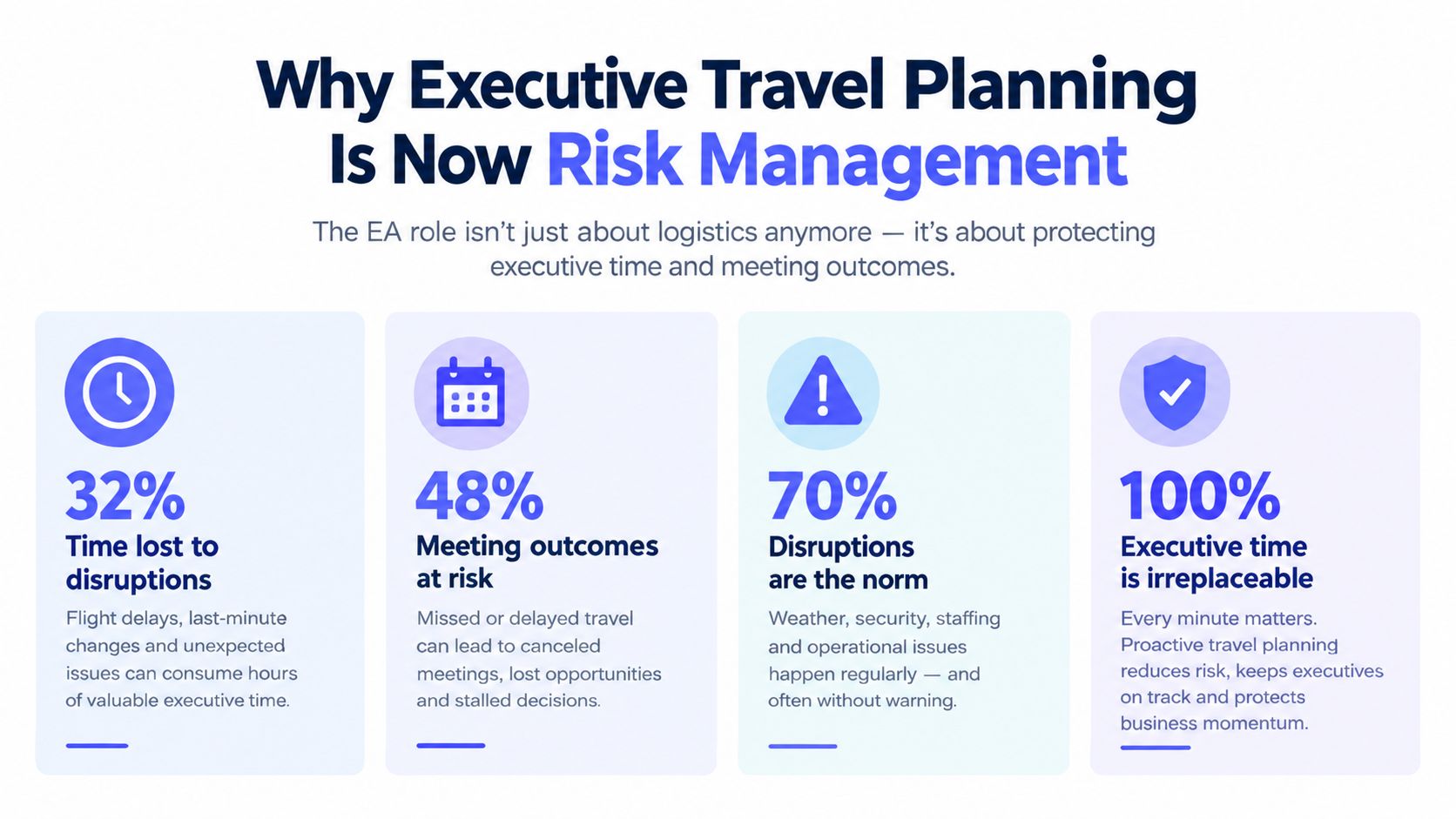
The EA's mandate is therefore broader than finding an acceptable fare. It is to protect the business objective by building redundancy, defining decision rights, and making the next action clear when one part of the trip fails.
Protect the meeting, not just the movement
Weather-related setbacks affected 50% of U.S. business travelers in 2025, cancellations disrupted 42% of U.S. professionals, and 28% said a disruption caused a missed business or sales opportunity. Among C-level executives, the figure reached 40%, according to the same business travel disruption analysis.
Those conditions justify practical safeguards: realistic arrival buffers, alternate routing, flexible hotel terms, and a named person who can approve changes. A cheaper ticket can cost more if its connections leave no workable recovery option.
Practical rule: Treat every critical meeting as an outcome with travel dependencies, not as an event placed after a flight.
A repeatable toolkit turns judgment into an operating model. The trip purpose sets the schedule. The schedule shapes the routing. The routing determines which backups are credible, and the executive profile records preferences that would otherwise slow an urgent decision.
A single-source itinerary should hold confirmations, transfer details, local contacts, meeting addresses, and disruption instructions. That record gives the EA and approved vendors the same facts, reducing conflicting updates across email, calendars, and booking portals.
For a broader view of the EA's responsibilities, review this guide to executive travel management. The working question is, “What could prevent the executive from achieving the trip's purpose, and who has authority to act when it happens?”
The Executive Assistant Travel Workflow That Prevents Chaos
A reliable workflow starts before you search for flights. Begin with the business reason for the trip, then build the travel around the commitments that matter most.
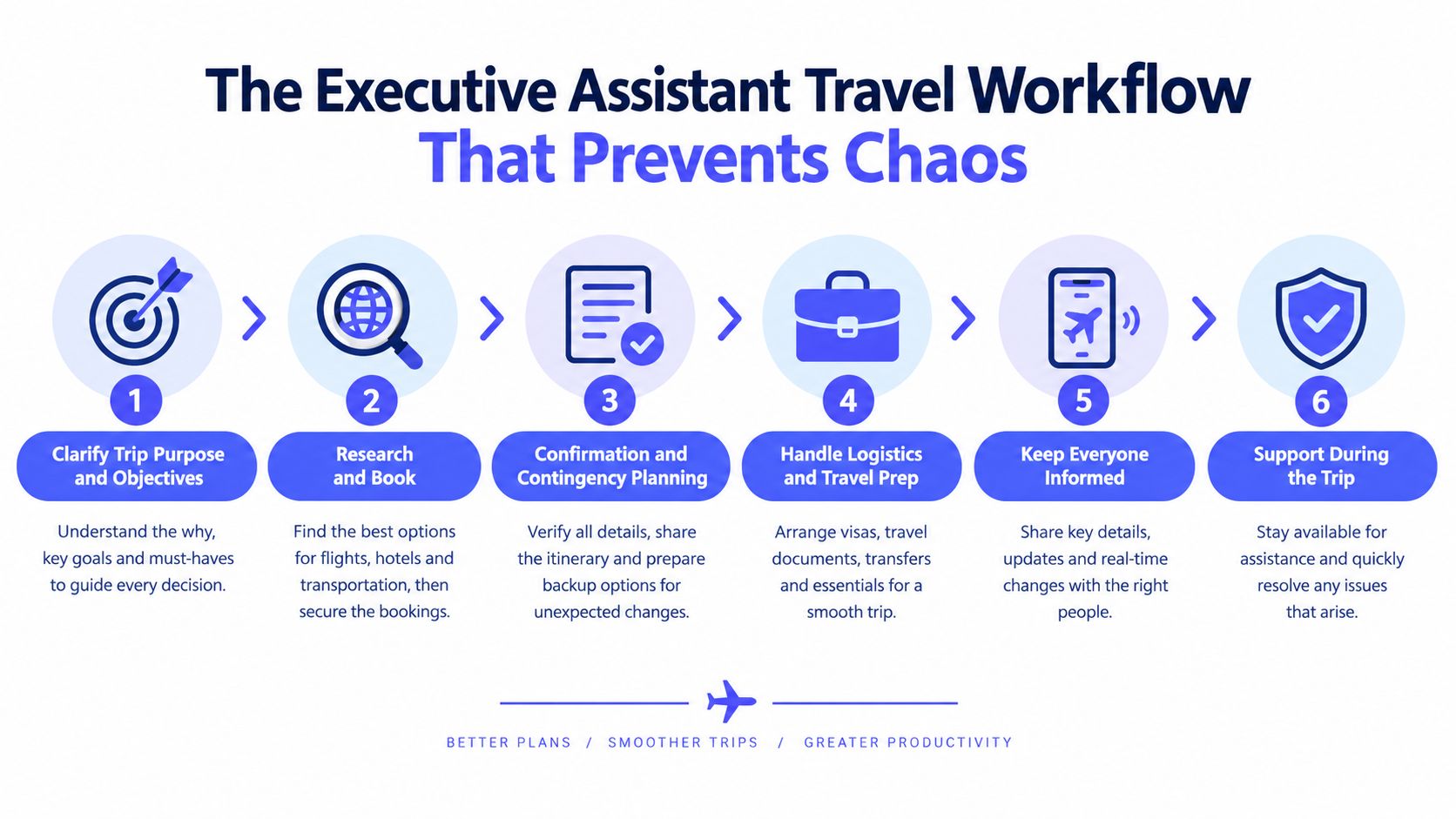
Start with the outcome
Write down the trip purpose in one sentence. Is the executive closing a deal, attending a board meeting, speaking at an event, visiting a regional team, or combining several objectives? The answer affects arrival standards, hotel location, meeting order, and the amount of recovery time required.
List every immovable commitment, including the time zone, address, host, expected duration, dress or equipment requirements, and the latest acceptable arrival. Don't treat an airport arrival as the same thing as being ready for a meeting.
Build backward from the first obligation
Plot the commitments on a timeline before looking at fares. Work backward from the required arrival time, allowing for airport processing, ground transport, check-in, and a buffer for ordinary delays. Then work forward through the rest of the trip, checking whether each move leaves the executive enough time to reset and prepare.
Group meetings by location where possible. A cheaper hotel in the wrong district can create repeated transfers and make the itinerary more vulnerable to traffic, weather, or venue changes.
Independent executive-assistant guidance recommends starting with the trip purpose, plotting meetings on a timeline, working backward from the required arrival, grouping meetings by location, adding buffer time, and avoiding critical meetings immediately after long-haul arrival. The sequence is set out in this executive assistant travel management checklist.
Book the primary plan and the escape routes
Once the timeline works, compare routing options by resilience, not just price. Consider connection complexity, arrival time, changeability, airport transfers, and whether another viable service exists if the primary option fails.
Pre-arrange the information needed for alternatives:
- Air backup: Record alternate flights, fare conditions, and the channel that can rebook them.
- Ground backup: Identify a second transfer provider or a practical local alternative.
- Hotel backup: Note nearby properties that can absorb a late arrival or unexpected overnight stay.
- Meeting backup: Keep virtual access, host contact details, and a revised arrival message ready.
Don't over-compress the schedule to make the itinerary look efficient. A plan with no recovery space transfers the risk to the executive, the client, and you.
Put everything in one living itinerary
Use one authoritative itinerary rather than allowing confirmations to remain spread across inboxes, texts, PDFs, and vendor portals. The central record should include transport, hotel, meetings, transfer details, emergency contacts, document notes, and the latest status of every moving part.
Give the executive a clean view, while retaining an internal operational view with booking references, vendor contacts, fare rules, approval notes, and backup options. Alerts should update the central record, not create another disconnected stream of information.
Before departure, run a final readiness check. Confirm names, dates, time zones, passport and visa requirements, hotel cancellation terms, transfer timing, meeting addresses, and who can approve a change. The workflow works because it separates planning, verification, and response preparation instead of treating confirmation as the finish line.
Watch the practical workflow here:
How to Choose Vendors and Partners Who Actually Deliver
Vendor selection is a risk-management decision, not a search for the lowest fare. Start with the failure scenario: the executive needs a change after office hours, inventory disappears, or a private itinerary must be discussed without exposing unnecessary schedule details. The vendor must have defined decision rights for those moments.
The market context makes those trade-offs harder. Global business travel spending was projected to reach $1.64 trillion in 2025, up from $1.48 trillion in 2024, while U.S. and Canadian average ticket prices rose from $668 in 2023 to $701 in 2024, a 1.9% increase, according to Travel Daily News' business travel statistics. A low headline price can carry a higher operational cost when the booking is rigid, the supplier is difficult to reach, or no one owns the full itinerary.
Compare channels by the job they must do
| Vendor Type | Best For | Flexibility and Support | Watch Out For |
|---|---|---|---|
| Airline or hotel direct | Straightforward trips and loyalty-led bookings | Direct access to the supplier and clear property or airline policies | Limited coordination across separate bookings |
| Corporate booking tool | Policy-controlled routine travel | Central reporting, approval workflows, and standardized traveler data | Complex changes may still require a human specialist |
| Online travel agency | Simple comparison shopping | Broad inventory and convenient search | Service ownership can become unclear during disruption |
| Dedicated travel advisor | Multi-city, VIP, international, or high-consequence itineraries | Coordinated air, hotel, ground, and on-trip support | Advisor quality, fees, and scope must be evaluated upfront |
| Local destination partner | Ground logistics and destination-specific needs | Local knowledge and rapid support on the ground | Communication, privacy, and accountability need clear controls |
A direct booking fits a simple itinerary with predictable preferences. A corporate tool earns its place when policy, reporting, and approvals matter. A dedicated advisor is more appropriate when several suppliers, cities, time zones, or privacy requirements must function as one plan.
Test the support before the trip
Ask vendors specific operational questions:
- Who answers after hours, and through which channels?
- Can the same person see the whole itinerary?
- What authority does the support team have to rebook or secure a room?
- How are changes documented and communicated?
- Can the vendor protect sensitive meeting details?
- What happens when the preferred option is unavailable?
- Does the partner coordinate transfers and hotels, or only air travel?
“24/7 support” is not a complete answer. Confirm whether it means a live agent with trip context, a general call center, or a self-service portal that sends you back to the original booking channel. Ask who can approve a fare change, move a hotel booking, authorize a driver replacement, or escalate a missed connection. Those boundaries determine how quickly an EA can act without waiting for several parties to respond.
Preferred partner networks can help when standard inventory is constrained, but the relationship still needs clear ownership and transparent escalation. This overview of preferred partner networks provides useful context for assessing the access and coordination a partner can provide.
Choose vendors that match the executive's risk profile and assign each one a defined role. A corporate booking tool may handle routine travel, while a specialist advisor manages complex or confidential trips. Require every supplier to update, or report changes to, one authoritative itinerary. The weak setup is a collection of disconnected vendors with no shared record and no agreed responsibility when the plan fails.
Itinerary Templates and Profile Systems That Save Hours
A polished itinerary is not enough at midnight, when an executive, assistant, driver, and hotel team need the same answer. The document should function as a decision record. Anyone supporting the trip must see what is confirmed, what is pending, what may change, and who owns the next action without searching several systems.
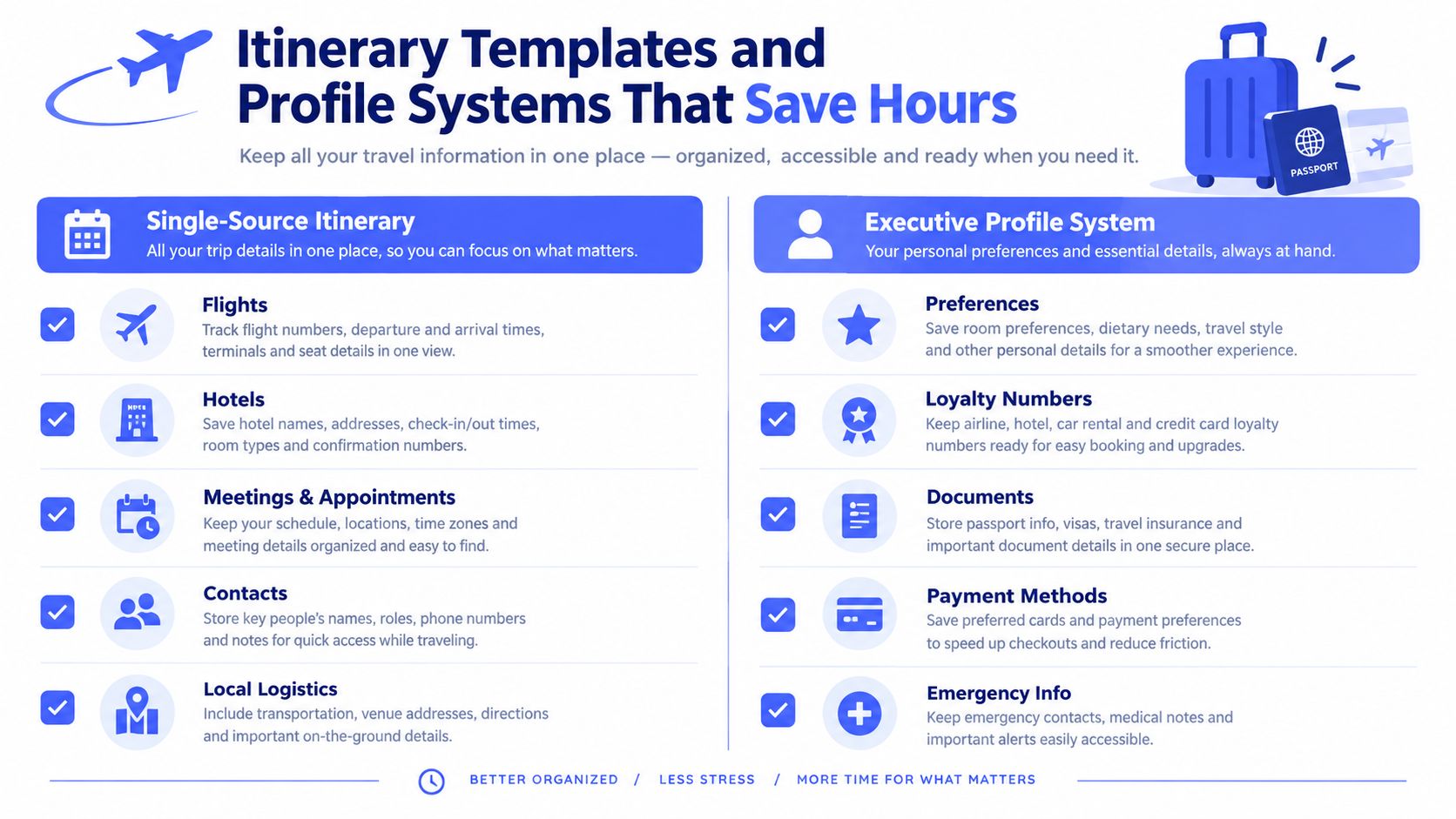
Build one source of operational truth
Arrange the central itinerary in the order the executive experiences the trip. Include:
- Movement: Flight numbers, departure and arrival airports, terminal information, rail details, and transfer arrangements.
- Accommodation: Property address, confirmation reference, check-in terms, room requirements, and cancellation conditions.
- Meetings: Local start time, location, host, purpose, preparation notes, and a virtual fallback.
- Contacts: Travel advisor, airline or hotel support, driver, host, security contact, and internal escalation owner.
- Documents: Passport and visa status, required health documentation, corporate approval, and expense instructions.
- Status: Confirmed, pending, held, changed, or canceled, with the latest update time.
Separate audiences and permissions. The executive-facing version may contain only essential logistics, while an internal version can hold operational notes. Confidential meeting titles and private residential details should not appear in a file accessible to every supplier.
Treat the traveler profile as infrastructure
A useful profile records more than an airline loyalty number. Capture preferred airlines, seating, meals, hotel standards, room-location preferences, transfer expectations, accessibility needs, communication preferences, passport details, visa history, and emergency contacts. Limit access to people who need the information, and record when sensitive details were last verified.
Guest travel creates a common gap. A GBTA study found 57% of travel managers said unprofiled guest travel caused at least some friction, while 55% reported friction in managing travel disruptions, according to Travel Daily News' coverage of the study. Create a guest profile process that collects only necessary information, confirms consent and ownership, and names the person who can approve a change.
Set lead-time triggers without making them rigid
International trips need early document review because visa sequencing can affect the route and booking decision. Industry guidance recommends beginning international planning about 12 weeks out, while domestic trips often need 30 to 45 days to secure availability, based on the executive travel checklist cited earlier. Treat those periods as planning triggers, not guarantees, and verify requirements with the relevant official authorities before committing to nonrefundable arrangements.
Deloitte reported that corporate travel incidence fell from 36% in 2024 to 31% in 2025, and fewer travel managers expected budget increases for 2026, according to its corporate travel survey. That pressure makes exception ownership worth documenting. If a VIP preference conflicts with policy, record the business reason, approval owner, cost implications, and compliance check rather than resolving the decision informally in email.
A reusable template should reduce questions while keeping decisions visible. For examples of organizing complex travel around an individual traveler, review this bespoke travel itinerary resource.
Emergency Protocols When Travel Goes Off Plan
A checklist helps you prepare. It doesn't tell you who gets to decide when the executive's flight cancels at an inconvenient hour and three acceptable alternatives have different costs, arrival times, and privacy implications.
In 2025, 89% of business travelers were affected by disruptions, and a UK study estimated that travel chaos cost firms £1.6 billion. Support preferences were divided, with 36% preferring a live agent and 34% comfortable with self-service tools, according to UK reporting on business travel disruption costs. The operational lesson is clear. A portal can surface options, but a high-stakes itinerary still needs a defined human escalation path.
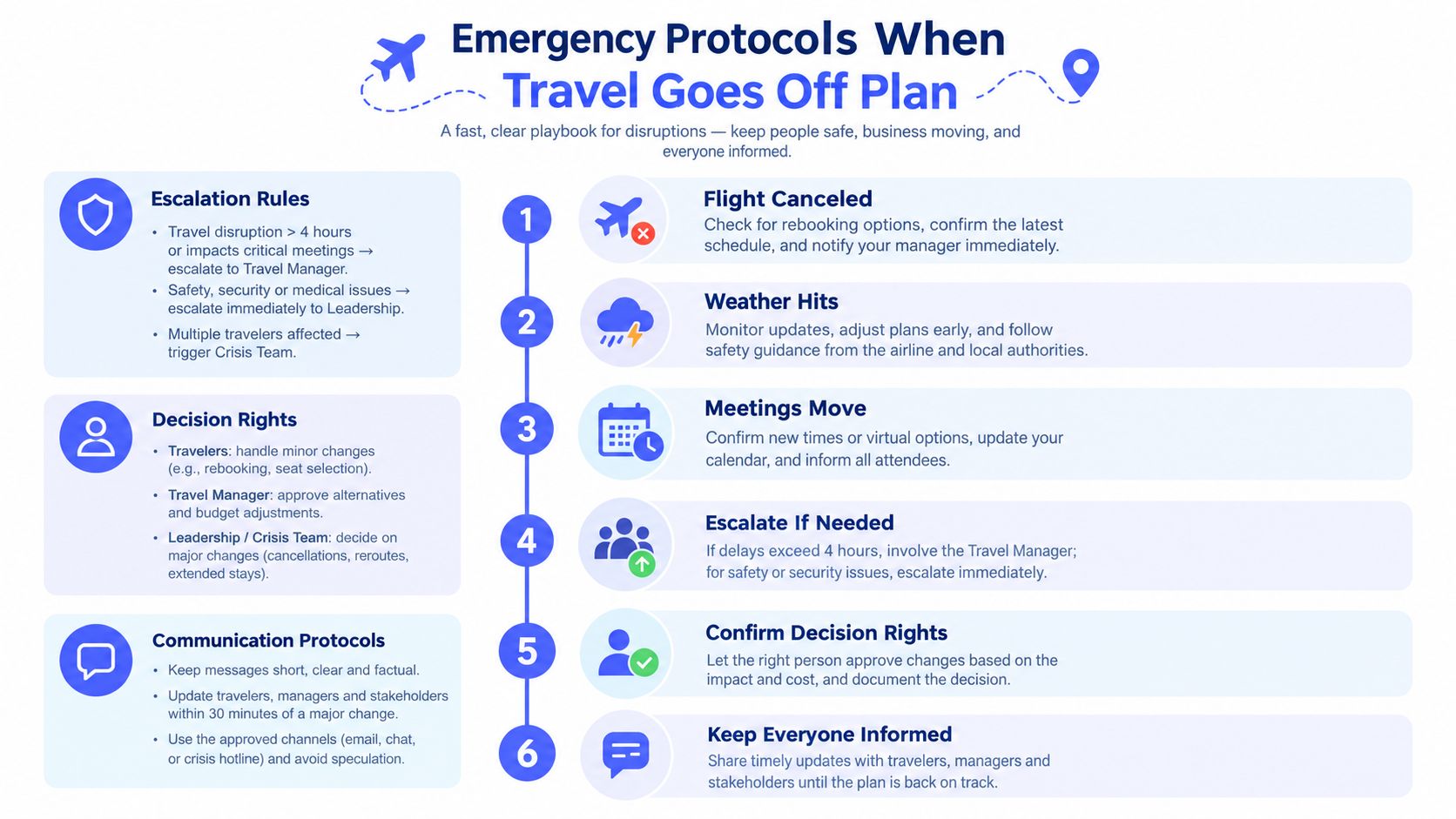
Assign decision rights before the alert
Write the protocol in plain language. The EA should know which changes can be approved independently, which require executive approval, and which require finance, security, or the host's involvement.
A practical escalation model separates decisions into three levels:
- Operational adjustment: The EA or travel partner can move a transfer, update a hotel arrival, or select a comparable route within agreed parameters.
- Business trade-off: The EA escalates when the choice affects a critical meeting, changes the arrival city, creates a material policy exception, or alters the executive's working day.
- Sensitive incident: Security, medical, privacy, or reputational concerns go to the designated senior contact immediately, even if the travel cost is still unknown.
The protocol should also state what happens if nobody responds. Silence can't be the approval mechanism during a cancellation.
Use a short communication loop
Send updates in a consistent order:
- Current position: What happened and where the executive is.
- Business impact: Which meeting, transfer, or obligation is at risk.
- Recommended action: The preferred option and why it protects the priority.
- Decision required: What needs approval, by whom, and by when.
- Next update: When the EA or advisor will report again.
Avoid broadcasting private schedule details to every participant. Tell the driver what the driver needs, tell the client what affects the meeting, and keep the full itinerary restricted to authorized people.
Response standard: Communicate the decision, the reason, and the next checkpoint. Don't send a stream of unfiltered possibilities that forces the executive to manage the disruption.
Monitor actively and rehearse the handoff
Turn on real-time alerts for flights, accommodation, and critical transfers, then decide who watches them across time zones. Keep alternate routing notes accessible, but don't create unnecessary bookings that add cancellation work and financial exposure.
Before departure, rehearse a basic scenario with the executive's office. Ask who contacts the client, who approves a premium alternative, who informs security, and who updates the itinerary. A protocol that exists only in a shared folder won't help if nobody remembers its sequence under pressure.
The aim isn't to eliminate every disruption. It is to make the response fast, discreet, and proportionate, while keeping the executive focused on the decision that only they can make.
Your Next Trip Made Seamless
The strongest travel operation connects five habits. Define the business outcome before searching. Build the schedule backward from the meeting that matters. Select vendors for recovery support as well as price. Maintain one authoritative itinerary and a current traveler profile. Assign decision rights before an alert arrives.
For the next trip, prioritize the work in this order:
- Identify the protected outcome: Name the meeting, appearance, negotiation, or event the itinerary must support.
- Expose the fragile points: Mark tight connections, long-haul arrivals, border crossings, single transport options, and schedule dependencies.
- Prepare the authority map: Record who can approve rerouting, policy exceptions, premium transport, hotel changes, and client communications.
- Run the readiness check: Verify documents, contacts, confirmations, preferences, and backup options.
- Measure execution quality: Review whether meetings were protected, whether the executive had avoidable downtime, and whether the EA had to rebuild information manually.
A trip doesn't mean nothing changes. It means the change doesn't become a crisis because the right information, partner, and decision path are already in place.
Bring in a dedicated advisor when the itinerary involves multiple cities, international entry requirements, senior-level privacy, constrained inventory, group coordination, or a meeting whose failure carries a serious business cost. For routine trips, a corporate tool may be sufficient. For complex travel, coordinated ownership can reduce the number of decisions that land on the executive's desk.
Start with the next itinerary already on your calendar. Convert it into a timeline, build the single-source record, document the backup route, and confirm who owns the first call if the plan fails. That small operational shift turns executive assistant travel planning from reactive booking into disciplined protection of time and outcomes.
JustKeeps Travel provides executive and corporate travel management for C-suite itineraries, complex multi-city routing, and private-office support, with coordinated air, hotels, transfers, and 24/7 emergency assistance while clients are actively traveling on itineraries arranged by the firm. Visit JustKeeps Travel to discuss a discreet travel desk built around precise planning, clear ownership, and fast response when plans change.