


Luxury Travel Advisor Guide to Bespoke Trips Done Right
You're probably here because travel that should feel exciting has started to feel oddly technical.
One hotel is sold out on your dates. Another has beautiful photos but mixed recent reviews. Your partner wants privacy, your children need a sane pace, and your work calendar leaves almost no room for mistakes. Then the small questions start piling up. Which room category is worth booking? Is the shoulder season a smart move or a weather gamble? Who fixes things if a transfer is late, a flight changes, or the hotel gives you the room next to the elevator?
That's the moment a luxury trip stops being about taste alone and starts becoming a coordination problem.
A good Luxury Travel Advisor doesn't “book nice things.” They remove friction you can't always see from the outside. They shape timing, protect privacy, manage moving parts, and make a complicated trip feel effortless when you're the one taking it. Their value is often invisible for the same reason great stage management is invisible. You notice it most when it's missing.
That role matters in a category that is anything but tiny. The luxury travel market is estimated at about USD 1.77 trillion in 2025 and projected to reach about USD 2.10 trillion by 2030, with roughly 3.4% annual growth over that period, according to The Business Research Company's luxury travel market report. The same report points to demand driven by travelers seeking premium, personalized, experiential trips, which is exactly the environment where high-touch advisory work becomes useful.
Table of Contents
- They curate, not just search
- They connect access to accountability
- They stay with the trip from first call to return home
- Before travel the work is mostly design and filtration
- During travel the advisor becomes an active control tower
- After travel the best advisors don't just close the file
- Leisure travelers and families
- Executive assistants and corporate travel managers
- Couples planning weddings and milestone trips
- Touring artists, entertainment teams, and privacy-sensitive travelers
- Clients who want year-round concierge help
- Why some bookings are fee-free and others aren't
- Luxury Travel Advisor engagement models compared
- A useful pricing reality check
Introduction Why Luxury Travel Feels Harder Than It Should
A family decides to plan ten days abroad during a school break. One parent wants a beach, the other wants culture, the teenagers want freedom, and everyone says they want “something special” without quite agreeing on what that means. They start with tabs open on flights, hotels, villa listings, restaurant blogs, maps, and weather charts. By the third night of research, they've collected options but lost confidence.
That's a common modern travel problem. More choice hasn't made planning easier. It's made the consequences of choosing badly more expensive.
Luxury travel gets especially tricky because the goal usually isn't just comfort. It's precision. You want the right suite, not merely an expensive one. You want a property with a calm atmosphere, not one that looks serene online and turns chaotic at breakfast. You want enough structure that the trip flows, but enough breathing room that it still feels like a holiday.
Where most travelers get stuck
The confusion usually comes from three places:
- Too many polished options: Many hotels, villas, and experiences look equally appealing until you understand their real differences on the ground.
- Timing pressure: School holidays, work windows, event dates, and weather patterns narrow your margin for error.
- Invisible logistics: Airport assistance, transfer timing, table reservations, guide quality, room placement, and backup plans rarely show up clearly at checkout.
Luxury today often has less to do with showing off and more to do with avoiding friction, crowds, exposure, and wasted time.
That's where a Luxury Travel Advisor becomes useful. Not as a luxury in the decorative sense, but as a person who makes complexity disappear.
What you should expect from this relationship
If you've never worked with an advisor before, the practical questions are usually straightforward. What do they do? Who gets the most value from one? How do fees work? And how do you tell the difference between a real advisor and someone packaging internet research?
Those are the right questions. They matter because advisor-led booking remains commercially significant across the wider travel market. ASTA says travel agency sales are projected to make up 26% of the total travel market by 2026, reaching $141.3 billion, and that travel advisors support more than 700,000 U.S. jobs. ASTA also projects 3% annual employment growth from 2022 to 2032 for travel advisors, according to the ASTA 2025 press kit. That doesn't describe a fading channel. It describes a profession clients still rely on when stakes are high.
What a Luxury Travel Advisor Really Does
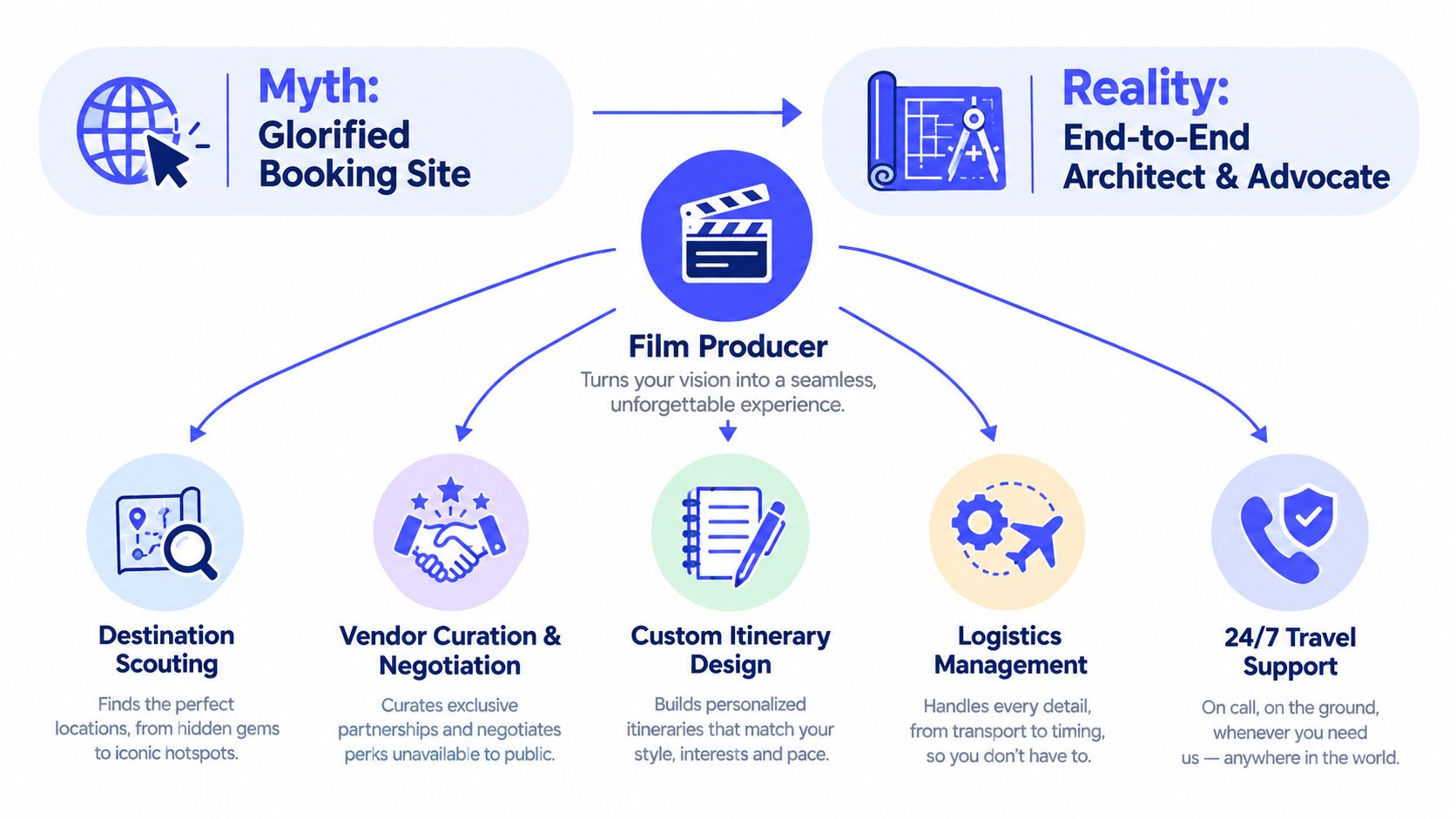
Many people assume a Luxury Travel Advisor is basically a booking site with better taste. That's the wrong model.
A better analogy is a film producer. A ticket seller gets you into the theater. A producer assembles the right people, sequences the work, solves problems before they become visible, and stays accountable when something changes. Travel works the same way.
They curate, not just search
A booking site gives you inventory. An advisor narrows that inventory to the options that fit how you travel.
If you say you want “quiet luxury” in Italy, that could mean several very different things. One traveler means understated design and privacy. Another means a grand hotel with impeccable service. Another means a villa with staff, boat access, and no lobby scene at all. A good advisor translates vague preference into a specific recommendation.
They connect access to accountability
This is one of the least understood parts of the job. Advisors often work through preferred partner and consortium relationships that can provide added value without forcing the client into a higher public rate structure.
Industry coverage on advisor hotel programs notes that these bookings often include daily breakfast for two, a property credit often around US$100, a room upgrade at check-in subject to availability, and early check-in or late checkout when available, while the traveler typically pays the same best available flexible rate and the advisor earns commission from the hotel, as explained in Hospitality Today's overview of preferred-program hotel bookings.
That matters because the value isn't “I found a cheaper room.” It's “I improved the stay, protected flexibility, and gave you an advocate.”
Practical rule: If someone only talks about luxury in terms of star ratings or marble bathrooms, they're describing decor. An advisor should also talk about pace, positioning, privacy, arrival experience, and what happens when plans shift.
They stay with the trip from first call to return home
The relationship is usually one-to-one. You explain the trip once, then refine it with the same person who understands your preferences, tolerances, priorities, and blind spots.
A serious Luxury Travel Advisor also builds from scratch. They aren't pulling generic packages off a shelf. They're aligning flights, room categories, transfers, guides, dining, and downtime into one coherent sequence, then remaining available when real travel does what real travel often does. It changes.
Inside the Service From Design to 24/7 Support
The easiest way to understand advisory work is to look at what happens before, during, and after a trip.
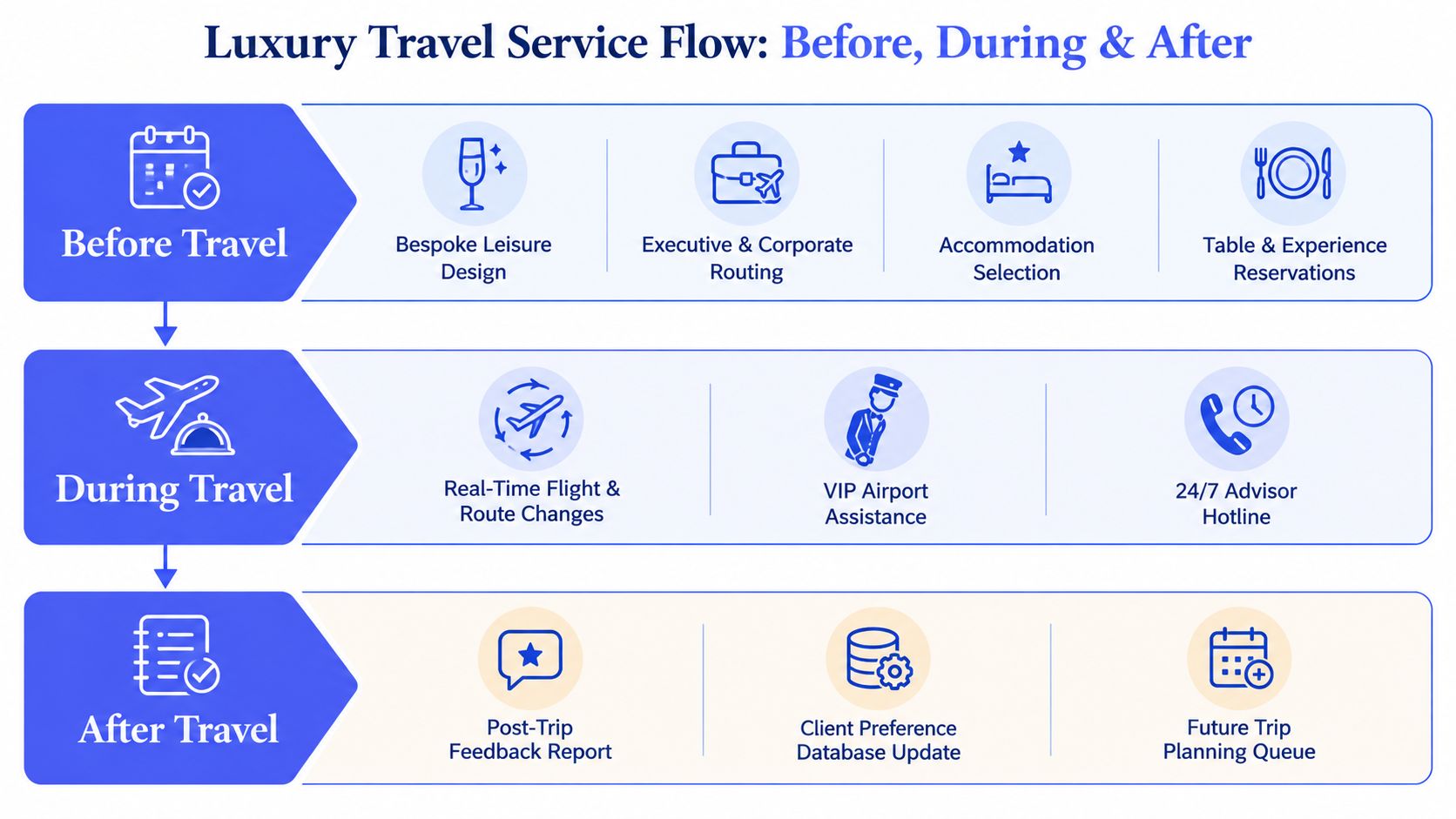
Before travel the work is mostly design and filtration
The advisor does the heavy lifting you rarely see.
For leisure travel, that can mean shaping a honeymoon so it doesn't become a blur of “must-do” reservations, or planning a family holiday with enough activity for younger travelers and enough recovery time for the adults. For corporate travel, it often means building multi-city routing around meeting schedules, keeping airport choices sensible, and avoiding itinerary structures that look efficient on paper but fall apart in practice.
For groups, the challenge changes again. A destination wedding, a milestone birthday, or a multi-family trip needs consistent standards across very different personalities. One guest wants every detail handled. Another wants freedom. Someone always books late. An advisor coordinates guest by guest while protecting the overall plan.
Consortia play a useful operational role here. They help advisors pool volume for stronger buying power, better commission tiers, exclusive supplier arrangements, and tooling such as booking platforms, itinerary builders, CRM systems, and lead-generation support, as described in AltexSoft's explanation of travel consortia and advisor infrastructure. For the client, that backend matters because better systems often mean more consistent booking, cleaner handoffs, and faster answers.
Here's a close look at what concierge-style support can include between and during trips: luxury travel concierge services.
During travel the advisor becomes an active control tower
A well-built itinerary still needs live oversight.
That can mean changing a transfer when a flight lands early, adjusting dinner plans after a delayed arrival, rerouting an executive when a connection becomes risky, or finding a calmer alternative when a destination feels more crowded than expected. For entertainment and production travel, the same principle applies with higher sensitivity. Timelines are tighter, names may be public, and discretion matters more.
A strong advisor usually supports things like:
- Air and transfer orchestration: Flights, private drivers, airport greetings, baggage coordination, and realistic handoff timing.
- Accommodation management: Matching room category to trip purpose, flagging celebration details, and requesting positioning preferences where relevant.
- Dining and experiences: Securing hard-to-get tables, private guides, specialist outings, and alternatives if conditions shift.
- Real-time support: Fast communication, often through tools clients already use, such as WhatsApp, rather than a slow call-center chain.
This short video gives a useful visual sense of how high-touch travel planning works in practice.
When travel goes well, support feels quiet. When travel goes wrong, support becomes the trip.
After travel the best advisors don't just close the file
They learn from what happened.
Maybe you loved having a guide in Kyoto but wanted more unstructured time by the coast. Maybe your family prefers one hotel move, not three. Maybe a certain style of safari camp felt too social and you'd choose something more private next time. Good advisors store those details and use them to make the next trip sharper.
That's one reason repeat clients often feel their trips become easier over time. The advisor isn't starting from zero. They're designing with memory.
Who Benefits Most and Why
Not every traveler needs the same kind of help. The value of a Luxury Travel Advisor changes depending on what problem you're trying to solve.

Leisure travelers and families
These clients usually aren't looking for more options. They're looking for better judgment.
A family might need a resort that works for different ages without feeling childish. A couple may want romance without performance. A solo traveler may want privacy without isolation. The advisor's job is to shape the pace, mix the setting, and protect the mood of the trip.
Executive assistants and corporate travel managers
For this group, the issue is less “luxury” in the decorative sense and more productivity protection.
A C-suite itinerary that misses a connection, uses the wrong airport, or stacks meetings too tightly can damage the purpose of the trip. Corporate-facing advisors help by sequencing routing, reducing transfer friction, and making changes quickly when schedules move. The traveler arrives ready to work instead of already depleted.
Couples planning weddings and milestone trips
These trips tend to carry emotional weight. People remember small failures more vividly because the occasion matters more.
An advisor helps hold standards across accommodations, guest handling, celebratory meals, activity pacing, and special requests. They also create a single point of accountability, which is a relief when multiple suppliers are involved.
Touring artists, entertainment teams, and privacy-sensitive travelers
Discretion stops being a pleasant extra and becomes operationally important.
A public figure, performer, or production team may need security-conscious routing, quiet arrivals, controlled exposure, and flexible movement if plans change. An advisor used to that environment thinks differently about schedules, access points, and communication.
Clients who want year-round concierge help
Some travelers don't only need help when a trip is on the calendar. They want someone who can handle dinner reservations, event access, gifting, transport, and occasional last-minute requests throughout the year.
The real dividing line isn't wealth. It's complexity, privacy needs, time pressure, and how costly a mistake would feel to you.
Understanding Pricing and Engagement Models
Pricing is where many travelers hesitate, mostly because the industry often explains it poorly.
The important thing to know is that planning fees and supplier commissions aren't the same thing. An advisor may earn commission from hotels or other travel suppliers, but they may also charge a separate fee for the design work, research, revisions, coordination, and ongoing support required for a custom trip.
Recent coverage shows a very wide fee spread, from $0 planning fees to several thousand dollars, with some luxury planning fees ranging from about $420 to $6,175 for highly customized trips, according to LuxGetaway's review of luxury travel advisor costs and fee structures. The takeaway isn't that one model is right and another is wrong. It's that price usually follows complexity.
Why some bookings are fee-free and others aren't
If you already know the hotel, dates, and basic structure, an advisor may be able to handle the booking through preferred partner channels and be compensated by the hotel. In that situation, the advisor is adding value through access and amenities rather than charging you separately for extensive planning.
If you need a multi-stop itinerary, villa sourcing, group handling, hard-to-secure experiences, air coordination, and live support, that's different. You're no longer buying a reservation. You're buying design, project management, judgment, and availability.
Luxury Travel Advisor engagement models compared
| Engagement Model | What You Pay | What Is Included | Best For |
|---|---|---|---|
| Hotel-only preferred partner booking | Often no separate planning fee, with advisor compensated by supplier where applicable | Hotel reservation, preferred partner amenities, pre-arrival notes, booking advocacy | Travelers who already know where they want to stay |
| Custom leisure planning | Planning fee plus any travel components booked | Destination matching, itinerary design, hotel and experience curation, logistics coordination, support while traveling | Honeymoons, family trips, milestone travel, multi-city vacations |
| Corporate or executive management | Service fee structure varies by scope and servicing model | Routing strategy, schedule-sensitive planning, change handling, supplier coordination, traveler support | Executive assistants, founders, corporate teams |
| Group and event travel | Higher-touch fee structure tied to complexity | Guest handling, rooming coordination, event-related logistics, timeline management | Destination weddings, celebrations, multi-family trips |
| Ongoing concierge relationship | Retainer or project-based structure depending on scope | Reservations, access requests, gifting, transport, ad hoc support beyond one trip | Clients who want year-round lifestyle and travel support |
A useful pricing reality check
Preferred hotel benefits usually don't require paying a higher rate just to work with an advisor. As noted earlier, many consortium-style hotel bookings are built around the same best available flexible rate while layering in amenities and recognition. That's one reason good advisors focus less on discount language and more on fit, access, and execution.
How to Choose the Right Luxury Travel Advisor
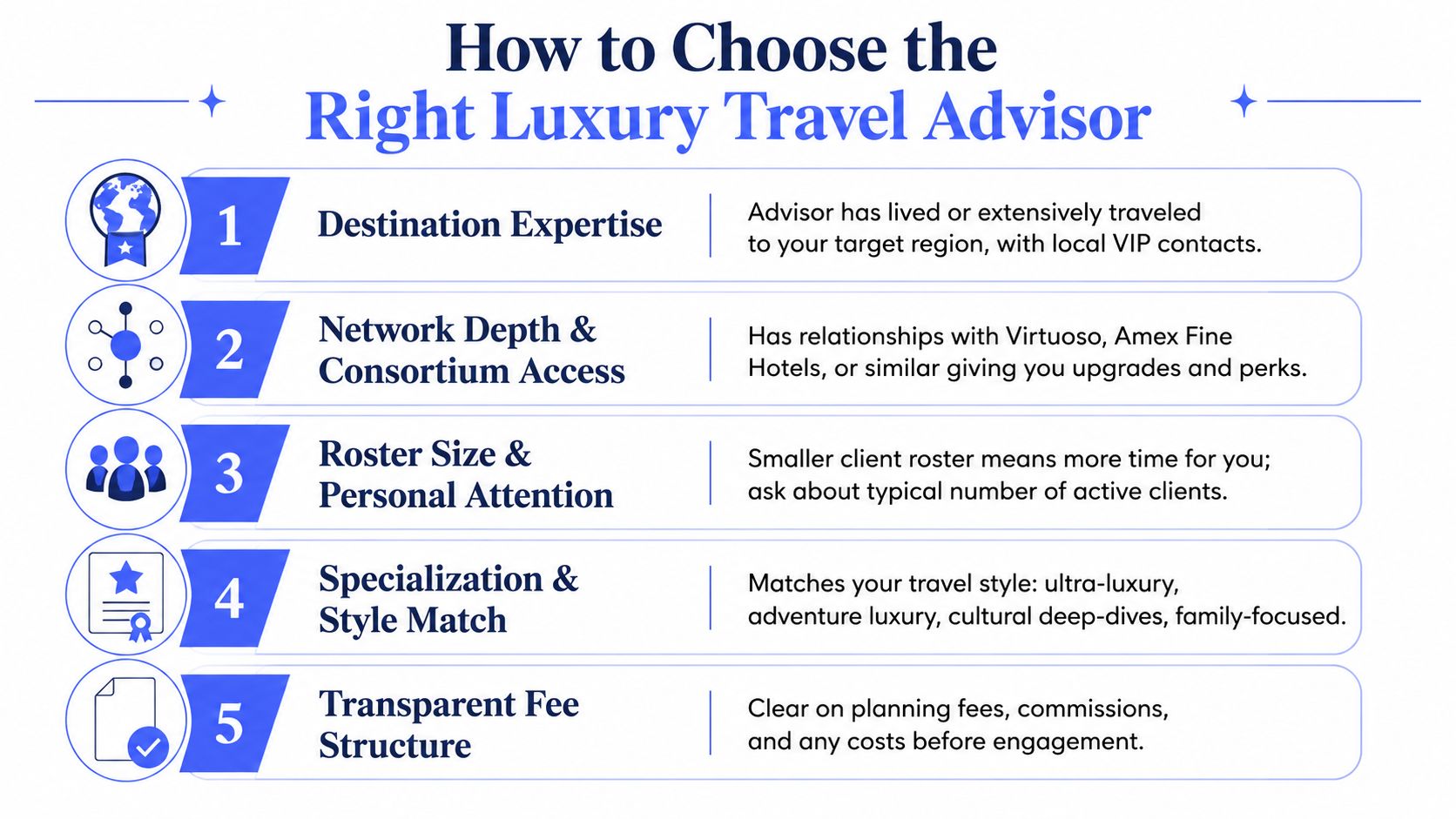
Choosing an advisor is less like hiring a search engine and more like choosing a private guide for a complex project. Competence matters, but fit matters too.
What to look for on the first call
Listen for specificity. If you mention Japan in spring and they immediately talk only about Tokyo and Kyoto, that's not necessarily expertise. If they ask about your tolerance for crowds, your interest in slower pacing, and whether you'd trade peak bloom for a calmer shoulder moment, that's a better sign.
You also want clarity around network depth, communication style, and discretion. Ask whether they work through preferred partner or consortium relationships. Ask how they handle in-trip changes. Ask who will be your point of contact once planning begins.
A useful comparison resource is this guide to the best travel concierge options for different traveler needs.
A short vetting checklist
- Ask for sample journey logic: Not just pretty destinations, but why they sequenced the trip that way.
- Check whether itineraries are custom-built: Templated packages often signal shallow planning.
- Probe for privacy protocols: This matters if names, schedules, or access need protection.
- Confirm support style: You want to know how they communicate when you're traveling.
- Review fee transparency: A serious advisor should explain what is included before engagement.
A good discovery call should make your trip feel clearer, not more dazzled.
Red flags worth taking seriously
Some warning signs are subtle. If every recommendation sounds interchangeable, if the advisor leans heavily on generic destination lists, or if they can't explain why one hotel works better than another for your specific style, move on.
Another red flag is overemphasis on extravagance alone. Today's luxury traveler often cares as much about meaning, privacy, crowd avoidance, and emotional ease as they do about beautiful hardware. Industry reporting gathered by Expedia Group notes that luxury travelers are increasingly drawn to less-crowded destinations, shoulder-season travel, wellness, authenticity, and personalized experiences, and cites a Virtuoso-linked view that luxury is being measured less by extravagance and more by personal meaning. The same coverage also notes fall bookings up 59% and sales up 69% as travelers seek quieter periods and less saturated places, according to Expedia Group's overview of luxury travel trends for 2026. An advisor who doesn't think about crowd strategy is missing part of the brief.
JustKeeps Travel in Action Sample Journeys and Next Steps
Consider four trips that all look “luxury” on paper but require very different judgment.
A Japan journey might avoid the most compressed peak periods, pair city intensity with quieter ryokan time, and use private guiding selectively rather than all day, every day. The point isn't to insulate you from the country. It's to let you experience it without spending the whole trip in lines, taxis, and recovery mode.
An East Africa safari needs a different kind of precision. Camp sequencing, flight timing, privacy, and energy management matter more than trying to see everything. The right advisor knows when to slow down, when to change regions, and when a smaller camp is better than a more famous one.
The Maldives can also be misunderstood. What looks interchangeable online often isn't. Some islands are designed for social energy, some for total seclusion, some for families, and some for wellness-driven quiet. A strong brief turns “I want the Maldives” into the specific island, villa type, transfer style, and stay length that fits your real goal.
The Amalfi Coast is perhaps the clearest example of luxury as strategy rather than extravagance. Timing changes the trip. So does base selection. So does knowing when to move by boat, when to stay inland, and when shoulder-season light and thinner crowds will produce a better experience than peak-summer bragging rights.
For travelers who want a closer look at how custom routing comes together, this example of a bespoke travel itinerary approach is useful.
One firm that works in this style is JustKeeps Travel, a luxury travel advisory and concierge company that plans bespoke leisure, corporate, group, and entertainment travel with a single planner relationship and end-to-end coordination. That kind of model suits travelers who want one person responsible for the whole sequence, not a string of disconnected bookings.
The larger shift is simple. Luxury isn't only about spending more. It's about wasting less. Less time in crowds, less uncertainty, less avoidable friction, less exposure, less compromise between what the trip costs and what it feels like.
If you want help designing a trip with that level of precision, JustKeeps Travel offers one-to-one luxury travel advisory and concierge support across leisure, corporate, group, and entertainment travel. If you're planning something that needs careful timing, privacy, and end-to-end coordination, visit JustKeeps Travel to start the conversation.