


Destination Management Company Explained Simply
You've approved the villa, confirmed the guest list, and built an itinerary that looks flawless on paper. Then one flight arrives late, the transfer vehicle is held at a restricted entrance, a restaurant changes its seating plan, and several guests need different arrangements at the same time. In a familiar city, your team might solve each issue quickly. In an unfamiliar destination, those small gaps can affect the entire program.
That's where a destination management company, or DMC, becomes valuable. A DMC is the local operating layer that connects transport, hotels, venues, guides, suppliers, event teams, and guests. It doesn't replace the travel advisor who understands the client's priorities. It gives that advisor reliable destination-side control.

This guide is for travelers, executive assistants, corporate planners, families, and production teams who need more than reservations. You'll learn what a DMC does, how it differs from a travel advisor or event planner, when its involvement protects an itinerary, and how to evaluate one before committing. You'll also see how JustKeeps Travel uses DMCs selectively, bringing in local specialists when complexity, access, or discretion requires an additional layer of control.
Table of Contents
- Transportation logistics
- Accommodation and venue sourcing
- Event and experience design
- On-site management
- Luxury leisure travel
- Corporate and incentive programs
- Weddings and milestone groups
- Entertainment and production travel
What a Destination Management Company Really Is
A flight arrives late, a restricted entrance delays the vehicle, and a venue changes its seating plan while guests are already on the move. The itinerary may look orderly in the client file, yet the destination can introduce several problems at once. A destination management company, or DMC, provides the destination-side control layer that keeps those details coordinated.
A DMC works like a local producer for travel. A film producer turns a creative brief into a finished production by coordinating locations, people, timing, and technical requirements. A DMC applies the same discipline to a destination program, translating the client's priorities into local actions that guests experience as smooth and intentional.
The company is based in, or closely connected to, the destination. Its team knows which venues can handle a particular arrival pattern, which roads create delays, which guides fit different personalities, and which suppliers can respond when the original plan changes. That practical knowledge helps decision-makers choose well under pressure.
The DMC model in plain language
Begin with the desired outcome, such as a private family celebration, incentive program, leadership retreat, destination wedding, or carefully managed tour leg. The DMC coordinates the local pieces required to deliver it:
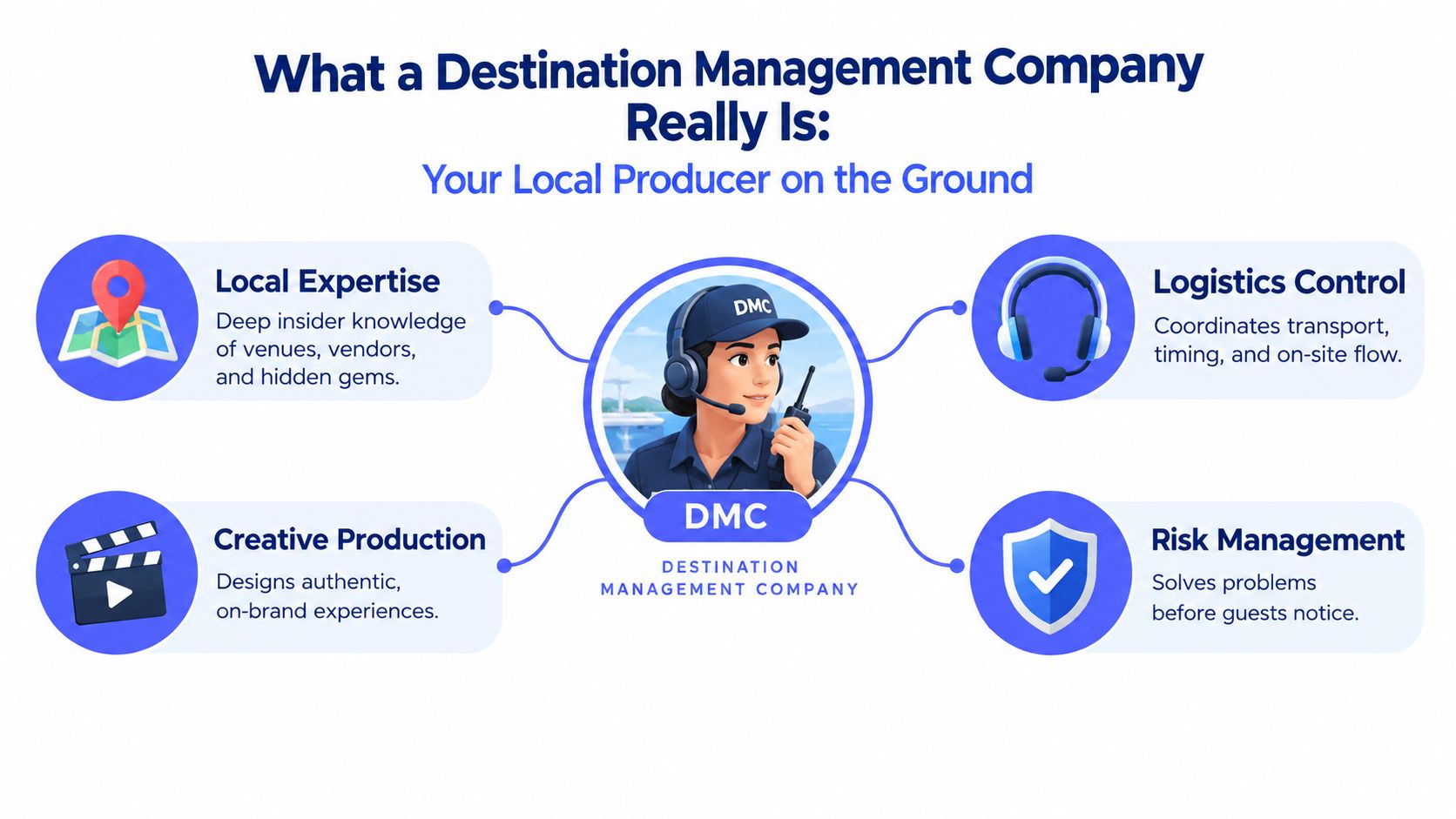
- Local expertise: The team assesses venues, guides, restaurants, transport operators, and experiences through a destination-specific lens.
- Operational control: It sequences arrivals, departures, meals, meetings, excursions, room requirements, and guest movements.
- Creative production: It shapes experiences around the destination instead of relying on standard sightseeing.
- Problem prevention: It identifies weak points and keeps alternatives ready when conditions change.
The phrase “local travel agency” can mislead. A general travel agency may arrange products across many destinations. A DMC concentrates on destination execution, often after the destination and broad objectives are established. It turns that framework into a working program involving people, vehicles, contracts, permits, schedules, and on-site teams.
Why DMCs emerged
DMCs developed through the meetings, incentives, conferences, and exhibitions ecosystem, often called MICE. Organizations needed local specialists to coordinate programs with many attendees, suppliers, venues, and timed movements. Euromic describes its network as established in 1973, reflecting the long history of organized DMC collaboration in international events (Euromic's network history).
Modern networks show how the model has expanded beyond individual local operators. Their reach connects destination knowledge with international planning, while each DMC still handles the practical realities on the ground. These networks illustrate the category's shift toward globally connected infrastructure.
Practical definition: A DMC is the destination-based team that turns a travel or event brief into coordinated local execution.
JustKeeps Travel uses a DMC when access, complexity, or discretion calls for local operating control. For a simpler itinerary, the travel advisor may handle arrangements directly, preserving a more direct and private process. The decision depends on the trip's moving parts, not on adding a DMC by default.
Core Services and How a DMC Actually Operates
A DMC's value appears most clearly when a program contains multiple moving parts. Market research commonly divides DMC demand across event management, accommodation booking, transportation logistics, and corporate or leisure applications, which reflects how broad the operating brief can become (destination management service market overview).
The four service clusters below are connected. A transfer schedule affects a dinner reservation. A venue affects vehicle access. A guest's mobility requirement affects walking routes, staffing, and timing. The DMC keeps those dependencies visible.
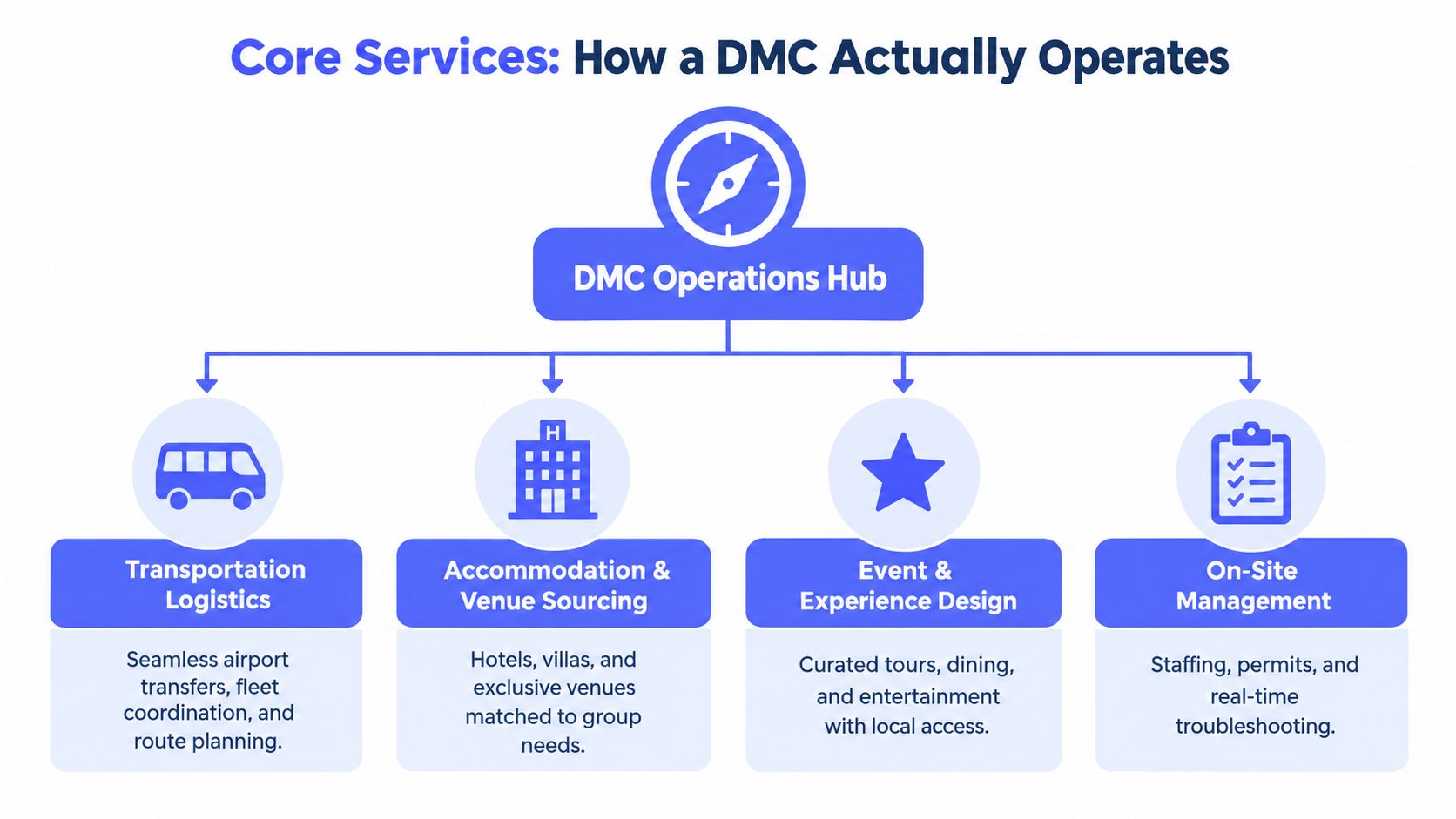
Transportation logistics
The transport team manages airport welcomes, private cars, coaches, minibuses, drivers, route planning, loading points, and timing. For a group, the challenge isn't reserving vehicles. It's assigning the right vehicle to the right guests, matching luggage capacity to the movement plan, and creating a response if an arrival changes.
A DMC may also arrange staggered departures, discreet vehicle access, or alternative routes when a central road is congested or a venue restricts coach access. The advisor sees the client's priorities. The DMC sees the local operating conditions.
Accommodation and venue sourcing
Hotels, villas, restaurants, estates, galleries, and event spaces each have practical limitations. A DMC checks those limitations against the brief, including access, service flow, privacy, weather exposure, guest movement, catering, technical requirements, and nearby transport options.
Local relationships matter. A DMC may know which property can manage a late private arrival, which restaurant can separate a group into appropriate tables, or which venue requires additional permissions. Direct online research rarely reveals that operational context.
Event and experience design
A DMC can shape a local experience around the client's purpose. That might mean arranging a private culinary visit, a guided cultural program, an incentive dinner, a wellness itinerary, or entertainment that suits the group's tone. The work is not selecting something attractive. It's matching the experience to the guests, destination conditions, timing, and service standard.
For travelers who want every detail designed around their preferences, a bespoke travel itinerary provides the broader planning framework, while the DMC can execute destination-specific components.
On-site management
During the program, local staff handle arrivals, guest questions, supplier coordination, schedule changes, signage, permits, rooming details, and troubleshooting. They may be stationed at a hotel, venue, airport, or event site, depending on the program.
That creates a destination-side control layer. Instead of asking the client, advisor, venue, driver, and guide to solve the same issue separately, the DMC routes the problem through one local operating team.
The market's scale reinforces why this function matters. One industry estimate values the destination management company market at $4.8 billion in 2025, with a projection of $8.2 billion by 2034 at a 7.2% CAGR (destination management company market estimate). Other estimates place the global destination management services market at $8.7 billion in 2024 and project $11.5 billion by 2030, demonstrating that DMCs operate within a substantial international services category rather than a narrow event niche.
How DMCs Compare to Travel Advisors Concierges and Event Planners
Clients often use these titles interchangeably because the professionals may collaborate on the same trip. Their responsibilities differ, especially when the itinerary includes private travel, corporate objectives, a large guest list, or sensitive movements.
A travel advisor owns the client relationship and the overall journey. The advisor learns the traveler's preferences, designs the itinerary, coordinates major components, advocates with suppliers, and remains responsible for keeping the plan aligned with the client's expectations.
A DMC owns the destination-side execution. It sources local suppliers, manages operational details, staffs the program, and responds to conditions on the ground. The DMC usually works through the advisor or planner rather than replacing that relationship.
A concierge handles lifestyle and access requests. Restaurant reservations, tickets, gifting, personal shopping, property arrangements, and last-minute requests may sit within that role. A concierge can support a trip without managing the complete transportation, accommodation, and event sequence.
An event planner focuses on the program's purpose and design. They may define the agenda, creative direction, speakers, branding, guest experience, and event objectives. The DMC then helps make that program workable in the destination.
Who does what in luxury and corporate travel execution
| Role | Primary Client | Where They Operate | Core Value Delivered |
|---|---|---|---|
| Travel advisor | Individual, family, executive, company, or group | Across the full journey | End-to-end itinerary ownership and client advocacy |
| Destination management company | Advisor, planner, company, or group program | At the destination | Local execution, supplier coordination, and on-site control |
| Concierge | Traveler, principal, family, or estate team | Wherever requests arise | Access, reservations, personal assistance, and lifestyle support |
| Event planner | Company, host, brand, or organization | Program and event environment | Event concept, agenda, production direction, and stakeholder alignment |
The boundaries can overlap. An advisor may coordinate directly with hotels and guides for a straightforward trip, while a concierge may manage complex property logistics. A corporate travel management company, discussed in this guide to travel management companies, may handle policy, traveler tracking, booking processes, and corporate travel administration.
JustKeeps Travel may retain a DMC as an extension of its own team when local execution requires more staffing or destination access. It can also manage arrangements directly when a smaller itinerary benefits from a single advisor coordinating the details without introducing another operating layer.
Decision rule: Hire the DMC for what must happen locally. Keep the advisor responsible for what the journey must feel like to the client.
Why a DMC Matters for Luxury Corporate Group and Entertainment Travel
A DMC becomes useful when the cost of a missed connection is greater than the inconvenience of changing a reservation. That can happen during a private celebration, an executive program, a wedding, or an entertainment schedule where timing and privacy matter as much as comfort.

Luxury leisure travel
A couple arrives at an Italian villa with family members who have different mobility needs, dining preferences, and arrival times. The advisor can arrange the overall stay, but the DMC can manage the local handoff, villa orientation, private guides, chef coordination, and vehicle movements. If a restaurant's access changes or a guide becomes unavailable, the local team can adjust the plan without making the guests carry the problem.
For a private traveler, the benefit isn't convenience. It's preserving the atmosphere of the trip. The guest should be enjoying the terrace, not waiting for several suppliers to decide who will answer a phone call.
A broader concierge relationship can also support requests outside the itinerary, including dining and priority-access arrangements. JustKeeps Travel describes its corporate concierge services as support for executive and corporate needs that can extend beyond individual reservations.
Corporate and incentive programs
A leadership retreat may depend on meeting-room readiness, airport transfers, executive privacy, group dining, and a carefully timed off-site experience. If a road closure affects the afternoon program, the DMC can assess local alternatives, communicate with drivers and venues, and protect the meeting objective.
The DMC doesn't decide what the company's leaders need to accomplish. It makes the destination behave predictably enough for the program to work.
Weddings and milestone groups
A wedding has one itinerary for the hosts and many personal itineraries for the guests. One person needs an early transfer, another has a dietary restriction, and someone else has luggage arriving separately. The DMC maintains the local guest flow while the advisor keeps the hosts informed and protects the emotional tone of the celebration.
This guest-by-guest handling is especially important when family members are arriving from different places. A shared schedule alone doesn't capture the operational detail required.
Entertainment and production travel
A touring artist or production team may need discreet transfers, secure movements, crew coordination, appearance logistics, and precise routing between venues. The DMC can manage destination-specific access points and supplier communication while the advisor protects the larger calendar and confidentiality requirements.
The local team's job is to notice friction before it reaches the principal. That might mean changing a pickup point, separating movements, or confirming that a venue can support the required arrival protocol.
The following video offers another visual perspective on how destination-side coordination supports travel and event programs.
DMC demand spans both business and leisure applications, with market research connecting the category to corporate travel, incentive travel, personalized leisure, and event logistics (destination management services market analysis). The practical lesson is simple: the more suppliers, guests, timing constraints, and privacy considerations a program contains, the more valuable local control becomes.
How to Vet and Hire the Right Destination Management Company
A polished proposal isn't enough. You're hiring an operating partner, so the evaluation should focus on how the company behaves before, during, and after a disruption.
Start with destination depth
Ask how long the team has operated in the destination, which staff members will be present, and whether they use local employees, independent contractors, or a combination. You're looking for specific knowledge, not a broad statement about “local expertise.”
Request references from programs similar to yours. A company experienced with conferences may not be the right fit for a private villa celebration. A wedding specialist may not have the staffing model required for an executive retreat or production schedule.
Test the operating model
Ask these questions before reviewing the final proposal:
- Who owns the account locally? Identify the person with authority to make decisions during the program.
- What happens when a supplier fails? Ask for a practical example of the backup process, without accepting confidential client details.
- How is guest information protected? Privacy-sensitive programs need clear handling procedures.
- Which services are managed in-house? Separate direct capability from outsourced supplier coordination.
- How does the team communicate changes? Establish whether the advisor, client, group lead, or venue receives updates first.
- What support is available outside office hours? Confirm the escalation route and staffing arrangement.
Pricing also deserves precise questions. A DMC may present management fees, per-person pricing, supplier markups, commissions, or a blended structure. Ask which costs are included, which are pass-through expenses, how cancellation terms work, and whether changes generate additional charges.
A useful test: If the DMC can't explain who will make decisions when the original plan fails, you haven't finished the vetting process.
Watch for red flags
Be cautious when a proposal uses vague supplier descriptions, avoids naming the on-site team, provides no contingency approach, or offers an unusually generic program. A DMC should be able to explain why a venue, route, guide, or transport plan fits your guests.
JustKeeps Travel evaluates potential DMC partners against the client's destination, service expectations, privacy needs, and program complexity. That preserves the advisor-led relationship while bringing in local specialists only when they add meaningful control.
Real World Scenarios and Your Next Step With JustKeeps Travel
A Japan incentive program may require airport welcomes, coordinated rail or road movements, private cultural access, group dining, and guest support across several locations. The advisor owns the company's objectives and traveler experience, while a DMC manages the destination-side sequence and local supplier response.
On the Amalfi Coast, a milestone celebration might combine villas, boats, guides, restaurants, and transfers on roads where timing and access require careful planning. The DMC handles local movements and on-site coordination, allowing the advisor to protect the hosts' preferences and keep the celebration personal.
An entertainment tour leg presents a different pressure. Crew, entourage, vehicles, appearances, security considerations, and venue access must align without drawing unnecessary attention. A destination partner can manage local details while the advisor maintains the broader routing and client communication.
The right answer isn't always to hire a DMC. For a simple itinerary, direct advisor coordination may offer greater discretion and fewer handoffs. For a complex program, the DMC functions as the destination-side control layer that protects timing, access, guest care, and recovery when conditions change.
JustKeeps Travel designs bespoke leisure, corporate, group, and entertainment journeys, then coordinates vetted destination partners when local execution calls for additional staffing, access, or discretion. Visit JustKeeps Travel to begin a conversation about an itinerary that needs precise planning from the first discovery call through the return home.