


Luxury Trips to Italy: Bespoke Itineraries for 2026
You've booked the flights, saved the villa photos, and started sending restaurant names to your partner. Then you arrive in Capri in mid-July and discover the first uncomfortable truth about luxury trips to Italy: money alone doesn't create access. The hotel is charming but half an hour from the beach, the pool is shared, the ferry terminal is a crush of luggage and day-trippers, and the restaurant your hotel recommended has no table for tonight.
A better-planned arrival feels almost like a different country. Your private boat transfer meets you outside Naples at the right moment, your suite is secured before the most desirable rooms disappear, and dinner is waiting under lemon trees rather than behind a two-hour queue. Italy rewards that kind of preparation because its best hotels, guides, boats, restaurants, and seasonal experiences are limited, regional, and often committed months before arrival.
Table of Contents
Why Italy Rewards the Well-Prepared Traveler
The glossy version of Italy makes every day look effortless. Wake beside the sea, stroll into a famous museum, find a table overlooking the water, and finish with a private boat at sunset. The selection is more exclusive. A coastal road can turn a short distance into a slow transfer, a small island hotel can have no alternative room category once it sells out, and a private guide who understands art, food, and local logistics may already be committed to another family.
That scarcity matters because Italy's luxury market is substantial and internationally driven. A 2025 industry report on Italy's luxury hospitality market said five-star hotels generated more than €9 billion in turnover in 2024, welcoming about 4.5 million guests and recording 12.8 million overnight stays. The report estimated that luxury hotels produced 16.8% of total hotel-sector earnings, while the overall hotel sector generated about €54 billion.
The room you want may not be available later
Italy's premium supply also looks larger on paper than it feels on the ground. An ANSA analysis of Italy's luxury hotel market reported 710 luxury properties with 47,335 rooms, but those rooms are spread across distinct destinations and operating calendars. The same report said the top 29 Italian luxury hotels generated €1 billion in revenue in 2023, with average revenue per room of €144,000, up 15% from 2022.
A traveler doesn't experience national inventory. They experience the one hotel in Ravello, Bellagio, or Capri that fits their dates, room requirements, and privacy expectations. When that property is full, a theoretical room elsewhere in Italy won't solve the problem.
Practical rule: Plan around the hotel and the experience you can't replace, then build transport and sightseeing around them.
Preparation protects the feeling of ease
A strong advisor sequences arrival times, reserves the right vehicle for narrow roads, identifies which days need a guide, and leaves enough unstructured time for the trip to feel personal rather than managed.
That's the difference between paying for luxury and receiving it. The value sits in the coordination, especially when the itinerary includes ferries, boats, restricted historic centers, seasonal restaurants, and several hotel changes. Italy can be wonderfully spontaneous for a local who knows the terrain. For a visitor with fixed dates and high expectations, spontaneity often means accepting what's left.
What a Bespoke Italy Trip Actually Includes
A bespoke itinerary is an operating plan, not a polished PDF of hotel names. Before you approve anything, ask what the advisor is arranging, who is responsible on the ground, and what happens when weather, transport, or availability disrupts the original design.
The first distinction is guiding. A private guide with serious art-history training can turn the Uffizi or Vatican Museums into a coherent experience, adjusting the route to your interests instead of delivering a memorized overview. A generic driver-guide may be perfectly useful for transfers, but they're not automatically qualified to interpret Renaissance painting, Roman history, or regional food culture.
The access layer
A well-built plan usually includes several separate specialists:
- Private cultural guides: Match the guide to the subject, whether that's Renaissance art in Florence, ancient history in Rome, or Baroque architecture in southern Italy.
- Vetted local partners: Use established operators for truffle hunting, boat charters, vineyard visits, and private homes rather than selecting the first highly reviewed activity online.
- Preferred hotel relationships: Ask whether the advisor is booking at a preferred rate and whether the property may offer benefits such as a welcome amenity or a suite upgrade, subject to the hotel's discretion.
- Concierge backup: Confirm who handles flight strikes, ferry cancellations, restaurant changes, and urgent transport issues while you're traveling.
The hotel relationship deserves particular scrutiny. “Preferred” shouldn't mean a vague promise that someone knows the front desk. Ask whether the advisor has a confirmed relationship with the specific property and whether the benefits are attached to your booking.
What arrives before you do
Expect a pre-arrival briefing that explains transfer points, dress expectations, timing, guide meeting locations, and realistic walking demands. Timed entries for the Uffizi and Vatican Museums should be built into the day, not treated as optional details after the hotels are booked.
Transfers should reflect the terrain. A Mercedes V-Class can make sense for a family with luggage and equipment, while a smaller chauffeured sedan may be more comfortable on narrower roads. Shared coaches belong to group logistics, not to a private itinerary advertised as smooth.
Restaurant planning should follow the route and the client, with reservations at destinations appropriate to the occasion and food preferences. A serious advisor may arrange a refined Tuscan lunch, a family-run trattoria, or a Locanda Locatelli-level dining experience, but the choice should serve the traveler rather than decorate the itinerary.
For a useful explanation of the planning model, see this guide to what a bespoke travel itinerary includes.
Bespoke planning isn't a magical black book of secret addresses. It's working infrastructure built around your travel style, with people, timing, access, and contingency plans connected before you leave home.
Choosing Between Amalfi, Tuscany, and Lake Como
These three regions can all deliver a high-end Italian trip, but they suit different clients. Don't choose based only on photographs. Choose based on how you want your days to feel, how much movement you tolerate, and whether you want the hotel itself to be the destination.
| Region | Best Season | Ideal Length | Pace | Best For |
|---|---|---|---|---|
| Amalfi Coast | Late May to early October, with September especially appealing | Four to six nights | Slow, scenic, water-led | Coastal glamour, sea views, private boats |
| Tuscany | Spring through autumn | Seven to ten nights | Spacious, exploratory | Villas, wine, art, countryside drives |
| Lake Como | May or September | Three to five nights | Relaxed but compact | Historic hotels, gardens, lake cruises |
Amalfi Coast
Choose Amalfi if you want a beautiful base with strong visual drama and you're happy to slow down. A four-to-six-night stay works better than a rushed sweep through every town. Positano, Ravello, and Capri each reward time, but the coast's vertical geography makes constant movement tiring, particularly for travelers with mobility limitations.
Late May through early October gives the classic coastal experience, while September is my preferred compromise. You'll still have the sea, boat days, and outdoor dining, but the itinerary can breathe more than it does in the height of summer.
The signature experience is a private boat day, ideally planned around the coast rather than used as a generic sightseeing loop. A driver-guide adds value on the road, where hairpins, traffic, and drop-off restrictions make independent navigation more effort than it's worth.
Tuscany
Tuscany is for travelers who want space, food, wine, and a house that becomes part of the trip. A seven-to-ten-night rhythm gives you time for Florence, vineyard estates, hill towns, and quiet afternoons without repacking every morning.
You'll need either a car or a driver, and that choice changes the experience. A self-drive route offers independence but requires confidence with rural roads, parking, and wine tasting logistics. A private driver lets you enjoy the scenery and the lunch without asking anyone to stay sober or find your way.
Tuscany suits couples, families, and multigenerational groups who value flexible days. Florence can carry the cultural weight, while Val d'Orcia provides the restorative counterpoint.
Lake Como
Lake Como works best as a short, polished pause, usually three to five nights. Base decisions matter. Bellagio offers a village atmosphere and access to gardens, while Como town provides a more practical finale with restaurants, shopping, and transport connections.
May and September are particularly attractive for travelers who want pleasant lake weather without building the trip around the busiest wedding calendars. Como isn't a beach destination, and evenings can feel cool even when the daytime is warm. The reward is historic architecture, elegant lake movement, and hotel service that encourages you to stay close to the property.
If your ideal holiday includes swimming, beach clubs, and late dinners by the sea, choose Amalfi or Puglia instead. If it includes gardens, boats, and a quiet aperitivo, Como is the sharper fit.
Sample Itineraries That Show How the Days Flow
A luxury itinerary should show its rhythm, not just its destinations. The following examples are seven-day frameworks, designed to keep transfers purposeful and preserve time for the hotel, the scenery, and meals.
Seven days on the Amalfi Coast
Day one begins in Capri, with a private boat transfer from Naples rather than a crowded sequence of car, terminal, ferry, and taxi. Check in, settle into the room, and keep the evening independent. Capri's lanes and gardens don't need a guide on arrival.
Day two uses a driver-guide for the coast. Let someone else handle the hairpins and restricted drop-offs while you stop for viewpoints, short walks, and a properly timed lunch. This is a day to guide selectively, not to schedule every village.
Day three stays deliberately slow. Arrange a private cellar lunch above Ravello, then return to the hotel for the pool or spa. The cellar visit benefits from local access and interpretation, while the afternoon should remain yours.
Day four is the private boat day, weather permitting. Build in alternatives before departure, such as a land-based lunch and a garden visit if wind makes the water unsafe.
Day five returns to Capri's quieter side, with independent time in Anacapri and a pre-arranged dinner. Day six can hold a second boat or beach-club experience, while day seven is reserved for departure logistics.
For travelers refining the coastal portion, this five-day Amalfi Coast itinerary offers a useful shorter framework. Reserve the hotel, boat, guide, and key restaurants as early as possible for peak dates, particularly when the room category is essential.
Seven days through Florence and Tuscany
Start with two nights in Florence, using a private art guide for the Uffizi and a separate walking route through the city's architecture and food markets. Independent time works well for shopping and evening wandering.
On day three, transfer to a working vineyard estate near Montalcino with a driver. The journey should include one meaningful stop, not a checklist of towns. Days four and five belong to the countryside, with a vineyard lunch, a cooking or farm experience, and an afternoon kept free for the pool or grounds.
Day six brings a sunrise hot-air balloon over Val d'Orcia if conditions allow. It's an experience that deserves early booking and a backup plan, followed by a slow breakfast rather than another major tour. Depart on day seven, or extend the stay if the countryside is the emotional center of the trip.
This route generally commands a higher planning fee than a simple hotel-and-driver booking because the value lies in matching estates, guides, meals, and transport to one another. Don't pay for a luxury label while accepting a rushed schedule.
Seven days on Lake Como
Spend the first three nights around Bellagio, with villa gardens and a private lake transfer arranged around check-in rather than treated as an excursion. Day two can combine gardens with independent time in the village.
On day three, take a chef-led lake cruise with stops at private waterfront homes where access is available through a vetted local partner. The guide or chef adds value here because they connect the scenery, ingredients, and homes in a way a standard cruise rarely does.
Move to a historic hotel for the next two nights. Use day four for a slow property day, then arrange a silk commission and aperitivo in Como town on day five. Day six is a flexible buffer for weather, shopping, or a second lake outing, and day seven handles departure.
For all three routes, the pre-booking priority is the irreplaceable element. Secure the hotel first, then the boat, guide, restaurant, and special experience. The itinerary should feel full because each day has purpose, not because every hour has been assigned.
Timing, Availability, and the Real Cost of Peak Summer
Peak summer creates a false impression of abundance. You may find a room somewhere, but the suite with the terrace, the guide with the right expertise, and the restaurant table at the right hour can all be gone. Italy's luxury inventory is especially exposed to seasonal compression because many coastal and lake properties close for part of the year.
The MICHELIN Guide's overview of key Italian hotels illustrates the operating-calendar issue. Casa Angelina in Praiano operates from mid-March through October, while Mandarin Oriental, Lago di Como operates from March through January. Those calendars concentrate demand into fewer open months and make peak availability a planning problem, not merely a pricing problem.
Shoulder season is the smarter luxury choice
Luxury hotel pricing varies widely. Coverage from TopWorldHotel's 2026 Italy guide places top-end nightly rates at roughly €166 to €1,960, with the strongest demand in April through June and September through October. The practical lesson is clear: July and August aren't automatically the most luxurious months, and shoulder season can offer better room choice and less friction.
| Factor | Shoulder, May and late September to October | Peak, July to August |
|---|---|---|
| Rate | Often more manageable, with more room-category choice | Highest pressure on premium rooms |
| Crowd level | Easier movement and a calmer daily pace | Busy ferries, roads, ports, and landmark sites |
| Restaurant access | More realistic preferred dining times | Prime tables disappear quickly |
| Weather | Generally favorable, with plans still requiring flexibility | Hotter, busier, and more exposed to seasonal disruption |
A 2026 luxury travel trends report from Grazia describes a move toward crowd control, shoulder-season travel, privacy, and quieter regions. That shift makes sense operationally. Repeat travelers aren't chasing a calendar label. They're buying better access, more comfortable movement, and the ability to change plans without losing the whole day.
Peak summer is worth the premium when the dates are fixed by a wedding, festival, school calendar, or family gathering. It's also worth considering when beach and swimming conditions are central to the trip. Otherwise, I'd steer a client toward May, late September, or early October and spend the savings on the experiences that make the itinerary personal.
Practical Planning Tips Before You Book
Before you authorize deposits, ask for answers to the details that glossy proposals often leave vague. The right questions expose whether the advisor has genuine access or is merely repackaging public inventory.
Confirm the booking mechanics
Ask whether the hotel rate is preferred or public, whether the advisor has an allotment at the exact property, and what happens if your preferred room category is unavailable. A preferred relationship may provide benefits, but an upgrade is never guaranteed until the hotel confirms it.
Then decide between a villa and a hotel. A villa offers space, privacy, and the possibility of a private chef, which can be excellent for families or long stays. It may also mean fewer concierge resources, limited spa services, and a location that requires a car. A hotel such as the Cipriani or Caruso earns its premium through service, central access, and an established operating team.
Audit every transfer
The route should show how people and luggage move, not just the destination names.
- Naples to Capri: Confirm the car-to-hydrofoil or private-boat handoff, porter support, weather alternatives, and where luggage waits during the transition.
- Florence to Tuscany: Ask whether a chauffeured sedan or larger vehicle fits the estate road, luggage volume, and number of travelers.
- Como town to a lakeside villa: Confirm water-transfer access, road limitations, porter handling, and whether the vehicle can reach the property entrance.
Require a disruption plan
Scirocco winds can cancel an Amalfi boat day. Local festivals can close Tuscan roads or alter access to a town. Fog on Lake Como can disrupt a seaplane transfer. Your advisor should identify the replacement experience before the original one fails, not begin improvising after you're standing at the dock.
Start planning nine to twelve months before peak travel. For shoulder season, six months can work, but highly specific suites, private villas, and specialist guides still justify earlier action.
Starting the Conversation With a Travel Advisor
The first advisor conversation works better when you arrive with decisions, not a vague request for “the best of Italy.” You don't need a finished itinerary. You do need to define the boundaries that determine what inventory is realistic.
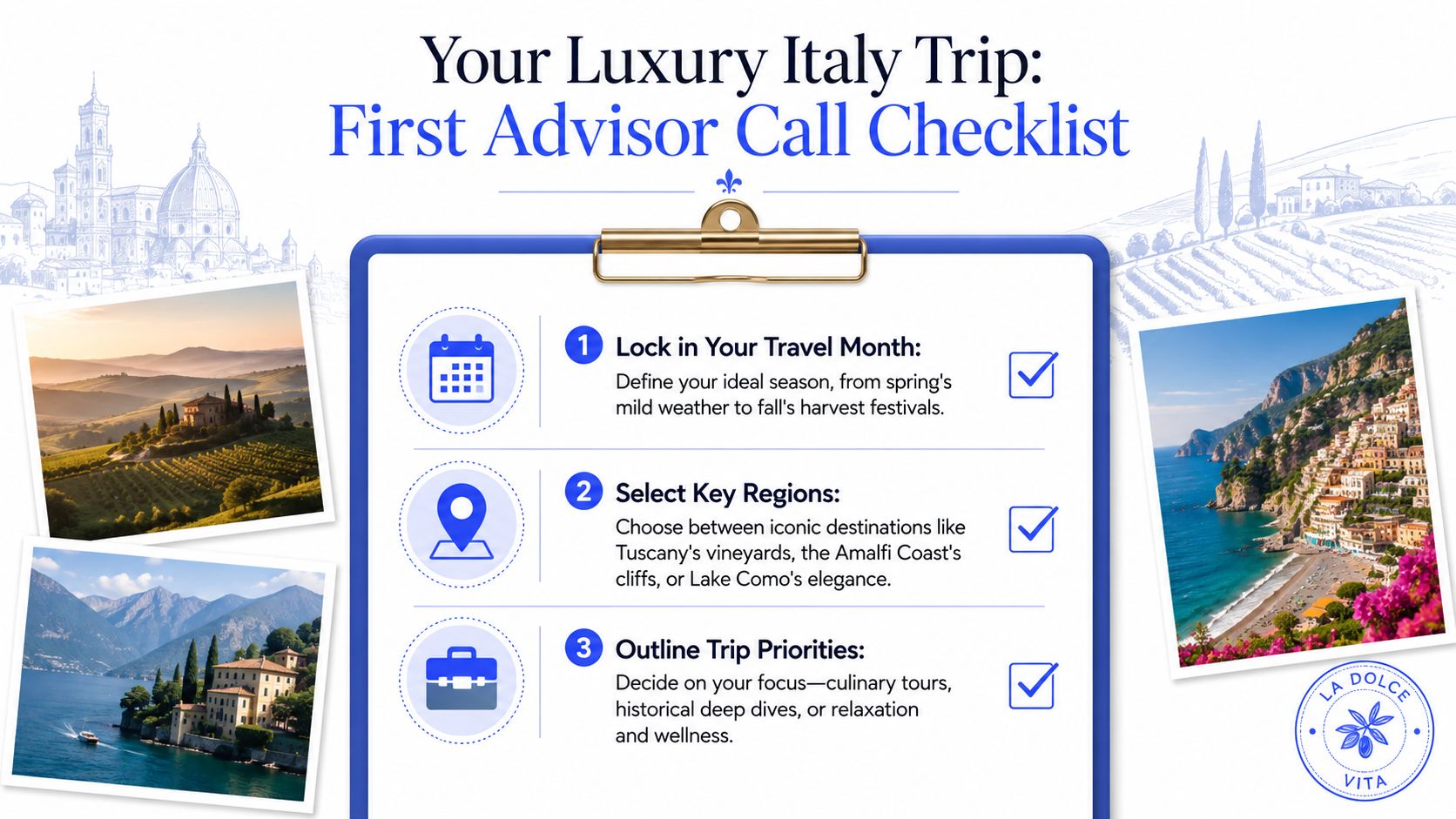
Start with three choices:
- Decide whether your month is fixed. If the dates can move, say how far. Flexibility is useful only when the advisor knows its limits.
- Choose a regional priority. If you had to select Amalfi, Tuscany, or Lake Como, which one would disappoint you most to miss?
- Set a hard budget ceiling per couple, excluding flights. A clear ceiling lets the advisor protect the experience instead of presenting hotels that were never viable.
Your written brief should include the trips you loved and why, mobility limits, dietary constraints, preferred room configuration, and any anniversary, birthday, or family milestone. Tell the advisor whether you want long lunches and hotel afternoons or a full program of guides and activities. A resource such as this explanation of what a travel advisor does can help clarify the difference between booking support and end-to-end itinerary design.
A strong first response should include a property shortlist with actual availability, two pacing options, and candid feedback on whether your dates work with hotel release calendars. I'd expect that initial direction within 48 hours when the advisor has the information needed to research properly.
Email first rather than calling cold. A written brief keeps names, dates, room requirements, and budget parameters clear across time zones. It also gives the advisor something precise to take to hotels, guides, and local partners.
A luxury Italy trip should feel relaxed once you arrive because the difficult decisions were made earlier. For bespoke leisure planning, private guides, preferred hotels, transfers, dining, and year-round support, visit JustKeeps Travel and begin with a written brief that identifies your dates, priorities, and ideal pace.