


Custom Travel Itinerary Guide for Bespoke Journeys
You've chosen the destinations, saved the hotel that looks perfect, and started a group chat full of restaurant links. Then the practical questions arrive. Is the arrival day too ambitious? Will the private guide suit everyone? Is there enough time between the train and dinner? What happens if a delayed flight makes the carefully timed connection impossible?
A custom travel itinerary answers those questions before they become problems. It isn't a longer list of places to visit. It's a modular journey built around your purpose, pace, privacy needs, preferred level of guidance, and tolerance for uncertainty. Each part should support the next, while selected elements remain flexible enough to change without damaging the whole trip.
Table of Contents
- Introduction Why Standard Trips Rarely Fit Real Travelers
- Customization changes selected components
- Personalization reflects known preferences
- Bespoke design builds the route around the brief
- Start with the travelers, not the map
- Turn preferences into routing logic
- Discuss timing before inventory becomes difficult
Introduction Why Standard Trips Rarely Fit Real Travelers
A pre-made package can work beautifully for a traveler who wants fixed dates, familiar sightseeing, and minimal decision-making. It becomes less comfortable when the trip includes several generations, different energy levels, complicated air routing, limited-access experiences, or a celebration that needs to feel personal.
Consider a family traveling to Japan. One person wants early-morning markets and intimate food experiences. Another prefers a slower start after the overnight flight. The children need movement and variety, while a grandparent needs short transfers and comfortable pauses. A standard package may include the right cities, but it rarely solves the tension between those needs. Everyone sees the headline sights, yet the journey feels like a sequence of compromises.
A bespoke design starts somewhere else. It asks what the trip needs to feel like, then arranges destinations, hotels, guides, transport, meals, and breathing room around that answer. Pace becomes a design choice, not an accident. Privacy can be built into the vehicle, villa, guide format, and dining plan. A couple can separate for an afternoon without splitting the entire itinerary. Friends or family can join selected modules while the core journey remains coherent.
The market context supports that shift toward high-touch planning. An independent bespoke itinerary planning market report values the global market at $4.8 billion in 2024 and projects it to reach $12.6 billion by 2033, implying an 11.2% CAGR across that period. The report also identifies North America as approximately 38% of global value in 2024, while demand continues to develop internationally.
Practical rule: A seamless trip shouldn't feel over-scheduled. It should feel as though the right decisions were made before you arrived.
This guide treats a custom travel itinerary as a working system. You'll learn how to define the brief, translate preferences into routing, connect the operational pieces, assess vendors, and preserve recovery options when real-world travel refuses to follow the plan.
What a Custom Travel Itinerary Really Means
The easiest analogy is clothing. An off-the-rack suit may look attractive and fit reasonably well, but a tailor starts with your measurements, posture, purpose, and preferred cut. A bespoke itinerary works the same way. It begins with traveler intent, not with whatever rooms, tours, or flights happen to be available.
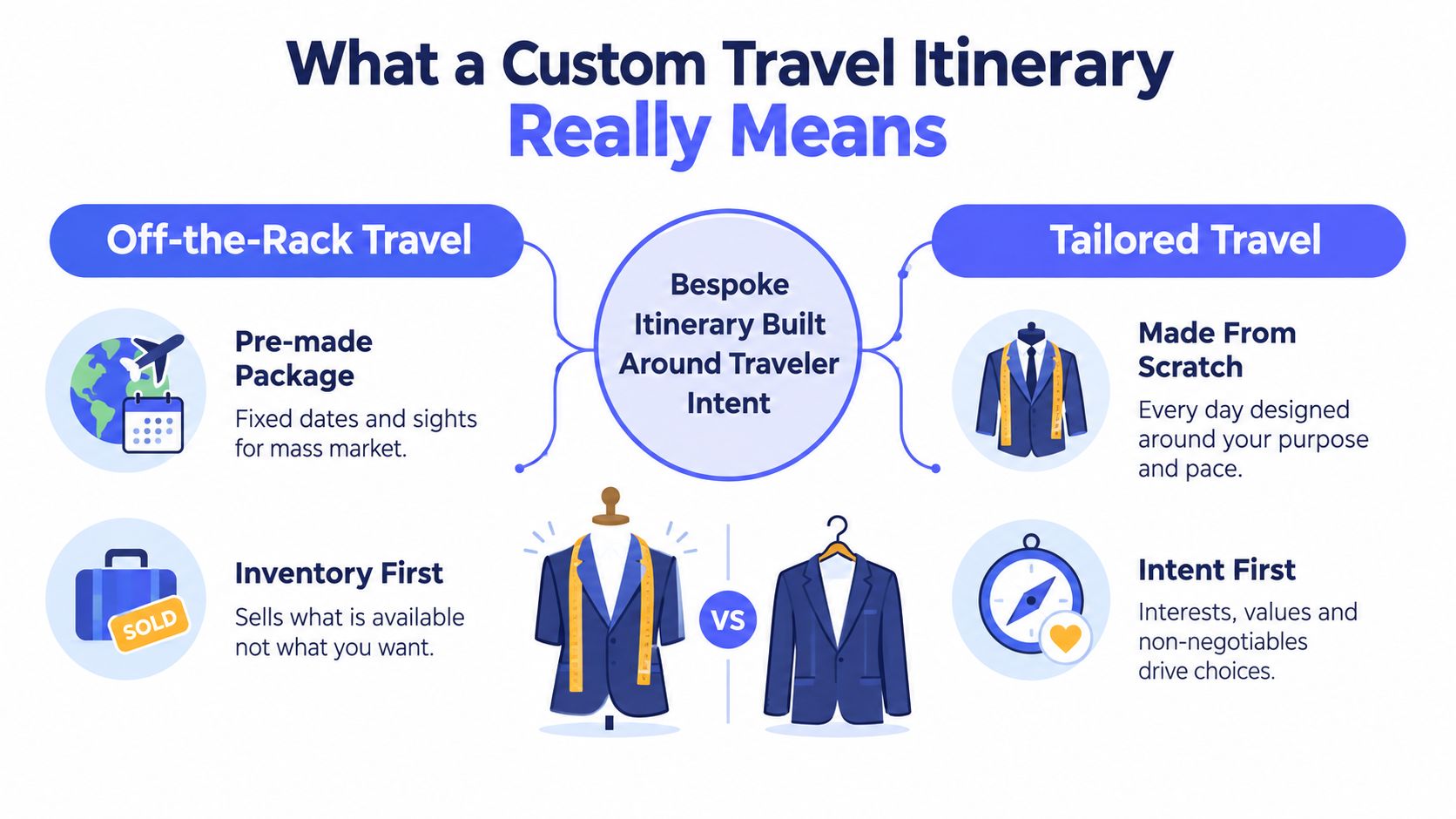
Three terms often get confused:
Customization changes selected components
A package may let you choose a room category, add an excursion, or extend a stay. Those choices matter, but the underlying structure remains largely fixed. Customization modifies an existing design.
Personalization reflects known preferences
Personalization goes further. A planner may recommend a boutique property because you value quiet design, schedule a market visit around your interest in regional cooking, or choose a private transfer because you dislike crowded group transport. The itinerary responds to your tastes, but the planner may still work within a pre-existing route.
Bespoke design builds the route around the brief
Fully bespoke travel starts from a blank page. The advisor considers why you're traveling, who is joining, what must happen, what must not happen, and how much control you want during the journey. The answer could be a private cultural immersion, a carefully paced family holiday, or a multi-country route with several independent travelers joining at different points.
That distinction changes the advisor's role. The advisor isn't just a booking intermediary. They act as a translator between personal intentions and travel mechanics. “We want meaningful contact with local culture, but no rushed group touring” becomes a route with carefully selected guides, unhurried stays, and room for independent exploration.
A concierge layer supports the design before, during, and after travel. It may include dining arrangements, special requests, property coordination, personal shopping, or assistance with changes while you're away. The strongest relationship is one-to-one, so the same planner understands the original reasoning when a detail needs to be adjusted.
A good bespoke itinerary therefore has two qualities that may seem opposite. It is highly curated, because someone has made deliberate choices on your behalf. It also preserves traveler control, because you can decide which days are structured, which are open, and who participates in each experience.
How Scoping Shapes Every Bespoke Journey
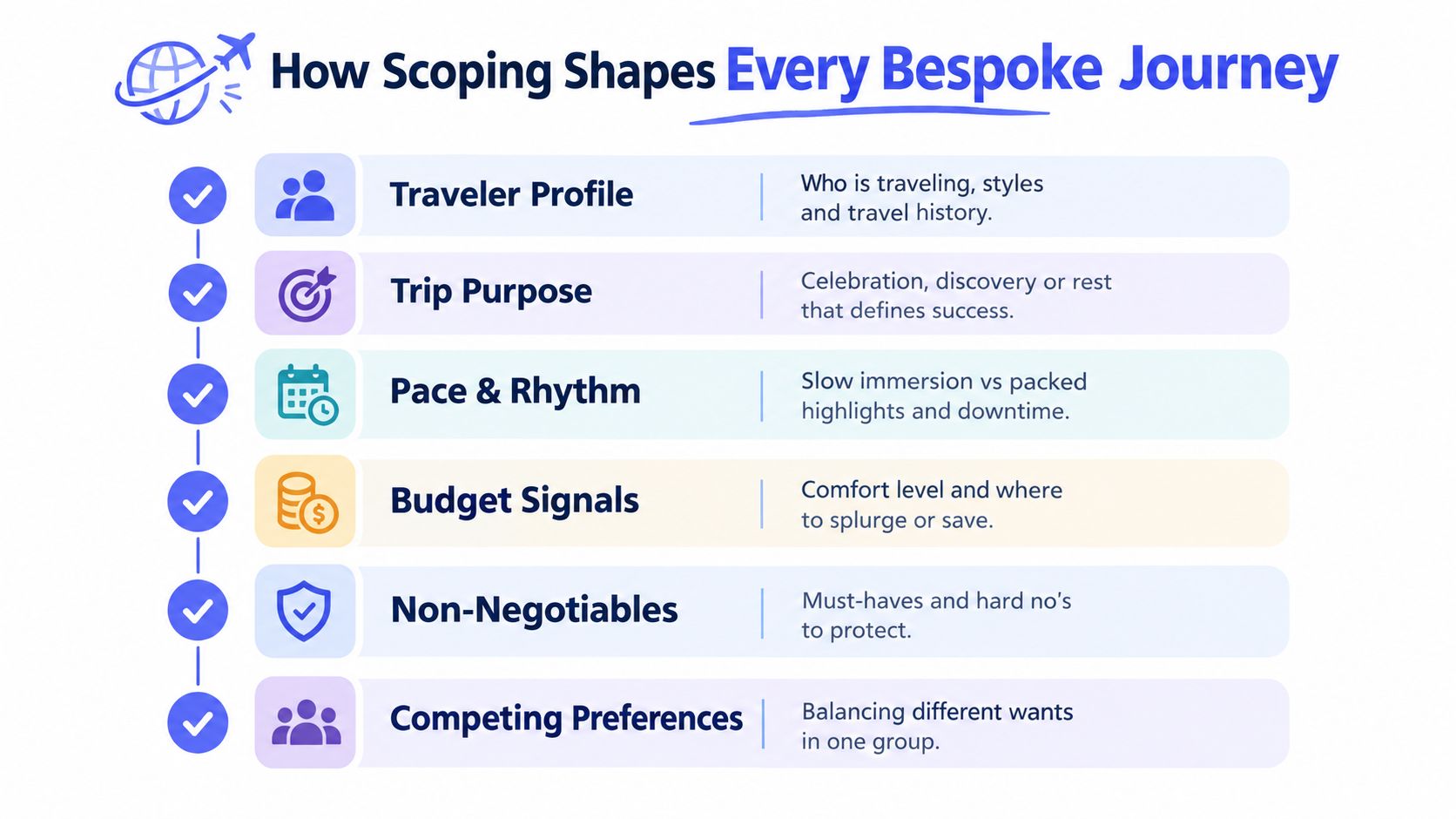
Good itinerary design begins before anyone searches for flights. Scoping is the discovery conversation that defines the job. Without it, an advisor can produce an attractive route that misses the emotional reason for the trip or creates avoidable pressure between destinations.
Start with the travelers, not the map
The first questions should identify who is traveling and how they've traveled before. A group that regularly handles independent rail journeys may want more unscheduled time than travelers who prefer a host each day. A family with young children, an executive traveling between meetings, and a couple celebrating an anniversary will define “comfortable” in different ways.
Then clarify the purpose. Rest, discovery, celebration, reconnection, and personal challenge lead to different decisions. A milestone trip may need one memorable anchor experience rather than a packed calendar of attractions. A wellness retreat may prioritize silence, transfer simplicity, and a property that supports the desired rhythm.
Turn preferences into routing logic
Useful scoping questions sound practical:
- How should a normal day feel? Ask whether the group prefers early starts, long lunches, late dinners, or unstructured afternoons.
- Where should the itinerary spend its energy? Identify the experiences that deserve a private guide, a premium room, or extra time.
- What creates friction? Clarify dislikes such as frequent hotel changes, long road transfers, crowded attractions, or connecting flights.
- Which preferences compete? A teenager's desire for activity may conflict with a parent's need for rest. The solution may be a modular day, not a compromise that satisfies nobody.
- What must be protected? Note dietary requirements, mobility considerations, privacy concerns, security protocols, and important dates.
These answers become operational decisions. A preference for slow immersion may lead to longer stays and fewer bases. A desire to combine hiking with rail travel may require luggage planning, guide coordination, and carefully chosen station transfers. A need for privacy may affect room layout, vehicle type, guide selection, and how guest information is shared.
Discuss timing before inventory becomes difficult
Lead times matter most for constrained elements, including sought-after suites, private villas, specialist guides, and restaurants with limited seating. The right time to raise these questions is during scoping, because availability can influence the sequence without changing the trip's purpose.
An industry report says 68% of travelers use travel advisors for complex itineraries, including multi-destination trips, while 45% use them for last-minute bookings because of convenience. The same travel advisor industry statistics report says 61% of travel advisors focus on luxury travel bookings, and average client spend is $5,000+. These figures point to a practical reality, not a booking rule: complex travel benefits from someone who can connect preferences to inventory, timing, and alternatives.
Before the design work starts, prepare dates, traveler details, passport information when appropriate, medical or dietary considerations, preferred room arrangements, and a candid sense of where you want to spend more or save. Clear boundaries produce a more useful first proposal.
Logistics That Make or Break a Custom Itinerary
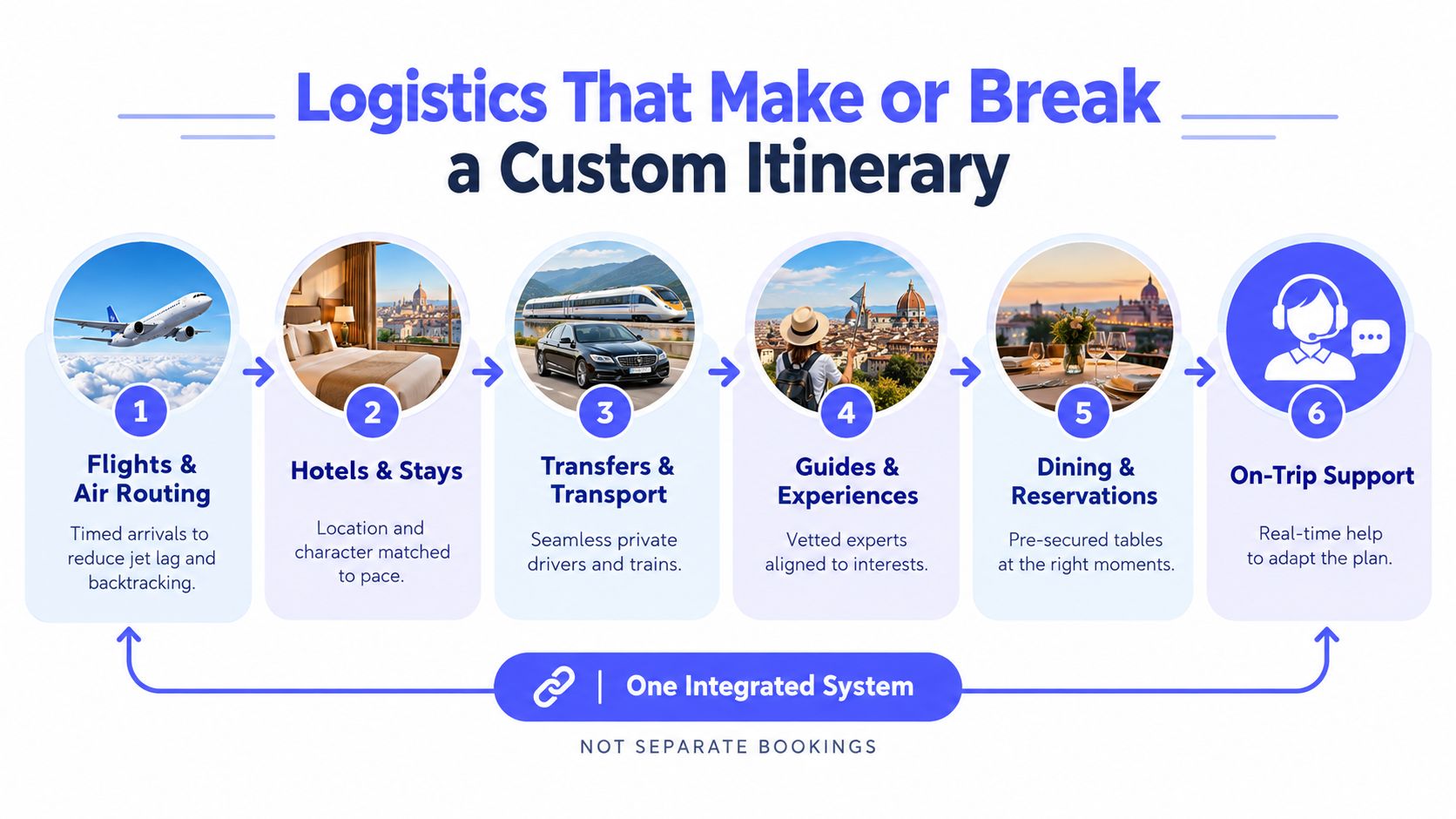
A polished itinerary can still fail if its components operate independently. Flights determine arrival energy and available check-in time. Hotel location affects transfer length and daily sequencing. A guide's meeting point can determine whether an afternoon experience is relaxing or rushed. Operational quality comes from the connections between bookings.
Build the day around movement
Start with air routing and arrival conditions. A late arrival may call for a nearby first night rather than an ambitious transfer. A long rail segment may work well after a restful morning, but not immediately after a private excursion that ends across town. The advisor should map the sequence, not just attach a transfer to each reservation.
Hotels should then be assessed for location, room configuration, atmosphere, and relationship to the plan. A beautiful property that sits far from the experiences you care about can create daily inefficiency. A less obvious hotel may be a stronger choice if it lets the group walk to dinner, return easily after a guide day, or divide activities without repeated vehicle movements.
Transfers, guides, dining, and support complete the chain. Each handoff needs a clear owner, meeting point, timing window, and contact method. The itinerary should also indicate which parts are fixed and which can move.
Design recovery before disruption
Airline disruption research offers a useful planning lesson. An MIT study of integrated passenger and aircraft recovery found that explicitly optimizing passenger itineraries alongside aircraft schedules could reduce passenger disruptions by roughly 66% to 83%, with fuel burn increasing by about 0.152% to 0.155%, while total cost savings remained around 5.7% to 5.9%. Those figures concern airline operations, not private itinerary outcomes, but the underlying principle transfers well: routing, connection risk, and recovery options should be considered together.
A passenger-centric schedule-recovery model also found that incorporating traveler response behavior and seat-capacity constraints produced solutions that were tractable and more reliable than decisions that ignored passenger effects. For a bespoke journey, that means keeping an alternative layer ready. If a flight fails, the advisor should know which reroutes are feasible, which seats may work, which transfer must be moved, and which experience can be preserved.
Use the travel management framework as a reminder that coordination extends beyond the reservations themselves. A working itinerary should include proactive monitoring, local contacts, updated documents, and a clear escalation path.
The following video illustrates how connected planning can be communicated visually:
Choosing Vendors and Gaining Preferred Access
The people and properties delivering a journey shape its quality as much as the route. A beautiful hotel may still be wrong if the room overlooks a busy area, privacy is limited, cancellation terms are restrictive, or late arrivals receive little support. The same applies to guides. Destination knowledge matters, but pace, communication style, and attention to the group's interests must also fit.
Direct booking works well for a simple stay. You speak with the supplier, control the conversation, and can review its public terms and availability directly. Aggregator platforms make comparison easier, yet their listings usually show searchable inventory rather than the wider context of a journey with several connected parts.
A preferred-partner relationship adds another layer. The advisor may know how a property places rooms, how a guide responds when timing changes, and which arrangements are more dependable within a particular route. Preferred access does not guarantee availability or remove the need to compare value. Its practical benefit is accountability: one person connects each supplier's work to the itinerary as a whole.
Vendor Access Comparison for Bespoke Itineraries
| Booking Channel | Inventory Access | Personalization Depth | On-Trip Support |
|---|---|---|---|
| Direct supplier booking | Public inventory and direct terms | Limited to that supplier's offering | Usually supplier-specific |
| Aggregator platform | Searchable multi-supplier inventory | Filter-based selection | Platform and supplier rules vary |
| Independent local specialist | Local knowledge and selected relationships | Strong within a destination or service | Often focused on its own arrangements |
| Luxury travel advisor | Preferred partner network plus public options | Designed across the full journey | Centralized coordination and escalation |
Ask specific questions before confirming any vendor. Who handles an arrival delay? Can the room configuration change? Does the guide understand the group's interests? What happens if the preferred restaurant cannot honor the reservation? These answers show how well the arrangement can recover when plans change.
The hidden value of preferred partner networks comes from accumulated context. A well-connected planner can assess not only what is available, but which option is likely to work reliably within your route, preferences, privacy needs, and recovery plan. That keeps travelers in control while giving each component a clear role in the larger design.
Examples of Fully Bespoke Journeys in Action
A couple planning a Japanese cultural immersion may begin with a desire for meaningful food, craft, and architecture rather than a checklist of famous sites. Their modular itinerary could pair a private tea experience with time in Kyoto neighborhoods, then move by rail to a slower rural stay. One day might have a guide and fixed reservations, while the next remains open for wandering. The structure protects access without dictating every hour.

An East Africa safari calls for a different logic. The travelers may want wildlife viewing, but they may also care about photography, conservation, sleep, and the ability to pause after an early drive. The itinerary can place guided safari blocks beside private time at camp, with transfers planned around light, road conditions, and the group's energy. The guide is essential, but control remains with the travelers because not every moment is preassigned.
For a Maldives escape, the modular design may be deliberately quiet. The fixed pieces could be the seaplane connection, villa, spa appointments, and a private sailing experience. Everything else can remain optional. That distinction matters for couples who want expert curation before arrival but don't want a resort stay to feel like a program.
An Amalfi Coast celebration often exposes group complexity. One household may want a boat day, another may prefer gardens and food, and guests may arrive at different times. A strong plan creates a shared celebratory anchor, then offers parallel modules. Guests can join the private boat, choose a shorter coastal outing, or spend time at the villa without forcing everyone into one schedule.
Recent trend coverage from Audley Travel describes demand for combinations such as rail plus hiking, as well as more privacy, control, and the ability to add family or friends to privately guided experiences. That supports a useful design principle: a bespoke journey can have a common spine without making every traveler follow the same branch.
The same principle helps with late additions. A family member can join for a city segment, a friend can meet the group for a guided experience, or an executive can leave before the leisure portion begins. The advisor protects the underlying sequence while treating participation as modular.
Bringing Your Custom Travel Itinerary to Life
A finished itinerary should be more than a beautiful document. Before departure, verify the dates, traveler names, room arrangements, flight connections, transfer meeting points, guide details, dining confirmations, cancellation terms, and emergency contacts. Mark the essential elements clearly, then identify which experiences can move if weather, fatigue, or delays change the day.
Engage an advisor when the journey has competing preferences, multiple destinations, scarce inventory, privacy requirements, or consequences for getting the sequence wrong. A travel advisor's role extends beyond finding attractive options. The value lies in translating intent into a workable route, coordinating suppliers, and staying accountable when the plan meets reality.
One industry study reports that 44% of travel agency owners and managers have used AI to generate custom itineraries, according to travel advisor industry data. AI can help organize ideas and identify patterns, but a human advisor remains responsible for judgment, supplier communication, privacy decisions, and recovery planning. In a luxury itinerary, the question isn't whether a tool can list possibilities. It's whether someone has tested those possibilities against the travelers and the actual journey.
The final check is simple: every fixed element has confirmation, every important handoff has an owner, every high-risk connection has an alternative, and every traveler knows how to request help. That's how a custom travel itinerary becomes a calm experience rather than a collection of bookings.
JustKeeps Travel designs bespoke leisure, family, corporate, group, and entertainment journeys by coordinating flights, hotels, villas, guides, transfers, dining, and on-trip support as one connected plan. To discuss a private itinerary built around your pace, priorities, and recovery needs, visit JustKeeps Travel and begin with a conversation about the journey you want to create.