



What Is a Travel Management Company
Most advice defines a travel management company as a booking platform with policy controls and expense reports. That description is incomplete, and for executive assistants, family offices, production teams, and multinational companies, it can lead to the wrong buying decision.
A serious TMC is an operating layer for travel risk, itinerary data, supplier coordination, and disruption recovery. Booking matters, but the test comes when an executive has a meeting in another country, a preferred suite is unavailable, a flight is cancelled after business hours, or several travelers need to move through different regions under one schedule.
The scale of the market explains why managed programs continue to attract investment. Global business travel spending reached USD 1.47 trillion in 2024 and is projected to reach USD 1.57 trillion in 2025, with a 2026 forecast of USD 1.71 trillion and 1.84 billion trips worldwide, according to GBTA's business travel forecast. At that volume, unmanaged bookings and fragmented service aren't minor administrative annoyances. They create blind spots.
Table of Contents
- Policy needs to guide decisions, not punish travelers
- Data creates control after the ticket is issued
Redefining the Modern Travel Management Company
A travel management company isn't the corporate version of an online travel agency. An online tool can display inventory and issue a confirmation. A capable TMC should also help an organization control how people book, identify where travelers are, coordinate suppliers, and recover quickly when plans fail.
That distinction matters most for travelers whose schedules carry consequences. A missed connection can affect a board meeting, a private event, a film call sheet, a shareholder presentation, or a family's movement between countries. The value of a TMC appears in the decisions around the booking, not only in the booking itself.
The operating layer behind the reservation
A managed program routes reservations through approved channels and keeps the resulting itinerary data in a usable system. That data can support traveler tracking, spend analysis, supplier negotiations, policy review, and emergency communication. Without it, an assistant may know where a traveler was supposed to be, while the airline, hotel, or local operator holds the actual change.
The business case is also substantial. One market report estimates the global TMC market at USD 26.4 billion in 2025, with a projection of USD 44.5 billion by 2034 and a 6% CAGR, while a separate business travel management services report estimates USD 8.53 billion in 2025 and USD 9.06 billion in 2026, growing at 6.1%. These estimates differ because they define the market differently, but both point to a structurally expanding category. The figures appear in Intel Market Research's TMC market report.
Practical rule: If a provider talks mostly about its booking interface, ask how it handles itinerary ownership, regional escalation, traveler risk, and changes after ticketing.
The modern TMC therefore combines transaction processing with governance and service recovery. For a standard employee trip, automation may be sufficient. For a principal, senior executive, or touring group, the service must also accommodate discretion, shifting priorities, limited inventory, and human judgment.
Why global scale creates operational pressure
The largest business-travel markets don't operate as one neat system. Suppliers, regulations, payment practices, currencies, languages, service expectations, and local agency capabilities vary by region. A TMC that promises global coverage but can't normalize data or provide accountable escalation adds another layer of complexity.
The right question isn't, “Can this company book travel worldwide?” Most established providers can answer yes. Ask instead, “Who owns the problem when the itinerary crosses borders and the local supplier, airline, hotel, and traveler all need a decision at the same time?”
That is the difference between a booking vendor and a travel operations partner.
Core Mechanics of Managed Travel Programs
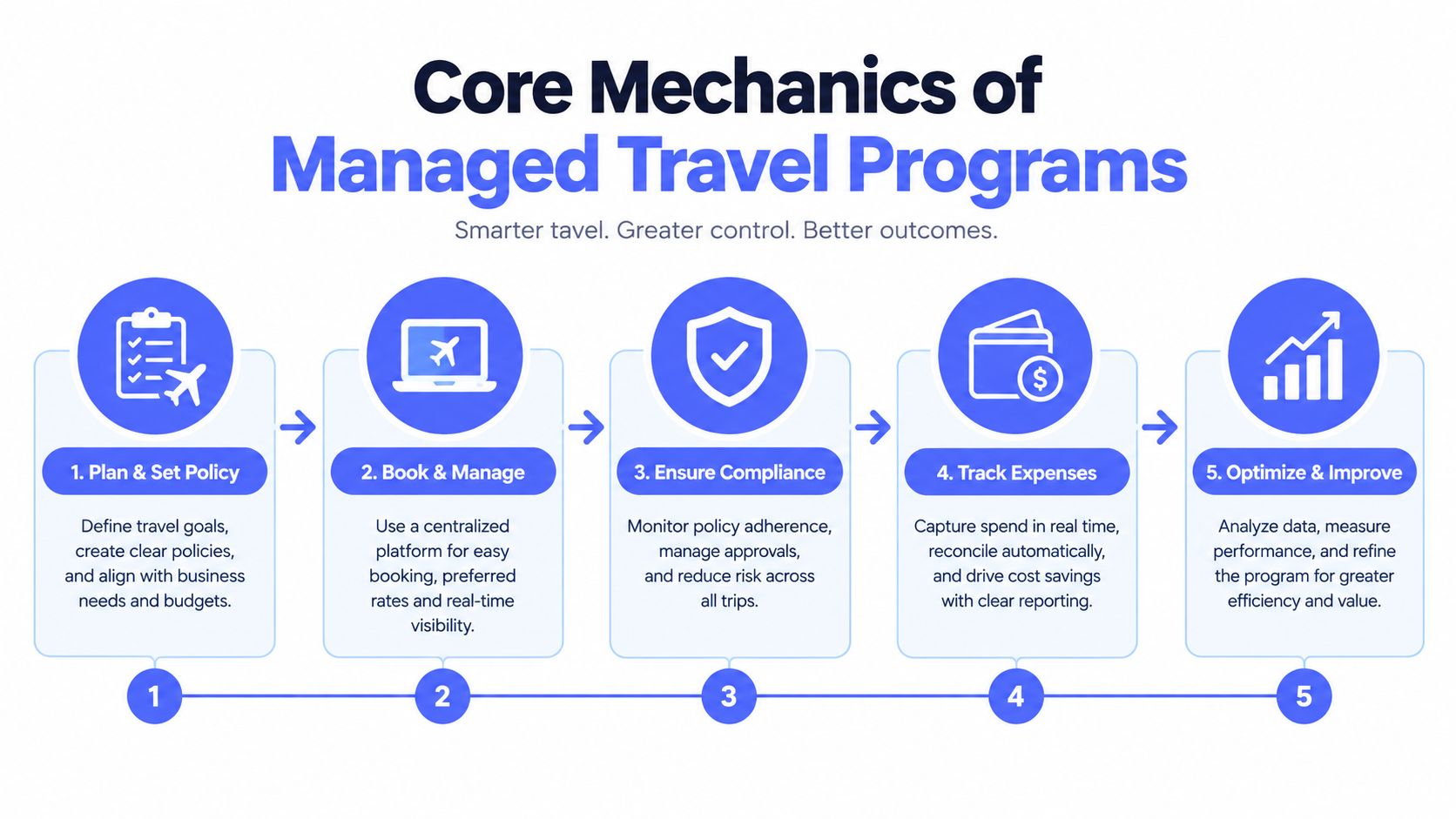
A managed travel program succeeds through operating discipline, not a booking interface. It connects policy, booking behavior, supplier preferences, traveler information, and reporting, then assigns ownership when an itinerary changes across regions. That structure lets a company explain spend, locate travelers, and make consistent decisions while assistants coordinate several trips at once.
Channel control is the first mechanism. Approved booking channels capture the itinerary, apply policy rules, present preferred suppliers, and preserve a record of exceptions. Industry reporting identifies bookings outside required channels as the single largest compliance issue for 35% of organizations. High-performing programs are commonly described as reaching 85% to 95% compliance and reducing trip costs by 10% to 25% through embedded controls and exception handling, as reported by GBTA on corporate travel policy and compliance.
Policy needs to guide decisions, not punish travelers
A useful policy defines the company's priorities and gives travelers a practical way to follow them. It can set preferred airlines, hotel standards, approval thresholds, advance-purchase expectations, cabin rules, and a clear exception process.
The booking flow should show compliant choices first, explain why an option falls outside policy, and let an authorized person approve an exception without sending the reservation into an untracked email chain. Executive travel needs more precise rules. A routine domestic journey may follow standard limits, while privacy, schedule flexibility, or arrival certainty may justify another choice.
A corporate travel planner can translate those requirements into an operating process, especially when an assistant manages several travelers with different preferences and approval paths. Set the policy around the traveler's actual work. Rules that look efficient on paper create hidden costs when they push people outside the managed channel.
Data creates control after the ticket is issued
The TMC's data layer must show more than total spend. It should identify preferred-supplier adoption, advance-purchase behavior, unused tickets, out-of-policy bookings, changes, cancellations, and exception rates. Travel managers can then adjust policy, negotiate with suppliers, and support departments that need help.
The same records support duty of care. An itinerary held inside the managed ecosystem is easier to locate and communicate around than a reservation made through an unrelated consumer channel. That difference matters when business and leisure are combined, several countries are involved, or plans change after departure.
Connect booking records with traveler profiles, contact preferences, approval history, and emergency procedures. Treat reporting as the program's operating memory, not an end-of-month finance exercise. That memory is what lets a service team recover quickly when a principal's itinerary fragments across suppliers, borders, and changing priorities.
Traditional TMC Versus Boutique Luxury Advisor
Traditional TMCs and boutique luxury advisors solve different problems. Confusing them is common, especially when an organization expects a single provider to manage routine employee travel, C-suite movements, family office requests, entertainment logistics, and bespoke leisure with the same workflow.
A traditional TMC is designed for scale, consistency, policy enforcement, and consolidated reporting. A boutique advisor is designed for judgment, access, discretion, and individualized execution. Neither model is automatically superior. The right choice depends on the traveler, the trip, and the cost of failure.
| Capability | Traditional TMC | Boutique Luxury Advisor |
|---|---|---|
| Routine corporate booking | Efficient self-service and agent-supported reservations | Personal planning, often with more manual involvement |
| Policy enforcement | Strong controls, approval workflows, and preferred-supplier rules | Usually customized to the principal or group rather than standardized across a workforce |
| Global reporting | Built for centralized spend and traveler data | More relationship-led, with reporting dependent on the agreed operating model |
| Bespoke itinerary design | Usually limited by standardized workflows | Designed around preferences, timing, access, and personal priorities |
| Scarce inventory | Can search broad supplier channels | May use relationship-based access and local partners |
| Executive support | Service tiers and escalation procedures | Direct advisor relationship and high-touch coordination |
| Disruption recovery | Structured rebooking and support processes | Personal intervention across air, hotels, transfers, guides, and activities |
| Privacy and discretion | Contractual controls and corporate processes | Often central to the advisor relationship and planning style |
Choose based on operational complexity
For a large employee population taking predictable trips, a traditional TMC usually offers the stronger foundation. It can standardize booking, consolidate data, apply rules, and provide a repeatable support model. It also gives procurement and finance teams a clearer view of how the program performs.
A principal's itinerary often requires something different. The traveler may need a specific room configuration, a discreet arrival, a villa with operational support, a yacht transfer, a guide who understands the household's preferences, or a schedule that changes around a private obligation. Those requirements aren't well served by a generic approval path.
Executives, touring artists, and production teams can sit between the two models. Their air travel may need corporate controls, while their ground logistics, accommodation, group movement, and last-minute changes require a relationship-led advisor. The practical answer is often a defined division of responsibility rather than a forced choice.
Don't mistake familiarity for fit
A corporate TMC may offer a VIP desk, but a VIP label doesn't tell you who answers, what authority that person has, or whether they can coordinate services outside the air-and-hotel booking. Ask for the service model in writing. Clarify response expectations, after-hours coverage, escalation ownership, and the boundary between ticket servicing and full itinerary management.
A boutique advisor may offer exceptional personal attention, but it may not provide the enterprise-grade reporting, policy automation, or workforce-wide controls a large company needs. This guide to travel advisors helps distinguish advisory work from a purely transactional booking relationship.
The best program matches the service model to the traveler profile instead of forcing every journey through one channel.
Navigating Disruptions and Complex Logistics
The test of a travel management company begins when the original itinerary stops working. A cancellation, missed connection, aircraft change, border issue, or hotel failure creates a chain of decisions. Someone must determine what can move, what must remain fixed, which supplier has authority, and how the change affects every person connected to the schedule.
The financial impact is material. Independent survey-based analysis estimates that U.S. companies spend more than USD 17 billion annually on flight cancellations and other disruptions, approximately 4% of the country's business-travel budget. Among affected travelers, 77% had to rebook, doing so at an average 27% higher cost, according to Perk's analysis of the hidden cost of travel disruption.
One executive delay can become a schedule failure
Consider an executive traveling through several cities for meetings. The first flight cancels. The replacement arrives after the ground transfer window, the hotel loses the original arrival time, and the next morning's meeting depends on a specific train or aircraft. A booking site may display alternatives, but it won't necessarily understand which connection protects the business objective.
A capable TMC tracks the itinerary, alerts the traveler or assistant, reviews viable alternatives, and rebooks in an order that protects the most important constraint. That may mean changing the flight, preserving the hotel, arranging a new transfer, updating the meeting team, and recording the new traveler location.
A disruption desk should manage the whole consequence, not just issue another ticket.
The same principle applies to entertainment and group travel. If a production team misses a connection, the problem may affect crew arrival, equipment movement, venue access, rehearsals, and local transport. If one traveler changes, the advisor or TMC must understand whether the change is isolated or whether it breaks the movement plan for the entire group.
Monitoring matters before the traveler calls
Reactive servicing begins when someone notices a problem. Proactive servicing identifies the problem early enough to preserve options. That requires itinerary tracking, alerting, traveler profiles, supplier contacts, and people who can act outside standard office hours.
For executive assistants, the important questions are concrete:
- Live monitoring: Who watches flight and itinerary changes, and how quickly do they alert the traveler?
- Authority to rebook: Can the support team make a decision, or must it wait for several approvals?
- Connected services: Does the provider update hotels, transfers, guides, venues, and group manifests?
- Escalation: Who takes ownership when the first solution fails?
- Communication: Can the traveler use a direct channel such as phone or WhatsApp rather than a generic queue?
Executive travel management guidance is most useful when it treats the itinerary as a connected operation. For high-value travel, the objective isn't merely to find the next available seat. It's to preserve the reason the trip exists.
Evaluating Global Coverage and Data Consolidation
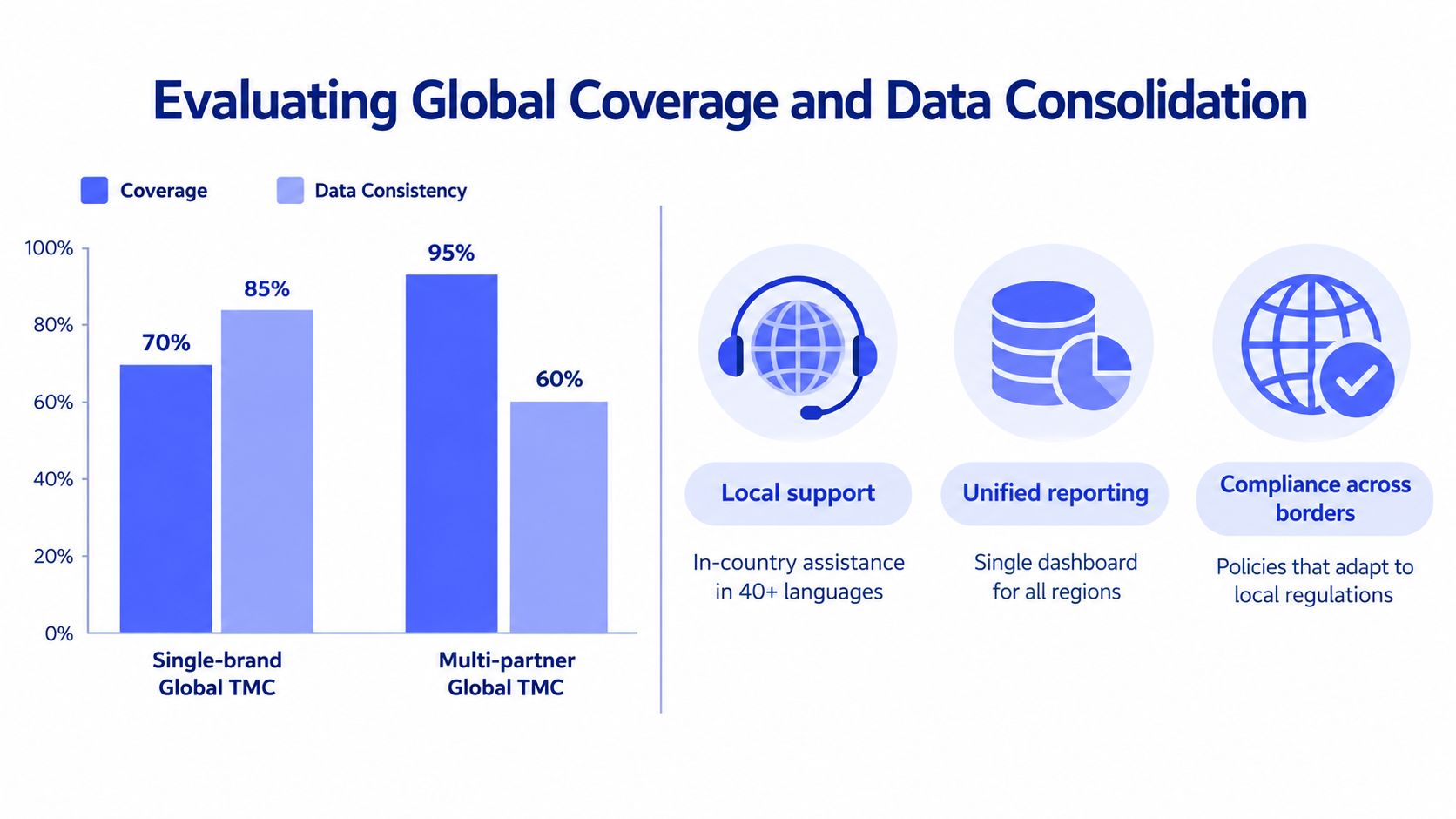
A global logo doesn't guarantee a global operating model. Many providers combine regional offices, partner agencies, franchise structures, or separate technology systems. That can produce impressive geographic reach while leaving the buyer with inconsistent service, disconnected reports, and unclear responsibility.
GBTA reports that 61% of buyers find managing travel across regions challenging. Only 12% have a consolidated view from a single data source, while 63% cite a lack of consolidated reporting and 52% struggle with multiple TMC relationships, according to the Deloitte 2025 corporate travel study announcement.
Test the operating model, not the sales map
Ask the provider to explain how it handles a trip booked across several markets. Don't accept a list of office locations as proof. Request a demonstration of the data flow from booking to reporting, including changes made by local teams and reservations created outside the primary booking tool.
Use these questions during an RFP:
- Data ownership: Where do all itinerary records live, and can the buyer view them in one reporting environment?
- Regional consistency: Which policy rules apply globally, and which rules adapt to local regulations or supplier practices?
- Service accountability: Who owns a disruption when the traveler is in a market served by a partner?
- Escalation design: Can a regional agent reach a central executive desk without restarting the case?
- Profile integrity: Do traveler preferences, loyalty information, approval rights, and emergency contacts remain synchronized?
- Reporting detail: Can the buyer separate booked, changed, cancelled, unused, and out-of-channel travel?
Consolidation must include human support
A single dashboard isn't enough if local teams can't resolve problems. Conversely, a network of excellent local agencies isn't enough if finance can't reconcile the data. The buyer needs both: regional competence and a shared operating structure.
The provider should be able to explain service hours, language support, handoffs, escalation targets, and quality controls. It should also distinguish between a unified program and a collection of local relationships marketed under one name.
AI won't solve weak governance on its own. GBTA reports that 58% of buyers say AI has had little or no impact so far, which reinforces a practical point: fix fragmented data, unclear ownership, and inconsistent support before adding automation.
Designing a Tiered Travel Service Strategy
A single travel channel rarely serves every traveler well. The better approach is to build a tiered travel service strategy that routes routine journeys through efficient managed channels while assigning complex, sensitive, or high-consequence travel to specialists.
Start with the traveler and trip profile, not the supplier's product catalogue. A junior employee traveling to a standard meeting has different needs from a principal moving between countries with family, staff, security, and private commitments.
Build tiers around risk and complexity
A practical structure might look like this:
- Routine employee travel: Use self-service booking, standard policy rules, approval workflows, and centralized reporting.
- Frequent or international travelers: Add stronger profile management, regional support, preferred suppliers, and proactive itinerary communication.
- Executives and principals: Provide a named service team, flexible approval logic, privacy controls, and coordinated air, hotel, ground, and calendar requirements.
- Entertainment and production groups: Assign specialists who can manage manifests, tour routing, crew movement, equipment considerations, venue deadlines, and rapid changes.
- Private family or multi-family travel: Use a boutique advisor for bespoke design, guest-by-guest coordination, villas, yachts, guides, activities, and ongoing concierge requests.
The TMC can remain the governance backbone while a luxury advisor handles the journeys that need discretion and judgment. The arrangement works only if the handoff is explicit. Every party should know who owns air, accommodation, ground transport, payment, itinerary data, traveler communication, and disruption escalation.
Protect control without flattening the experience
Overly rigid programs drive high-value travelers into unmanaged channels. That creates precisely the visibility gap the TMC was hired to prevent. A better policy recognizes legitimate exceptions and gives authorized assistants or travel managers a clean process for approving them.
The finance team still receives reporting. The security team still has usable itinerary data. The principal receives service suited to the trip rather than a generic booking workflow.
This hybrid model also makes supplier evaluation more honest. A TMC doesn't need to pretend it provides bespoke concierge design, and a boutique advisor doesn't need to claim it replaces enterprise reporting infrastructure. Each partner should be measured against the work it is responsible for.
Prioritizing Resilience in Your Travel Partnership
Buyers often compare TMCs by booking fees, interface design, hotel content, or promised discounts. Those factors matter, but they shouldn't outrank resilience, accountability, and data continuity. A lower-cost booking channel has little value if the traveler is stranded, the itinerary is incomplete, and no one owns the recovery.
Longer and more dispersed trips increase the number of points where a schedule can fail. GBTA reports that 39% of travel buyers saw more linked or multi-destination trips, while 33% reported longer trip durations and 32% saw day trips decrease. Those patterns make real-time visibility and exception management more important than a polished booking screen.
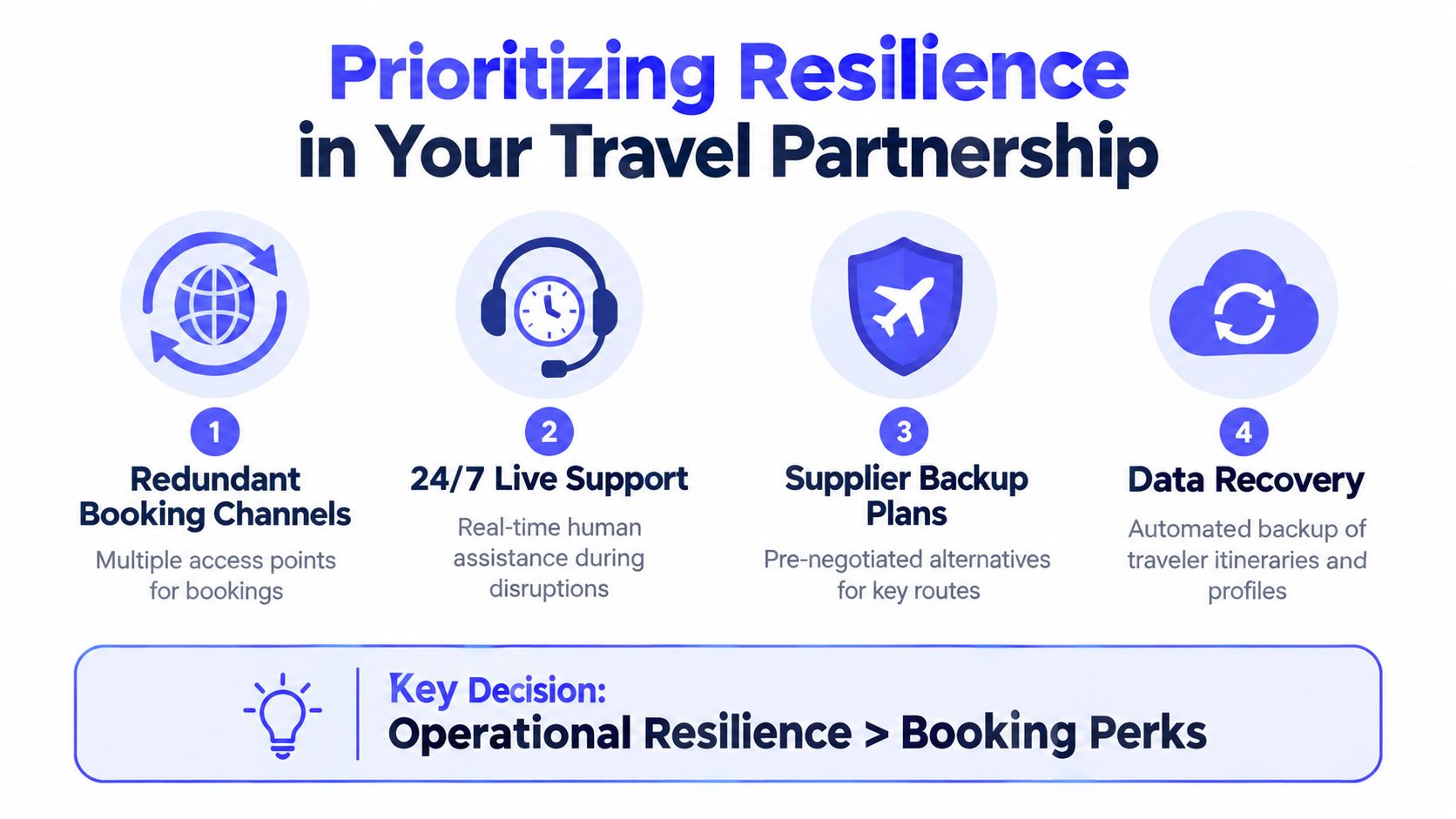
Use this final checklist when evaluating a partner:
- Redundant booking channels: Travelers and assistants need more than one way to reach support when a tool or supplier fails.
- 24/7 human assistance: Confirm who answers outside office hours and what authority that person has.
- Supplier backup plans: Ask how the provider handles constrained routes, sold-out hotels, and failed local arrangements.
- Data recovery: Verify that traveler profiles and active itineraries remain available when bookings change across systems.
Decision standard: Choose the partner that protects the itinerary after the reservation, not the provider with the most attractive booking demonstration.
For routine corporate travel, a traditional TMC may provide the necessary governance. For executive, private office, group, and entertainment travel, a boutique advisor may be the more appropriate service layer. In either case, demand clear ownership, consolidated data, practical escalation, and evidence that the team can recover under pressure.
JustKeeps Travel coordinates bespoke leisure, executive, corporate, group, and entertainment travel with one accountable advisor, including air, hotels, ground arrangements, complex routing, and support while clients are traveling. Visit JustKeeps Travel to discuss a travel program built around your principals, travelers, risk profile, and operational requirements.